










Proposed NIH Cuts Threaten U.S. Biopharma Leadership, Experts Warn
For Your Health News

The foundation of American medical innovation, including breakthroughs like mRNA vaccines and CRISPR technology, is facing a severe threat as proposed federal budget cuts loom over the National Institutes of Health (NIH), according to a new report from the Information Technology and Innovation Foundation (ITIF). The analysis warns that deep funding reductions, coupled with accelerating investment from global competitors, risk ceding U.S. biopharmaceutical leadership, undermining national security, and slowing the pace of life-saving medical discoveries.


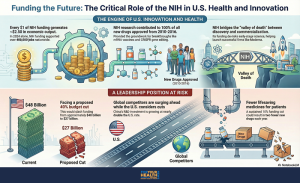
The NIH, established in the early 20th century, is the worldโ€™s largest public funder of biomedical research, investing nearly $50 billion annually into its own laboratories and over 2,500 institutions across the United States. This public investment is crucial because it supports foundational, or basic, scientific researchโ€”studies on genes, cells, and disease mechanismsโ€”that often lack immediate commercial returns and are thus less appealing to the private sector. Yet, this basic science provides the essential groundwork for future medical advances; for instance, between 2010 and 2016, NIH-funded research contributed biological, chemical, or molecular insights to the development of all 210 new drugs approved by the Food and Drug Administration (FDA). Furthermore, the NIH helps bridge the โ€œvalley of death,โ€ the high-risk stage between lab discovery and commercial viability, through programs like the National Center for Advancing Translational Sciences (NCATS) and grants that support biotechnology startups.


Case studies reveal the profound impact of this sustained public funding. The rapid development of mRNA vaccines during the COVID-19 pandemic was enabled by decades of NIH-supported research that began in the late 1980s, culminating in breakthroughs like the pseudouridine substitution in 2005 that made therapeutic use viable. Similarly, the revolutionary CRISPR-Cas9 gene editing technology is rooted in decades of federally funded basic research into bacterial immune systems, demonstrating how long-term public commitment fuels transformative health technologies. This investment has tangible effects on patient outcomes, exemplified by targeted cancer therapies like Gleevec for chronic myeloid leukemia (CML) and Herceptin for HER2-driven breast cancer, which transformed once-fatal diseases into manageable conditions after their underlying molecular targets were identified through NIH-supported research.

For Your Health News


Beyond specific diseases, sustained investment is critical for addressing health equity and preparing for future crises. For instance, the proposed FY2026 budget would reduce NIH funding by a staggering 40 percentโ€”from approximately $48 billion in 2025 to about $27 billion in 2026โ€”a cut that would specifically eliminate entire institutes, including the National Institute on Minority Health and Health Disparities and the National Institute of Nursing Research. However, programs like the All of Us Research Program are attempting to mitigate long-standing disparities by building one of the worldโ€™s most diverse genetic data repositories, intentionally including participants historically underrepresented in biomedical research. Funding also supports emerging frontiers such as Artificial Intelligence (AI) in drug development, where NIH initiatives like the Bridge to Artificial Intelligence (Bridge2AI) program are creating the high-quality datasets necessary to power the next generation of representative and reliable models. Furthermore, NIH initiatives like the ReVAMPP network proactively advance countermeasures against high-risk virus families to strengthen pandemic preparedness, while ongoing support for early-stage discovery helps combat the escalating global health security challenge of antimicrobial resistance (AMR).


This domestic contraction comes at a time when global competition in the life sciences is intensifying rapidly. While the U.S. weighs steep cutsโ€”which have already led to the reported cancellation of over 2,100 grants worth approximately $9.5 billion, prompting universities to pause hiring and delay clinical trialsโ€”strategic rivals are dramatically increasing investment. China, for example, has developed a comprehensive national strategy to bolster its biopharmaceutical capacity, increasing R&D investment by 8.9 percent annually between 2019 and 2023, nearly matching U.S. total R&D spending in 2023. Similarly, the European Union launched Horizon Europe with a budget exceeding โ‚ฌ95 billion to support collaborative health and research. Experts warn that if U.S. science budgets are cut, China could soon surpass the United States in R&D spending, posing a direct threat to U.S. leadership in high-value markets and potentially leaving the U.S. reactive in a future global health crisis. Already, prominent scientists have warned that budget cuts could jeopardize future breakthroughs, noting that reduced opportunities may prompt top U.S.-based scientists to move their labs abroad, creating a “brain drain” that weakens America’s capacity for innovation.


Sustained public investment in the NIH is not simply a budgetary matter but a strategic pillar of U.S. strength. Every dollar invested by the NIH generates roughly $2.50 in short-term economic returns and stimulates additional long-term private-sector R&D investment. As global competitors funnel massive public funds into biopharmaceutical innovation, maintaining robust NIH funding is essential to preserve Americaโ€™s biopharmaceutical leadership, protect national security, and sustain long-term economic prosperity.


The original paper, “How NIH-Funded Science Supports US Biopharmaceutical Innovation,” was authored by Sandra Barbosu and Sarina Fereydooni and published by the Information Technology and Innovation Foundation (ITIF) on December 15, 2025. It can be found on the ITIF website.


Stay Informed. Stay Empowered.

Trending Topics

Features

Download and distribute powerful vaccination QI resources for your community.

Sign up now to support health equity and sustainable health outcomes in your community.

MCED tests use a simple blood draw to screen for many kinds of cancer at once.

FYHN is a bridge connecting health information providers to BIPOC communities in a trusted environment.

Discover an honest look at our Medicare system.

ARC was launched to create a network of community clinicians to diversify and bring clinical trials to communities of color and other communities that have been underrepresented.

The single most important purpose of our healthcare system is to reduce patient risk for an acute event.

Related Posts
Vitamin D, depression symptoms, and diabetes: what researchers saw in older Hispanic adults
Mental Health During the Holidays and Winter Months: What Experts Are Warning About
Holiday Travel Health: Staying Safe in Airports, Planes, and Public Transit
Scroll to Top
Featured Articles
Diabetes vitamin D depression in Hispanics fyh.news
Vitamin D, depression symptoms, and diabetes: what researchers saw in older H...
Mental Health During the Holidays and Winter Months: What Experts Are Warning About
Mental Health During the Holidays and Winter Months: What Experts Are Warning...
Holiday Travel Health: Staying Safe in Airports, Planes, and Public Transit
Millions of immigrant families to forgo essential healthcare due to fears over public charge immigration policy changes.
The "Chilling Effect" Returns: New Public Charge Rule Threatens Health Covera...
Health Equity in the United States: 2025 Year in Review
Health Equity in Review: The U.S. Stories That Shaped Care and Access in 2025
Cold Weather Safety: Preventing Hypothermia, Frostbite, and Winter Injuries
Categories
AI
BIPOC News
Cancer
Clinical Trials
Covid19
Diseases of the Body
Environment
Health Data
Health Equity Events
Health Policy
Heart Health
kidney Health
Subscribe to our newsletter to receive our latest newsโ€‹
All Stories
Diabetes vitamin D depression in Hispanics fyh.news
Vitamin D, depression symptoms, and diabetes: what researchers saw in older H...
Mental Health During the Holidays and Winter Months: What Experts Are Warning About
Mental Health During the Holidays and Winter Months: What Experts Are Warning...
Holiday Travel Health: Staying Safe in Airports, Planes, and Public Transit
BIPOC News
New Yearโ€™s Eve Safety Tips Driving, Fireworks, CO Risks fyh.news
New Yearโ€™s Eve Safety Tips: Driving, Fireworks, CO Risks
Members of the Lumbee Tribe gather in Pembroke, North Carolina, to celebrate the U.S. Senate vote advancing long-sought federal recognition.
Lumbee Tribe Achieves Long-Sought Federal Recognition in Senate Vote
Low COVID and Flu Booster Uptake in 2025 Raises Public Health Concern
Low COVID and Flu Booster Uptake in 2025 Raises Public Health Concerns
Environment
Cold Weather Safety: Preventing Hypothermia, Frostbite, and Winter Injuries
Cancer Inequity Is Structuralโ€”and Preventable fyh.news
The Hidden Geography of Cancer: Why Minority Communities Face Higher Burdens ...
Interior view of a data center with rows of servers and cooling equipment, representing the massive energy and computing demands of xAIโ€™s Memphis supercomputer facility.
Environmental Justice on Display: xAI Supercomputer Operation Sparks Clean Ai...
Work Force
dreamstime_s_243253251
The Caregiver Journey: The Hidden Backbone of American Healthcare
Families gather at a Bronx community festival with live music, kidsโ€™ activities, and health booths sharing SOMOS social care resources and free screenings.
Celebrating Hispanic heritage while learning about health care

msn

Racial/Ethnic Minorities have Greater Declines in Sleep Duration with Higher Risk of Cardiometabolic Disease
Racial/Ethnic Minorities have Greater Declines in Sleep Duration with Higher ...

pubmed

Clinical Trials
Illustration depicting heart failure interventionsโ€”remote monitoring, valve therapies, revascularization, and cardiogenic shockโ€”framed within a health equity roadmap.
90% Problem: Why Minorities Are Shut Out of Advanced Valve Procedures and Lif...
Give the Gift of Sight Month Highlights Urgent Need to Prevent Avoidable Blindness
Give the Gift of Sight Month Highlights Urgent Need to Prevent Avoidable Blin...
A diverse clinical research team collaborating in a modern lab, representing progress in FDA leadership, equity in clinical trials, and inclusive drug development
What Dr. Richard Pazdurโ€™s Appointment to FDA CDER Means for Equity in Clinica...
Vaccines and Outbreaks
New Yearโ€™s Eve Safety Tips Driving, Fireworks, CO Risks fyh.news
New Yearโ€™s Eve Safety Tips: Driving, Fireworks, CO Risks
FYH NEWS FLU SEASON STATS
Severe Flu Season Echoes Pandemic-Era Losses as Pediatric Deaths Rise
For Your Health News
Proposed NIH Cuts Threaten U.S. Biopharma Leadership, Experts Warn
Other Categories
AI
Cancer
Read the latest Cancer stories trending around the world
Covid19
Diseases of the Body
Read about the latest Diseases of the Body trending around the world
Friday Webinars
Every Friday, we bring you insightful webinars covering critical topics in healthcare, data equity, and policy reform.
Health Data
Read the latest Health Data stories trending around the world
Health Equity Events
Read the best Health Equity Events around the country.
Health Policy
Read the latest Health Policy stories trending around the world
Heart Health
Read the latest on Heart Health News, Stories and Tips.
kidney Health
Read more trending News about Kidney Health, Stories and Tips.
LGBTQ Health
Read the latest LGBTQ Health stories trending around the world
Lift Every Voice Patient Network