Race, ethnicity among factors linked to cancer treatment delays for patients with COVID-19

[ad_1]

August 23, 2022

4 min read

Disclosures:
A Conquer Cancer 2021 ASCO Registry Research Grant supported the study. Mullangi reports no relevant financial disclosures. Please see the study for all other authors’ relevant financial disclosures.


We were unable to process your request. Please try again later. If you continue to have this issue please contact customerservice@slackinc.com.

Certain patient demographics, including race and ethnicity and underlying primary malignant neoplasm, appeared associated with delays in cancer treatment among patients with COVID-19.

The findings, published in JAMA Network Open, showed some disparities in cancer care may have worsened during the COVID-19 pandemic.


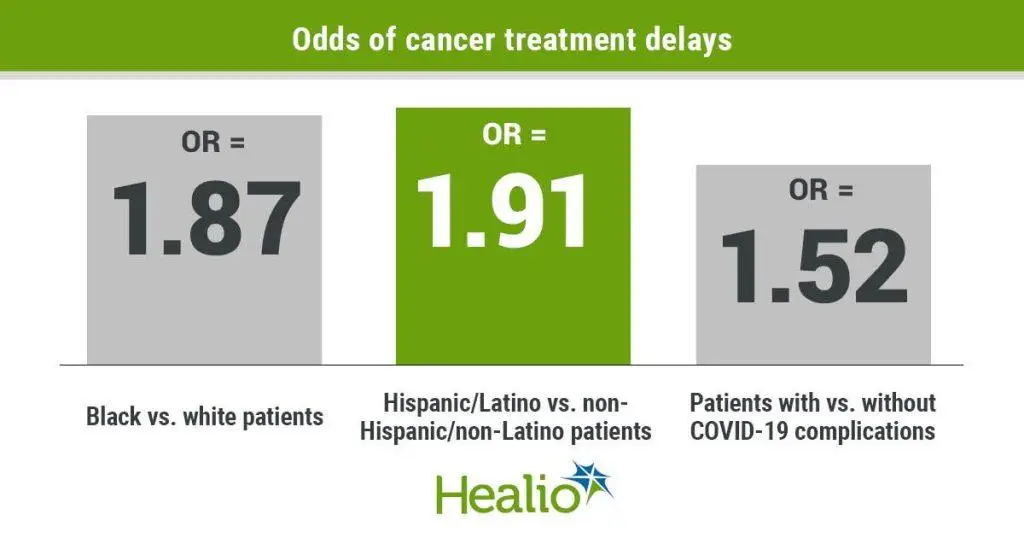
Odds of cancer treatment delays

Data derived from Mullangi S, et al. JAMA Netw Open. 2022;doi:10.1001/jamanetworkopen.2022.24296.

Rationale and methods

The COVID-19 pandemic drastically affected oncologic care delivery, and the health care community recognized patients with cancer had a high susceptibility to infection, as well as severe complications and death, compared with those without a cancer diagnosis, Samyukta Mullangi, MD, MBA, hematology-oncology fellow at Memorial Sloan-Kettering Cancer Center, told Healio.

Samyukta Mullangi

Samyukta Mullangi

“To that end, there were many professional and ad-hoc institutional guidelines about how to modify treatments to minimize infection risk, how frequently and in what contexts to screen patients for COVID-19, and what to do with a positive result,” Mullangi said. “We began to wonder whether these protocols, constructed with the best of intentions, may have led to unintentional harm by way of leading to delay in cancer treatments. As our thinking evolved and we received the data file from ASCO, we wanted to ask whether there were systemic differences between patients in their propensity to have a treatment delay. We hypothesized that among a cohort of patients who all tested positive for COVID-19, certain demographic factors would be associated with differential rates of delays in care.”

Investigators looked specifically for associations of factors such as race and ethnicity, social determinants of health, COVID-19 infection severity and timing of COVID-19 diagnosis with the risk for cancer treatment delays among 3,028 patients (49% aged 65 years or older; 58% women; 14% Black; 72% white; 10% Hispanic or Latino; 81% not Hispanic or Latino) who received treatment across 60 U.S. academic and community medical practices between March 2020 and July 2021 for a cancer diagnosis, and who also contracted COVID-19.

Researchers used multivariable analyses to assess delays more than 14 days between the originally planned date of cancer treatment initiation or discontinuation of cancer therapy.

Key findings

Results showed 46% of patients experienced delays in cancer treatment or therapy discontinuation.

Researchers observed the highest rates of treatment delays among Black patients compared with white patients (OR = 1.87; 95% CI, 1.4-2.51), Hispanic or Latino patients vs. non-Hispanic or non-Latino patients (OR = 1.91; 95% CI, 1.34-2.72), patients with two or more comorbidities vs. patients with one or no comorbidities (OR = 1.23; 95% CI, 1-1.53), patients with metastatic disease vs. locoregional disease (OR = 1.63; 95% CI, 1.29-2.05) and patients who experienced COVID-19 complications vs. those who did not experience complications (OR = 1.52; 95% CI, 1.24-1.86).

Conversely, researchers observed a lower likelihood of cancer treatment delays among patients who reported residing in areas with a higher proportion of Hispanic or Latino residents (OR = 0.76; 95% CI, 0.6-0.95) and among those who contracted COVID-19 later during the pandemic (between January and March 2021) vs. those infected between March and June 2020 (OR = 0.38; 95% CI, 0.26-0.53).

Moreover, 47% of the 202 patients requiring radiation treatment had two or more comorbidities that appeared associated with delays in radiation treatment (OR = 2.69; 95% CI, 1.2-6.2), whereas patients with a higher local-area median household income had a lower likelihood for delays in radiation treatment (OR = 0.41; 95% CI, 0.17-0.94).

Among the 125 patients requiring surgery, 71% experienced delays in surgical treatment and researchers found that patients residing in the South had a much higher rate of delays than patients in the Midwest (OR = 9.66; 95% CI, 2.14-52.3). Of note, patients with two or more comorbidities experienced a lower likelihood of delays in surgery compared with those with one or no comorbidities (OR = 0.26; 95% CI, 0.07-0.88).

“These results show that various vulnerable populations experienced systematic cancer treatment delays and that a positive COVID-19 test may be one additional reason contributing to overall poor outcomes among these populations,” Mullangi told Healio. “Our findings are in line with other data that show persistent disparities in COVID-19-associated outcomes in subgroups of disadvantaged and minority populations, although other hypotheses for this have been advanced elsewhere, such as gaps in vaccination rates, spread of virus initially to urban areas, and infections being concentrated among essential workers who are disproportionately members of racial and ethnic minority communities.”

Implications

Investigators acknowledged study limitations, including the fact that the ASCO registry contains limited information about practice factors and the participating ASCO practices may not represent the general population. In addition, researchers only enrolled patients with positive COVID-19 test results and did not have information on patients with cancer but without COVID-19 treated at the same facilities.

“Three things would be logical next steps,” Mullangi said. “For one, the hope is that we can understand the near-term and medium-range outcomes of these treatment delays with longer follow-up. Two, with a larger sample size either with this registry or a different data source, there is a need to differentiate between patients who had one-time delays vs. persistent delays vs. treatment discontinuation due to spread of cancer, or loss of functional status of patient. Three, we need to better understand the impact of clinic-specific protocols, such as testing for routine surveillance and testing for symptoms on rates of COVID-19 detection and outcomes. However, we would only be able to do this with either practice identification or a separate study combining surveys of practice managers with these results.”

For more information:

Samyukta Mullangi, MD, MBA, can be reached at smullangi13@gmail.com.

[ad_2]

Source link

Trending Topics

Features

Download and distribute powerful vaccination QI resources for your community.

Sign up now to support health equity and sustainable health outcomes in your community.

MCED tests use a simple blood draw to screen for many kinds of cancer at once.

FYHN is a bridge connecting health information providers to BIPOC communities in a trusted environment.

Discover an honest look at our Medicare system.

ARC was launched to create a network of community clinicians to diversify and bring clinical trials to communities of color and other communities that have been underrepresented.

The single most important purpose of our healthcare system is to reduce patient risk for an acute event.

Related Posts
The Communities Most Burdened by Disease Should Be the First to Benefit from Artificial Intelligence
Black and Asian Cancer Patients Wait Longer for Pain Relief in New Study
What Is Cyclosporiasis? The Foodborne Illness Showing Up in the News
Scroll to Top
Featured Articles
The Communities Most Burdened by Disease Should Be the First to Benefit from Artificial Intelligence
The Communities Most Burdened by Disease Should Be the First to Benefit from ...
Cancer Pain Care Access Gap Hits Black, Asian Patients
Black and Asian Cancer Patients Wait Longer for Pain Relief in New Study
What Is Cyclosporiasis Symptoms, Food Safety, and Reasons
What Is Cyclosporiasis? The Foodborne Illness Showing Up in the News
Why Minority Mental Health Awareness Month Matters More Than Ever
From Childhood Cancer to Alzheimer’s and ALS Celebrity Health Stories Spark National Conversation on Disease, Caregiving, and Equity
From Childhood Cancer to Alzheimer’s and ALS Celebrity Health Stories Spark N...
Learn How NMQF Is Transforming Early Disease Detection in Flint
Categories
AI
ATTR-CM
BIPOC News
Cancer
Clinical Trials
Covid19
Diseases of the Body
Environment
Health Data
Health Equity Events
Health Policy
Health Tips
Subscribe to our newsletter to receive our latest news​
All Stories
The Communities Most Burdened by Disease Should Be the First to Benefit from Artificial Intelligence
The Communities Most Burdened by Disease Should Be the First to Benefit from ...
Cancer Pain Care Access Gap Hits Black, Asian Patients
Black and Asian Cancer Patients Wait Longer for Pain Relief in New Study
What Is Cyclosporiasis Symptoms, Food Safety, and Reasons
What Is Cyclosporiasis? The Foodborne Illness Showing Up in the News
BIPOC News
The Communities Most Burdened by Disease Should Be the First to Benefit from Artificial Intelligence
The Communities Most Burdened by Disease Should Be the First to Benefit from ...
Why Minority Mental Health Awareness Month Matters More Than Ever
From Childhood Cancer to Alzheimer’s and ALS Celebrity Health Stories Spark National Conversation on Disease, Caregiving, and Equity
From Childhood Cancer to Alzheimer’s and ALS Celebrity Health Stories Spark N...
Environment
UV Safety Awareness Month Raises Urgency on Skin Cancer Prevention and Sun Protection Equity
UV Safety Awareness Month Raises Urgency on Skin Cancer Prevention and Sun Pr...
Extreme Heat Safety Tips 5 Ways to Protect Your Health This Summer fyh.news
5 Heat Safety Tips That Could Protect Your Health This Summer
Lupus Awareness Event in Baltimore Aims to Support Research and Shine a Light on Health Disparities
Lupus Awareness Event in Baltimore Aims to Support Research and Shine a Light...
Work Force
A multigenerational Black and Hispanic family sitting together in a park, showing how Social Security helps support older adults, people with disabilities, and families across generations.
Millions of Older Americans Could Face Smaller Social Security Checks by 2032...
dreamstime_s_243253251
The Caregiver Journey: The Hidden Backbone of American Healthcare
Families gather at a Bronx community festival with live music, kids’ activities, and health booths sharing SOMOS social care resources and free screenings.
Celebrating Hispanic heritage while learning about health care

[xyz-ips snippet=”Output-Source-Name”]

Clinical Trials
Clinical Trial Diversity Remains a Critical Challenge in Alzheimer’s Research
Healthcare professional collecting a blood sample from a diverse patient as part of multicancer early detection screening.
Bridging the Gap: How Multicancer Early Detection Can Advance Health Equity i...
dreamstime_s_174488289
PCOS to PMOS: Why the 2026 Name Change Matters for Women’s Health

[xyz-ips snippet=”Output-Source-Name”]

Vaccines and Outbreaks
A parent checking a child's temperature during summer, illustrating the changing RSV patterns and year-round respiratory virus risks.
Can You Get RSV During the Summer?
Michelle Lam, MBA, of NYC Health + Hospitals/Elmhurst & Amy Harris of NYC Health + Hospitals/Elmhurst
Healthcare Leaders Spotlight Vaccine Equity and Adult Immunization Strategies...
Measles Outbreaks Surge: Essential Facts and Prevention Strategies
Other Categories
AI
Read the latest AI News stories trending around the world
ATTR-CM
Cancer
Read the latest Cancer stories trending around the world
Covid19
Diseases of the Body
Read about the latest Diseases of the Body trending around the world
Friday Webinars
Every Friday, we bring you insightful webinars covering critical topics in healthcare, data equity, and policy reform.
Health Data
Read the latest Health Data stories trending around the world
Health Equity Events
Read the best Health Equity Events around the country.
Health Policy
Read the latest Health Policy stories trending around the world
Health Tips
Heart Health
Read the latest on Heart Health News, Stories and Tips.
kidney Health
Read more trending News about Kidney Health, Stories and Tips.