










[ad_1]

Summary
Background
Systemic progress in improving trial representation is uncertain, and previous analyses of minority trial participation have been limited to small cohorts with limited exploration of driving factors.
Methods
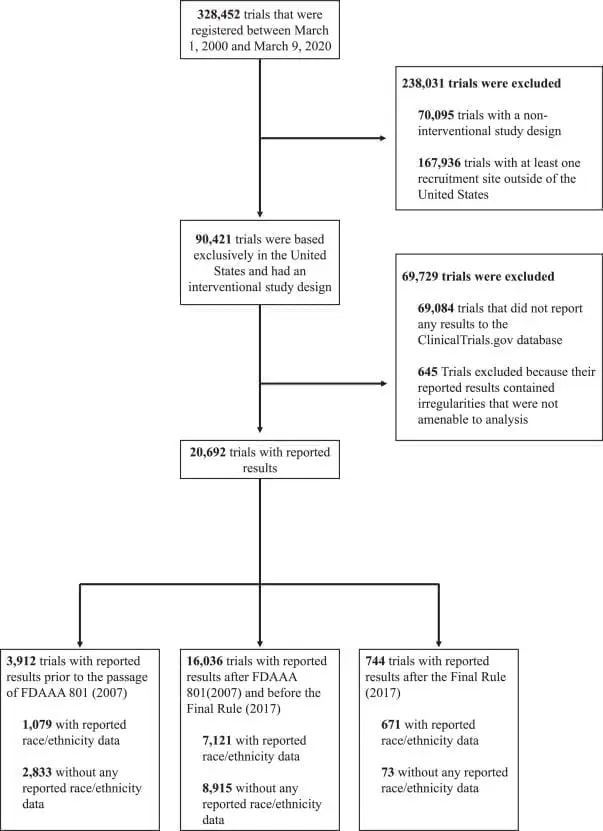
We analyzed detailed trial records from all US clinical trials registered in ClinicalTrials.gov from March 2000 to March 2020. Minority enrollment was compared to 2010 US Census demographic estimates using Wilcoxon test. We utilized logistic regression and generalized linear regression with a logit link to assess the association of possible drivers (including trials’ funding source, size, phase, and design) with trials’ disclosure of and amount of minority enrollment, respectively.
Findings
Among 20,692 US-based trials with reported results (representing ∼4·76 million enrollees), only 43% (8,871/20,692) reported any race/ethnicity data. The majority of enrollees were White (median 79·7%; interquartile range [IQR] 61·9–90·0%), followed by Black (10·0%; IQR 2·5–23·5%), Hispanic/Latino (6·0%; IQR 0·43–15·4%), Asian (1·0%; IQR 0·0–4·1%), and American Indian (0·0%; IQR 0·0–0·2%). Median combined enrollment of minority race/ethnicity groups (Black, Hispanic/Latino, Asian, American Indian, Other/Multi) was below census estimates (27·6%) (p < 0·001) however increased at an annual rate of 1·7%. Industry and Academic funding were negatively associated with race/ethnicity reporting (Industry adjusted odds ratio [aOR]: 0·42, 95% confidence interval [CI]: 0·38 to 0·46, p < 0.0001; Academic aOR: 0·45, CI: 0·41 to 0·50, p < 0.0001). Industry also had a negative association with the proportion of minority ethnicity enrollees (aOR: 0·69, CI: 0·60 to 0·79) compared to US Government-funded trials.
Interpretation
Over the past two decades, the majority of US trials in ClinicalTrials.gov do not report race/ethnicity enrollment data, and minorities are underrepresented in trials with modest improvement over time.
Funding
Stanford Medical Scholars Research Funding, the National Heart, Lung, and Blood Institute, NIH (1K01HL144607) and the American Heart Association/Robert Wood Johnson Medical Faculty Development Program.
Introduction
Multiple academic and government initiatives to increase inclusion followed.
Despite these efforts, more than twenty-five years later minority racial/ethnic groups remain underrepresented and racism remains an international public health crisis.
,
The Covid-19 vaccine trials underscored these disparities; Despite Black individuals representing 21% of Covid-19 deaths, they comprised only 3% of major vaccine trial participants.
Other minority populations were similarly underrepresented.
,
Data generated from investigations that lack racial/ethnic diversity formalize a biased framework of “normal” and “diseased” biological variants which subsequently become propagated through future research and precision therapies.
,
Furthermore, underrepresented populations lack access to the health benefits conferred through trial participation.
An international reckoning regarding racial discrimination has added urgency to current efforts to evaluate progress with improving diversity and inclusion within health research. Though randomized trials and trial meta-analyses comprise the gold standards for evidence generation, the overall state of diversity in trials, progress over time, and associated factors are poorly understood.
Previous studies of racial/ethnic representation have employed varied sampling strategies, usually within subsets of journals and/or selected publications for a specific disease.
,
These approaches have produced divergent assessments of the race/ethnicity landscape including frequent discrepancies in the literature regarding minority enrollment trends
,
,
progress with race/ethnicity reporting
,
,
,
and whether industry and government funding influence these outcomes.
,
Effective comparison between previous studies is further undermined by their disparate data sources. Relatedly and potentially due to insufficient sample size, previous studies seldom controlled for other factors or performed multivariable analyses.
In this study, we conducted an analysis using available data from all registered trials in the ClinicalTrials.gov registry from 2000 to 2020 that were conducted within the US. We aimed to investigate temporal trends in race/ethnicity reporting and enrollment in US clinical trials, compare racial/ethnic enrollment in clinical trials to the US population census, and identify trial features associated with greater reporting/representation of minorities.
Discussion
In our analysis of two decades of data from over 20,000 USA-based clinical trials registered in ClinicalTrials.gov, we found that fewer than 44% of trials report any race/ethnicity data. Among trials that do report race/ethnicity, as a group minorities remain underrepresented compared to their US populations, though at the subgroup level median Black enrollment is not statistically below their US population. Even after controlling for other trial features and conducting several sensitivity analyses evaluating alternative encodings of race/ethnicity, we found that industry-funded trials were associated with less race/ethnicity reporting and with lower rates of minority race/ethnicity enrollment compared to US government-funded trials.
Reporting progress is further complicated by the large subset of completed trials (excluded from this analysis) that have not reported any trial results. Decades of research have highlighted the clinical and ethical concerns presented by selective reporting of trial results (despite legal reporting obligations for many trials).
Our data showed that smaller trials were less likely to report race/ethnicity data. While this may reflect trialists’ assessment of the limited utility of tracking small populations within limited studies, the absence of transparent trial demographics obscures the generalizability of results and weakens the medical community’s ability to identify gaps or opportunities for further research.
) may stem from a lack of power and/or differences among their sampled populations. For example, Kwiatkowski et al. found significantly improved race/ethnicity reporting over time in their study of 304 Phase 3, non-industry trials,
whereas Loree et al. found only minimal reporting changes in their study of 230 drug approval trials with 97% industry funding.
Our model showed industry funding was strongly associated with lower levels of reporting, which may explain the modest findings observed in the drug approval trials. Many studies do not state the funding mix of the trials in their samples, nor the mix of other features that may influence reporting rates. The large sample size and multivariable approach used in our study help resolve these discrepancies and may explain some of the discordance observed in the literature.
Federal Drug Administration Race and Ethnicity Guidance
HHS, FDA. Collection of race and ethnicity data in clinical trials: guidance for industry and food and drug administration staff clinical medical preface public comment. 2016 https://www.fda.gov/media/75453/download.
and International Conference on Harmonization Guidance. Our sensitivity analyses showed our observation of minority underrepresentation over time was robust and most pronounced for Latinos and Asians: even in the most generous sensitivity models, median representation was less than half their respective US populations. Previous studies have highlighted the unique shortage of Latino enrollees in trials.
This may be connected to healthcare distrust or the historical challenge of capturing Latino identity in administrative records.
We suspect the over-representation of Whites in our analysis understates the true overrepresentation of non-Latino Whites. Unfortunately, the standard demographic categories offered by ClinicalTrials.gov (and reported in many trials) lack precise race and ethnicity combinations and instead aggregate each separately, despite FDA recommendations to provide cross-tabulation.
HHS, FDA. Collection of race and ethnicity data in clinical trials: guidance for industry and food and drug administration staff clinical medical preface public comment. 2016 https://www.fda.gov/media/75453/download.
Through the lens of median enrollment, Blacks were not underrepresented. This is similar to an FDA Snapshot analysis of trials leading to 231 new drug approvals from 2015 to 2019. While Asians remained underrepresented (2% of US participants), Blacks and Latinos were not (16% and 15%, respectively). Trials leading to FDA drug approvals represent a particularly meaningful cohort in the context of concerns regarding discrepancies in drug efficacy or safety among underrepresented populations. However, these trials comprise a narrow subset (total US participants were approximately 103,000, compared to the approximate 2,0878,000 in our study) and apply only to studies for new molecular entities or biologics (i.e. does not include trials for expanded indications, off-label use, or non pharmacologic interventions). In our cohort 21% of trials reported 0 Black enrollees, indicative of the heterogeneity that can be obscured in smaller samples.
Similar to reporting, the inconsistent results among previous studies assessing trial diversity is likely influenced by the varying mixture of trial features (e.g. funding) present within their samples. Detection of minority enrollment trends is also more challenging because only a fraction of trials report race/ethnicity enrollments (especially for all five groups) and the trends’ true effect sizes are likely modest as demonstrated in our analysis. Our findings begin to resolve these inconsistencies, but without complete race/ethnicity reporting, all estimates remain susceptible to reporting bias.
As industry contributes the most to applied preclinical and clinical research in addition to production, marketing and distribution of new therapies,
this finding may have unique implications for disparities in treatment efficacy and access. Interestingly, industry and academic funding trended toward a positive effect among Latinos relative to government funding. We suspect this may reflect a unique barrier to recruitment of Latinos compared to other minorities among US Government trials. Relative to US Government-funded trials, the association of academic funding with race/ethnicity enrollment was similar to though typically weaker than that of industry. Academic trialists may experience a mixture of the regulatory and diversity influences within government agencies and the convenience and cost-incentives within industry.
,
Thomas JK. Medical Apartheid: The Dark History of Medical Experimentation on Black Americans from Colonial Times to the Present, by Washington H.A., Illustrate. Doubleday Books, 2009. https://doi.org/10.1526/003601109789037187
However, this trend was driven primarily through increased enrollment of Asians within Asian countries, and the proportion of Blacks actually decreased in these studies. An analysis by Loree et al. that included non-US trials found that Asians represented 18% of trial participants and were “overrepresented”, though they compared Asians representation only to their population within the US.
Khan et al. found that in European and multiregional trials Asians represented approximately 8% of participants while Blacks and Latinos represented
In contrast to these global studies, we find that among USA-based trials Asians are underrepresented and had a median enrollment of 1% compared to 10% and 6% for Blacks and Latinos, respectively.
Our methods help mitigate the sampling bias observed in other studies and increase the generalizability of our findings. Our large cohort of trials permitted examination of temporal trends and multivariable analyses to account for potential sources of confounding and clarify potential sources of inconsistency among previous reports.
Our dataset is thus representative only of the data that trials voluntarily report. We attempted to account for this with multiple imputation and sensitivity analyses, but nonetheless the findings must be interpreted with this context. Fifth, we performed multiple comparisons and did not perform testing correction; some findings may have occurred by chance.
In conclusion, the reporting of participant race/ethnicity and the enrollment of diverse populations in USA-based trials are poor but improving. In an era of data-driven medicine, it is difficult to improve what we do not measure. Clear and consistent reporting represents an achievable goal which enables downstream innovation and accountability. A standardized system with easier data entry and more detailed demographics (including cross-tabulations for race and ethnicity) may present initial steps. Straightforward tools to analyze race/ethnicity data within ClinicalTrials.gov could allow researchers to examine and learn from similar trials while anticipating likely challenges to diverse recruitment. Compulsory race reporting for funding or journal publication are straightforward and similar requirements have historically been effective (e.g. trial registration). Additional incentives and enforced regulations may be needed to ensure all sponsors are engaged and accountable for the recruitment of representative cohorts. All stakeholders must commit to consistent and transparent results reporting to enable innovative solutions for the recruitment of cohorts that are representative of the population as a whole.
Contributors
Dr. Brandon E Turner: Literature search, figures, study design, data collection, data verification, data analysis, data interpretation, writing
Dr. Jecca R. Steinberg: Literature search, study design, data verification, data interpretation, writing
Dr. Fatima Rodriguez: Data interpretation, writing
Dr. Mark R Cullen: Study design, data interpretation, writing
Dr. Brannon T Weeks: Study design, writing
[ad_2]
Source link