











[ad_1]
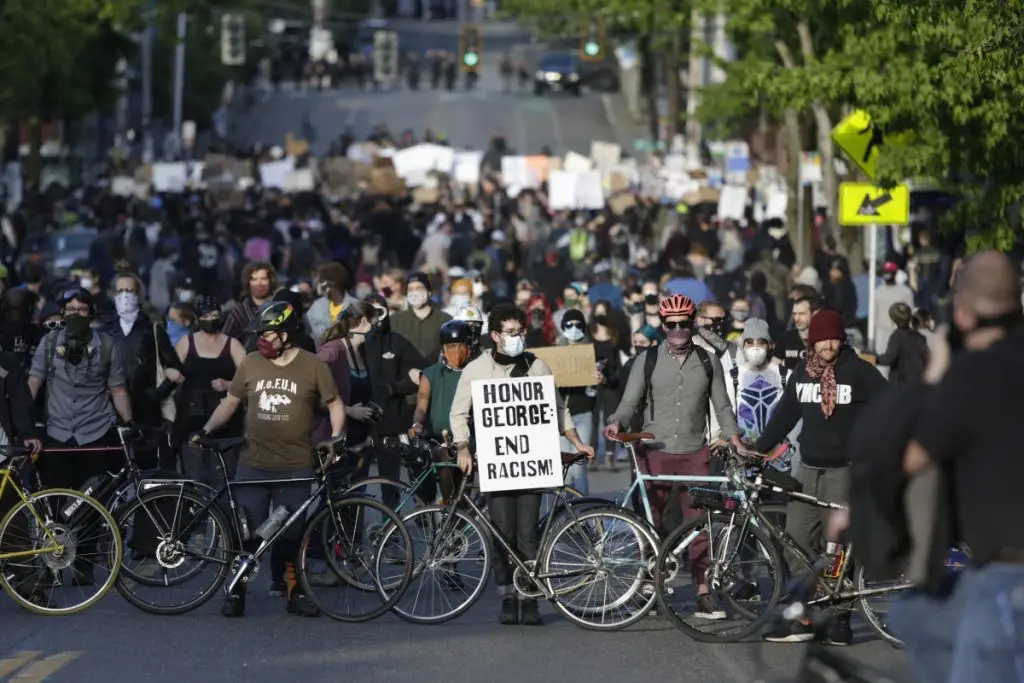
In Seattle, home to one of the largest populations of bike commuters in the country, officials have overturned a decades-old regulation requiring cyclists to wear helmets because of discriminatory enforcement of the rule against homeless people and people of color.
The King County Board of Health voted to repeal the requirement Thursday, with only one member opposing the decision to roll back a measure that even critics acknowledge has saved lives.
“The question before us yesterday wasn’t the efficacy of helmets,” said Girmay Zahilay, a board member who is also a member of the King County Council. “The question before us was whether a helmet law that’s enforced by police on balance produces results that outweigh the harm that that law creates.”
Sign up for The Morning newsletter from the New York Times
Seattle is the largest city in the country to enforce a bike helmet requirement. The city of Tacoma, Washington, repealed its requirement in 2020, citing similar equity concerns, as did Dallas in 2014 for those 18 and older, as a means of encouraging more bike-sharing.
In a county that has made racial justice reform a priority — the King County health board declared racism a public health crisis in 2020 — the regulation pitted the need to address racial equity against the obvious safety benefits of helmets.
“We have to have a broad view of public health: Yes, we have to think about brain injury, and we also have to think about the impact on our criminal legal system,” Zahilay said.
The health board, made up of elected officials and appointed medical experts from across the county, began to scrutinize the helmet rule in 2020 after an analysis of court records from Crosscut, a local news site, showed that it was rarely enforced, and enforced disproportionately when it was. Since 2017, Seattle police had given 117 helmet citations, more than 40% of which went to people who were homeless. Since 2019, 60% of citations went to people who were homeless.
A separate analysis from Central Seattle Greenways, a safe streets advocacy group, found that Black cyclists were almost four times as likely to receive a citation for violating the helmet requirement as white cyclists. Native American cyclists were just more than twice as likely to receive one as white cyclists.
Neither study looked at whether homeless people or people of color wore helmets less frequently than other groups — or whether, out of economic necessity, they were more likely to ride a bike. Critics nonetheless said enforcement appeared to be discriminatory.
“It was a law that really just allowed the Police Department, the Seattle Police Department, to harass Black and brown community members,” said KL Shannon, an organizer for Seattle Neighborhood Greenways and police accountability chair for the Seattle King County chapter of the NAACP.
Shannon’s nephew was 8 years old when he and three friends were stopped by an officer a few blocks from their houses for not wearing helmets, Shannon said. She said the officer accused them of stealing the bikes.
“Until this day my nephew doesn’t ride a bike,” Shannon said. “He’s never forgotten that.”
In an incident in 2016, a Black man was stopped by Seattle police for riding a bike with no helmet. In a dashcam video of the tense, 19-minute stop, one officer shared with another that the man “matches the description of a burglary suspect,” suggesting that the helmet regulation was used as a pretense.
In 2019, Daniel Oakes was stopped for not wearing his helmet while riding his bicycle on a sidewalk near a homeless encampment and then charged with an unrelated offense. A judge dismissed the case after Oakes’ lawyer argued that the helmet requirement had been unconstitutionally used as a pretext to make the stop.
In a statement to Crosscut in response to its analysis of bike stop data, a Seattle Police Department spokesperson, Randall Huserik, said the traffic stops were often used to educate riders about the benefits of wearing a helmet.
“The focus is the behavior, not the status,” he said. “A risk of serious brain injury/death remains just as dire for someone experiencing homelessness as it does for someone who is housed — that is the risk these citations are intended to mitigate.”
Last month, the department announced that it would no longer use bicycle helmet infractions — along with a few other low-risk safety violations — as primary reasons for a traffic stop.
As the largest city in King County, Seattle is the biggest jurisdiction affected by the rollback. Seventeen jurisdictions outside Seattle — making up just more than one-third of the county’s population — have their own mandates requiring helmet use and will not be affected by Thursday’s vote.
Opponents of the repeal have warned that it could have serious safety consequences.
“No helmets means more death and more serious injury,” said Richard Adler, a lawyer who works with clients who have suffered brain injuries. “Access to helmets is already an issue, and repealing this disincentivizes everybody to not wear their helmet over time.”
Helmets reduce the likelihood of serious head injury by 60%, according to the National Transportation Safety Board. In cases where it was known whether cyclists were wearing helmets, 79% of those who were fatally injured in bike crashes between 2010 and 2017 were not wearing them.
Advocates for the repeal said they believed that people would continue to wear helmets even in the absence of a legal requirement.
When the requirement was first enacted in 1993, helmet use was not widespread, said Joe McDermott, a board member who voted in favor of the repeal. But times have changed, he said.
“The law and the public education around creating the law helped change behaviors and norms,” McDermott said. “And 30 years later it’s essential that we do reevaluate our intended purposes when we adopted the helmet law and the unintended consequences of having it in place.”
Helmet use in the city is as high as 91% among private bike riders, according to one study. In nearby Portland, Oregon, advocates for repeal noted, use is similarly high, despite the fact that the city does not have an all-ages helmet law.
Access to helmets is a particular challenge for low-income people: According to a study from the National Highway Traffic Safety Administration, people in the lowest income bracket were about half as likely to wear a helmet for all rides as people in the highest income bracket.
But McDermott said he doubted that those disparities accounted for the extent of the disproportionate enforcement of the rule. And he said the county could address the disparities without policing: The county recently budgeted more than $200,000 to buy helmets and expand education on bike safety.
Across the country, other kinds of biking regulations have also been found to be enforced in discriminatory ways.
In Chicago, a study found that tickets were issued to cyclists eight times more often in majority-Black parts of the city. An investigation by the U.S. Department of Justice found that 73% of bicycle stops in Tampa, Florida, between 2014 and 2015 involved Black cyclists, despite the fact that Black people made up 26% of the population.
“The data revealed that the stops did not reduce crime or produce any other positive outcome,” such as reducing bike crashes or injuries, the report said.
“The best investments to keep people safe while riding bikes is creating safe streets, safer transportation systems,” said Bill Nesper, director of the League of American Bicyclists. “Those are the types of investments that are going to keep people walking and biking safest in our communities, instead of investing in laws like this that could be a barrier to people riding bikes and that may be enforced in a discretionary and discriminatory way.”
© 2022 The New York Times Company
[ad_2]
Source link
Trending Topics
Features
- Drive Toolkit
Download and distribute powerful vaccination QI resources for your community.
- Health Champions
Sign up now to support health equity and sustainable health outcomes in your community.
- Cancer Early Detection
MCED tests use a simple blood draw to screen for many kinds of cancer at once.
- PR
FYHN is a bridge connecting health information providers to BIPOC communities in a trusted environment.
- Medicare
Discover an honest look at our Medicare system.
- Alliance for Representative Clinical Trials
ARC was launched to create a network of community clinicians to diversify and bring clinical trials to communities of color and other communities that have been underrepresented.
- Reducing Patient Risk
The single most important purpose of our healthcare system is to reduce patient risk for an acute event.
- Jessica Wilson
- Victor Mejia
- Jessica Wilson