








[ad_1]
By Dr. Gary L. Deel, Ph.D., J.D.
Faculty Member, Wallace E. Boston School of Business
As I discussed in a previous article, competent workforce planning around significant changes in the operating environment is critical to the success of all businesses. However, some events are so unpredictable and impactful that they create revolutionary, permanent changes for organizations everywhere. One such event was the COVID-19 pandemic that began in 2020 and is still persisting in 2022.
This viral pandemic has been truly a once-in-a-century occurrence, with the last pandemic of comparable scale and effect occurring back in 1918 when the Spanish flu ravaged the world. The COVID-19 virus first spread to the human population in late 2019, and since that time, it has already killed almost six million people worldwide. As I’ve previously stated, COVID-19 is significantly worse than the seasonal flu or any other ordinary malady we’re used to weathering from one year to the next.
COVID-19 Is Likely Here to Stay, So Workplace Changes Due to the Pandemic Will Remain
Many rational people had hoped that if we took the COVID-19 situation seriously, embraced the newly developed vaccines, and complied with public health protocols such as social distancing and mask wearing, we might snuff out the virus early enough to minimize the damage. Unfortunately, it goes without saying we fell far short of accomplishing that goal as a global society.
Poor decision making, fueled by misinformation and conspiracy theory, led to huge portions of the population refusing to become vaccinated or observe the public health guidelines. As a result, there have been far more deaths than needed to occur, and we’ve had to endure the consequences of failing to act responsibly in the face of a lethal threat.
But to be fair, even if we had acted perfectly in response to the pandemic – wore masks, stayed at home, and vaccinated every last individual – we still would have not eradicated COVID-19 like we did with smallpox, polio, and other serious afflictions. This inability to completely eliminate COVID-19 is because the novel coronavirus is classified as zoonotic, which means that it passes fairly easily between different animal species.
Already, experimental research has shown that cats, dogs, hamsters, pigs, bats, deer, and a whole host of other animals can become infected with COVID-19. So unless we’re able to either vaccinate or kill every last animal with vulnerability to COVID-19 infection (which would be absurd and impossible), the virus will continue to live on and permeate throughout the animal kingdom worldwide.
The best we can do is work hard to control COVID-19 infections within the human population. But make no mistake: COVID-19 is here to stay. Many experts believe there could be seasonal variants of COVID with each new year moving forward, just as there are for influenza today.
COVID-19 Has Caused Significant Changes to Business, But Those Changes Can Be Beneficial
So what does the likely permanent existence of COVID-19 in our society mean for employers in a post-COVID world? It means major, potentially permanent shifts in our workforce models, but those changes may actually have silver linings.
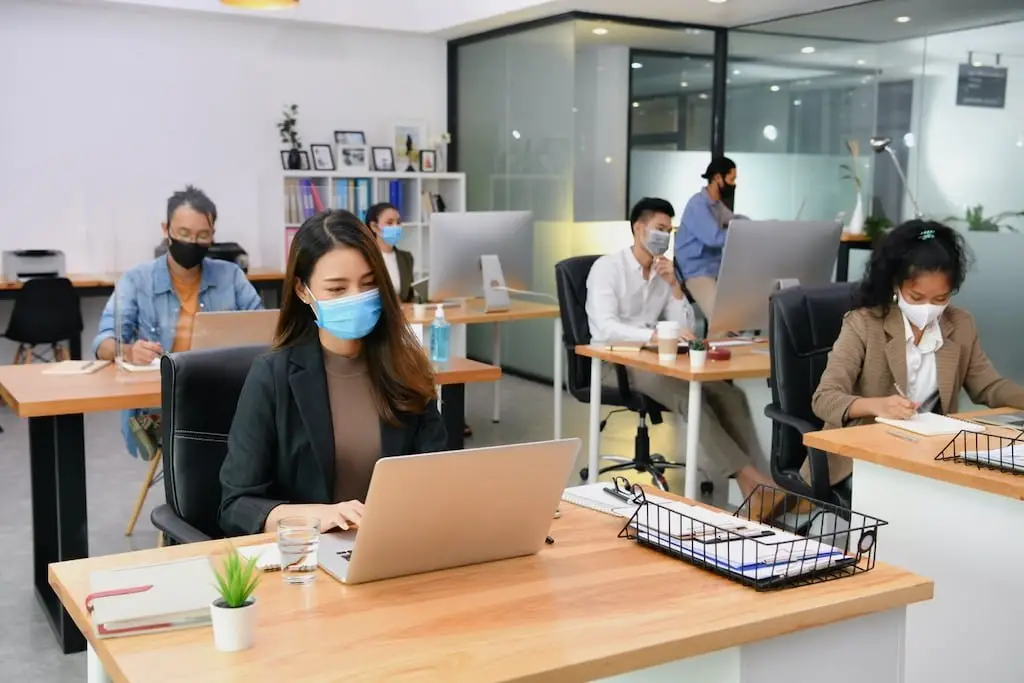
Following the immediate emergence of COVID-19, global lockdowns to control the spread meant that virtually all businesses that could afford to reduce human-to-human contact took steps to limit exposure. So wherever offices, warehouses, or factories could afford to reduce human headcounts, transfer work to remote environments, or replace human beings with technology, these steps were undertaken in the interest of public health. Even managers who were previously resistant to the emergence of remote work or automation technologies in their organizations were suddenly forced to embrace these new strategies in the interest of public health.
Now in January 2022, we have seen signs that the Omicron variant wave in the United States is peaking. There is hope that on the other side of this latest surge, there might be a return to some level of normalcy. But after having been forced to operate for nearly two full years in a pandemic-constrained work situation, many businesses have realized that the “new normal” is a workable and perhaps even superior model to the old ways of doing business.
For better or worse, it appears that both remote work and automation are trends that are here to stay. Obviously, these strategies have their inherent advantages in pandemic-proofing our workplace. However, beyond the public health benefits, there are many other reasons why companies might want to stick with the new trends of automation and remote work.
Automation and Remote Work
On the subject of automation, I have discussed the myriad benefits of replacing humans with technology extensively in the past. I would encourage readers to review my full breakdown of all the surprising ways in which automation and self-service tech can be superior to the human labor alternative.
But for the sake of this article, it suffices to say that the cost savings of automation are often staggering. In addition, as technology advances along the exponential trajectory of Moore’s Law, automation is quickly becoming as good as or even better than humans in many of the routine, repetitive tasks required in the business world today.
Regarding remote work, this new model for human capital presents several subtle but important advantages that may not have been apparent to companies in the past. Chief among them may be the significant reductions in required infrastructure.
Think about it. If you want to have your employees come to work at an office, you must first provide that office. This physical space often comes at a significant cost, whether your company is leasing or owning.
Also, there are the ancillary costs for office furniture, computers, office supplies, utilities, security, maintenance, insurance and other related expenses. Providing a physical place for people to work is expensive, all things considered.
But if employees are permitted to work from home, most of those business expenses evaporate. Suddenly, office space is no longer needed. Companies can provide their employees with equipment and computers if they like, but they may also choose to require employees to use their own personal computers or devices.
This practice is controversial, but not per se illegal. Also, remote working employees almost invariably front the costs for their home office’s heat, electricity and internet service. So there is a lot to be saved through this approach – pandemic or not.
Finally, there is evidence that remote workers tend to be happier and maintain a better sense of work-life balance, which in turn leads to better retention levels. Employee turnover is one of the most expensive business costs due to the enormous amounts of time and money wasted whenever a valuable employee leaves due to frustration, burnout, or poor management. So this conversion to remote work is a big deal for companies everywhere.
Companies Should Leverage COVID-19 Business Changes to Stay Competitive
COVID-19 has been a huge challenge for organizations in all industry sectors. But the aftereffects of this pandemic have forced exposure to some new ways of doing business that, serendipitously, carry the prospect of lasting benefits.
Measures that were once just public health protocol are now potential sources of competitive advantage. Ideally, smart businesses should leverage those measures for the value they add to their organizations.
[ad_2]
Source link
Trending Topics
Features
- Drive Toolkit
Download and distribute powerful vaccination QI resources for your community.
- Health Champions
Sign up now to support health equity and sustainable health outcomes in your community.
- Cancer Early Detection
MCED tests use a simple blood draw to screen for many kinds of cancer at once.
- PR
FYHN is a bridge connecting health information providers to BIPOC communities in a trusted environment.
- Medicare
Discover an honest look at our Medicare system.
- Alliance for Representative Clinical Trials
ARC was launched to create a network of community clinicians to diversify and bring clinical trials to communities of color and other communities that have been underrepresented.
- Reducing Patient Risk
The single most important purpose of our healthcare system is to reduce patient risk for an acute event.
- Jessica Wilson
- Victor Mejia
- Jessica Wilson