








[ad_1]
As omicron has increased infections, sickened workers and closed schools, public policy experts have questioned the Biden administration’s emphasis on vaccinating as many Americans as possible — a focus that has only convinced 60% of Texans to get vaccinated.
Aerosol experts have increasingly called for more attention on air quality as a way to reduce the number and density of tiny particles of coronavirus floating through indoor air in schools, offices and hospitals. And among the numerous expensive, resource-heavy interventions, an increasingly popular option is a tool that can be built with a box fan, some tape, and a few high-quality air filters for a total cost of about $65.
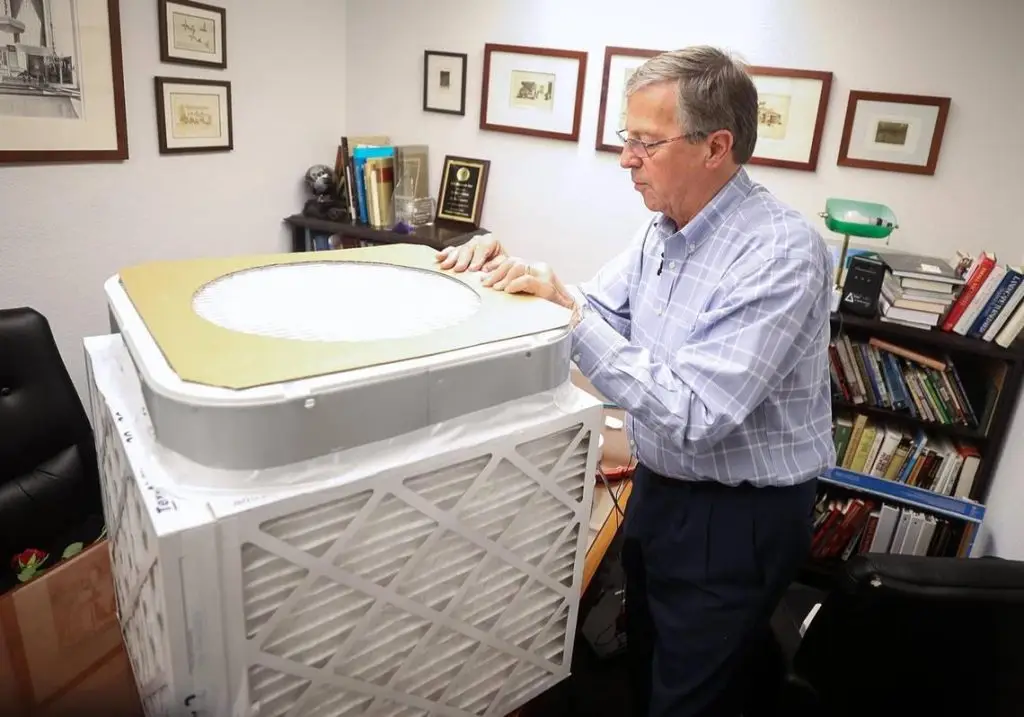
The Corsi-Rosenthal box, also called the Corsi-Rosenthal cube, takes its name from Jim Rosenthal, a Fort Worth resident and CEO of Tex-Air Filters, which Rosenthal founded in Fort Worth in 1997.
Rosenthal, 73, began thinking about how to make indoor air safer in summer of 2020, as scientific consensus emerged that the coronavirus could spread via the air. Eventually, he put the basic principles and research that have backed decades of air quality research into action, and built a cube that relies on high-quality air filters and air flow to trap tiny particles of virus and other pathogens, thereby reducing the virus in an enclosed space.
How a homemade air filter got its start in Fort Worth
If you search for examples of the Corsi-Rosenthal Box, you’ll find them across the country: In an elementary school in Brooklyn, constructed by parents who want to protect their kids. In classrooms at the Brown School of Public Health in Rhode Island, where students are studying how well they work. In schools throughout Phoenix, where a group of college students volunteered to construct and install the boxes in local classrooms, and where any local teacher can request a donated unit.
But the very first box was built in Fort Worth, in Jim Rosenthal’s office, which is cluttered with stacks of air quality research and books on Civil War history. In August 2020, Wired magazine convinced Rosenthal to give the idea a try. The concept originated with Dr. Richard Corsi, the dean of the engineering school at the University of California, Davis. Corsi suggested combining enough filters to clean the air, and a fan to push that cleaned air back out into the room. Rosenthal ultimately offered to try and make the ideas Corsi articulated into an actual air cleaner. The resulting article, “Could a Janky, Jury-Rigged Air Purifier Help Fight Covid-19?” introduced the concept to the world. In subsequent conversations, Rosenthal and Corsi got feedback from other experts and inventors, and some tweaks were made to the box’s original design. Five air filters was reduced to four, and a shroud was added. The Corsi-Rosenthal box was born.

The box itself requires only a few things to assemble: A standard box fan; the box the fan comes in, to make a shroud; four air filters with a MERV 13 rating or higher; and duct tape to construct the whole thing together. Rosenthal and Corsi decided to publish the instructions for making the box online as an open-source design, meaning anyone can build and tinker with the original design. The instructions that Rosenthal usually directs people to use aren’t even on his company’s website, and his favorite how-to video stars a fourth grader he’s never met demonstrating how to build the box.
As this stage in the pandemic, Rosenthal identifies his main role in the development of the Corsi-Rosenthal box as a cheerleader. He gives feedback on Twitter to people making their own boxes at home, answering questions and encouraging those who are making the boxes. And he’s been following the research happening at universities through the country, including at the school of nursing at the University of Connecticut and at the University of California, Davis. As experts have studied interventions like the Corsi-Rosenthal box and other high-quality air filters, consensus has grown that reducing the amount of virus that can spread via the air is essential in limiting new infections.
“We really should have the National Guard making these by the truckload,” said Jose-Luis Jimenez, an atmospheric chemist at the University of Colorado.
Jimenez explained that when a person breathes, speaks and shouts, they emit small amounts of spit. Some are larger, and are known as droplets, which come out of someone’s month before quickly falling. The smaller amounts, largely invisible to the human eye, can float in the air, lingering in enclosed spaces for minutes and sometimes hours.
A good way to think about aerosols, Jimenez said, is to think about how the scent of cigarette smoke will linger in an enclosed space long after someone has put out their cigarette.
The same thing can happen with aerosols containing the coronavirus, which is why maintaining a distance of six feet alone is not enough to provide protection in enclosed, crowded spaces with poor ventilation, like schools and office buildings.
Rosenthal and Corsi’s intervention relies on the air filtration provided by MERV 13 filters, which researchers have repeatedly found is capable of trapping small particles that contain the coronavirus or other viruses.

Last year, one modeling paper concluded that of three possible interventions — adding MERV 13 filters, increasing air flow without changing filtration, and reducing class sizes — the advanced filtration would reduce infections in schools by a greater amount than any other step.
Jiannan Cai, one of the researchers on the study, said improving air quality was one step in a series of steps needed to make schools, offices, and other public spaces safer.
“People are always looking for a silver bullet,” she said. “I think this strategy has to be more like a Swiss cheese kind of model. No one single strategy is going to eliminate it. So just like masking alone is not going to solve the problem, vaccines alone are not going to resolve the problem.”
As the number of new infections caused by the omicron variant wanes after a deadly surge throughout the U.S., Rosenthal said he hopes people who are able to build and construct the box can find some comfort in a small, concrete step they can take to reduce their risk.
“There’s something about doing this that you actually feel like you’re not helpless,” Rosenthal said. “You’re actually you’re accomplishing something. It works. It’s easy to do.”
[ad_2]
Source link