








[ad_1]

(Bloomberg) — The U.S. maternal mortality rate — already high compared to other wealthy countries — has increased, with Black women faring far worse than their White peers, according to new data.
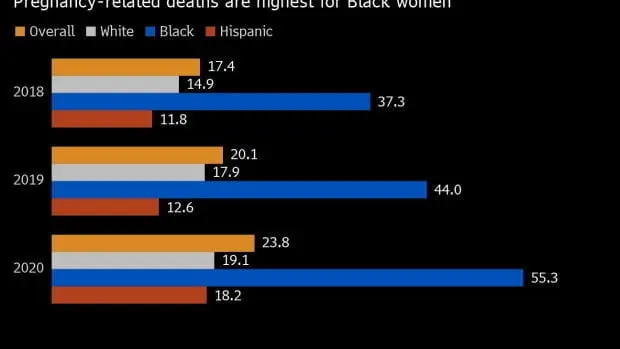
In 2020, 861 women died of maternal causes in the U.S., up from 754 in 2019, according to a report released Wednesday by the U.S. Centers for Disease Control and Prevention. That puts the 2020 maternal mortality rate at 23.8 deaths per 100,000 live births, a figure that is more than double the rate in countries including the U.K., Canada or France.
At 55.3 deaths for every 100,000 live births, the maternal mortality rate among Black women was about three times that of White and Hispanic women in 2020.
A 2020 report from the Commonwealth Fund found that increased use of midwives, universal health care and maternity leave — all programs that are lacking in the U.S. — better maternal health outcomes. Maternal morbidity, and new or worsened health problems because of pregnancy, cost each mother-child pair an additional $8,624, according to the organization, a foundation that supports health care research.
At a White House event in December, Vice President Kamala Harris called maternal mortality and morbidity “a serious crisis and one that endangers both public health and economic growth.” Public figures like tennis star Serena Williams and track and field athlete Allyson Felix have called attention to issues Black women often face when having babies in the U.S., such as lack of access to affordable medical care and discrimination within the health care system. Williams said doctors ignored her symptoms.
A recent study assessing language used in medical records found health-care providers more often describe Black patients with negative descriptors like “non-compliant” and “agitated.” In a January survey of 1,000 Black Americans, a third said they’d experienced racism while dealing with the health-care system, leading some of those to delay making a health decision or stopping treatment altogether.
“Think of the tenants of medicine in general — it’s a very personal relationship,” said Jessica Shepherd, an obstetrician-gynecologist and chief medical officer at Verywell Health, which conducted the survey. “Sometimes when it becomes transactional or where there are instances of racism or issues in the relationship, it can taint it in a way where both parties may not feel part of it at all. And that’s then when we lose interest and therefore you have a change in the outcome of the actual health-care condition.”
Once a medical provider loses a patient’s trust, it decreases the chances that the patient will return — leaving fewer opportunities to identify potential health issues.
Representative Lauren Underwood in early 2020 introduced the Black Maternal Health Momnibus Act, after her friend Shalon Irving died from pregnancy-related complications three years earlier. Pieces of the legislative package, which proposes growing the perinatal workforce and establishing campaigns to boost vaccination rates among pregnant people, are included in President Joe Biden’s stalled Build Back Better plan.
There are early indications that the pandemic has exacerbated the problem. An early 2021 study found that global maternal and fetal outcomes worsened during the pandemic, with more maternal deaths, stillbirths, ruptured ectopic pregnancies and maternal depression. Disruptions to the health care system and less health-seeking behavior may have contributed to the worse outcomes. Another study of more than 87,000 women in Scotland found that those who had Covid-19 toward the end of their pregnancy were more vulnerable to stillbirths, newborn deaths and other birth-related complications. The most complications occurred in women who were unvaccinated against the virus.
©2022 Bloomberg L.P.
[ad_2]
Source link