









Underreporting and Underrepresentation of Race and Ethnicity in Head and Neck Cancer Trials, 2010-2020: A Systematic Review | Head and Neck Cancer | JAMA Otolaryngology–Head & Neck Surgery

[ad_1]


Key Points

Question 
How often are race and ethnicity reported and represented in head and neck cancer clinical trials, and what is the generalizability of trial results given the demographics described by Surveillance, Epidemiology, and End Results Program cancer registries?

Findings 
In this systematic review of 155 studies from 2010 to 2020, only 89 (57%) studies reported race or ethnicity. When compared with data in the Surveillance, Epidemiology, and End Results Program registries, clinical trials enrolled fewer Black (10% vs 8%) and Asian or Pacific Islander (6% vs 2%) participants with head and neck cancer.

Meaning 
Efforts must be made to increase the representation of all people in future head and neck cancer clinical trials to improve generalizability of the results and reduce racial health disparities in patients with head and neck cancers.

Importance 
There is substantial evidence demonstrating racial disparities in the survival outcomes of patients with head and neck cancer. The reporting and representation of race and ethnicity in cancer trials is crucial for generalizability of trial results to patient care and reduction of racial health disparities in head and neck cancers. Racial disparities in oncologic outcomes across various therapeutic interventions may only manifest when diverse races are appropriately represented in trials.

Objective 
To characterize the reporting and representation of race and ethnicity in head and neck cancer clinical trials.

Evidence Review 
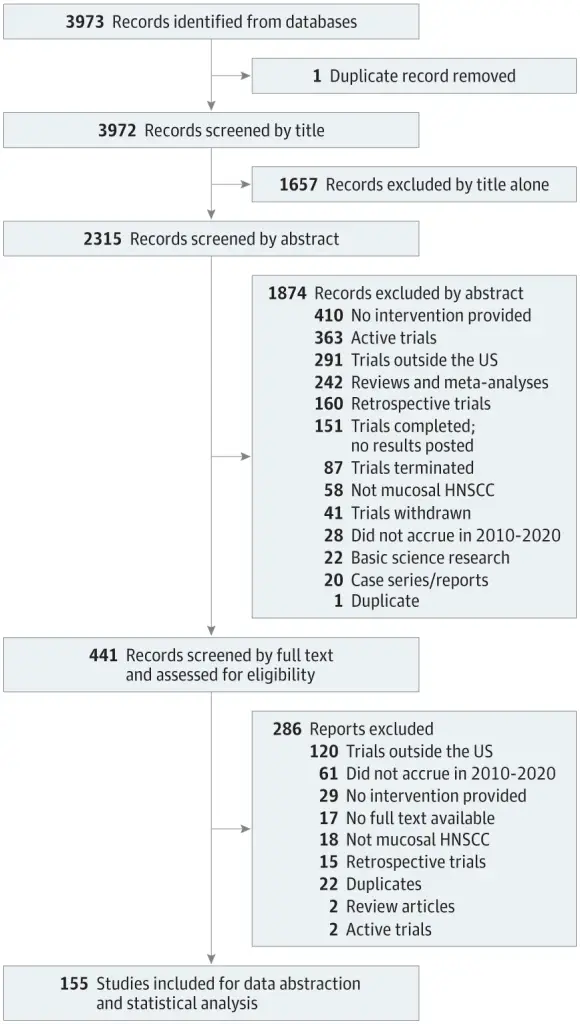
A systematic search of published trials and those available on ClinicalTrials.gov was conducted to identify 3973 studies from 2010 to 2020. Title, abstract, and full-text review yielded 155 trials for data extraction of patient demographics. Year of publication, type of intervention, publication source, and funding source were also collected. Race and ethnicity data were compared with Surveillance, Epidemiology, and End Results (SEER) Program cancer registry data.

Findings 
Of the 155 included studies, only 89 (57%) reported race or ethnicity. Only 81 (52%) of the studies reported detailed classification of race or ethnicity per the US Census Bureau classification scheme. Race and ethnicity reporting varied considerably with year of publication, type of intervention, data source, and funding source. Studies in the latter half of the decade were more likely to report race or ethnicity (odds ratio, 2.78; 95% CI, 1.33-5.80), with the highest number in 2019 (24 of 30 [80%] trials), followed by 2020 (20 of 29 [69%] trials). Among the possible interventions, trials on therapeutic chemoradiation most frequently reported race or ethnicity (11 of 12 [92%]), followed by supportive drug trials (22 of 31 [71%]), and then therapeutic chemotherapy trials (28 of 48 [58%]). When compared with SEER data, race and ethnicity distribution in clinical trials showed fewer Black patients (10% vs 8%) and Asian or Pacific Islander patients (6% vs 2%).

Conclusions and Relevance 
In this systematic review, nearly half of head and neck cancer trials in the past decade did not report the race or ethnicity of participants. Participation of Black and Asian or Pacific Islander patients does not adequately reflect the US population’s head and neck cancer demographics, limiting the generalizability of trial results and adding to racial health disparities in patients with head and neck cancers.

[ad_2]

Source link

Trending Topics

Features

Download and distribute powerful vaccination QI resources for your community.

Sign up now to support health equity and sustainable health outcomes in your community.

MCED tests use a simple blood draw to screen for many kinds of cancer at once.

FYHN is a bridge connecting health information providers to BIPOC communities in a trusted environment.

Discover an honest look at our Medicare system.

ARC was launched to create a network of community clinicians to diversify and bring clinical trials to communities of color and other communities that have been underrepresented.

The single most important purpose of our healthcare system is to reduce patient risk for an acute event.

Related Posts
GLP-1 Bridge 2026 What Medicare Patients Need to Know.
Illinois Infant Mortality Is Declining, but Racial Disparities Remain
National Disability Employment Awareness Month and Health Access
Scroll to Top
Featured Articles
GLP-1 Bridge 2026 What Medicare Patients Need to Know.
ID 213880366 ©  Prostockstudio | Dreamstime.com
Illinois Infant Mortality Is Declining, but Racial Disparities Remain
Canva Stock Photo
National Disability Employment Awareness Month and Health Access
dreamstime_s_276142618
RSV Season Is Starting. Here’s What Families Should Know
Victor Mejia Lacayo
World Dense Breast Day 2026 What Dense Breasts Mean
World Dense Breast Day 2026 Raises Awareness of Breast Density and Cancer Risk
Health Literacy Is a Health Access Issue When Patients Cannot Understand or Navigate Care
Health Literacy Is a Health Access Issue When Patients Cannot Understand or N...
Categories
AI
ATTR-CM
BIPOC News
Cancer
Clinical Trials
Covid19
Diseases of the Body
Environment
Health Data
Health Equity Events
Health Policy
Health Tips
Subscribe to our newsletter to receive our latest news​
All Stories
GLP-1 Bridge 2026 What Medicare Patients Need to Know.
ID 213880366 ©  Prostockstudio | Dreamstime.com
Illinois Infant Mortality Is Declining, but Racial Disparities Remain
Canva Stock Photo
National Disability Employment Awareness Month and Health Access
BIPOC News
GLP-1 Bridge 2026 What Medicare Patients Need to Know.
ID 213880366 ©  Prostockstudio | Dreamstime.com
Illinois Infant Mortality Is Declining, but Racial Disparities Remain
Canva Stock Photo
National Disability Employment Awareness Month and Health Access
Environment
ID 213880366 ©  Prostockstudio | Dreamstime.com
Illinois Infant Mortality Is Declining, but Racial Disparities Remain
Gary, Indiana Tap Water Raises Health and Environmental Justice Concerns
UV Safety Awareness Month Raises Urgency on Skin Cancer Prevention and Sun Protection Equity
UV Safety Awareness Month Raises Urgency on Skin Cancer Prevention and Sun Pr...
Work Force
A multigenerational Black and Hispanic family sitting together in a park, showing how Social Security helps support older adults, people with disabilities, and families across generations.
Millions of Older Americans Could Face Smaller Social Security Checks by 2032...
dreamstime_s_243253251
The Caregiver Journey: The Hidden Backbone of American Healthcare
Families gather at a Bronx community festival with live music, kids’ activities, and health booths sharing SOMOS social care resources and free screenings.
Celebrating Hispanic heritage while learning about health care

[xyz-ips snippet=”Output-Source-Name”]

Clinical Trials
ID 467708657 | Black Doctor ©  Fizkes | Dreamstime.com
Multi-Cancer Early Detection Could Shift Cancer Earlier, But Who Has Access?
Historic Cancer Leadership Milestone Highlights the Importance of Early Detection and Community Outreach
Historic Cancer Leadership Milestone Highlights the Importance of Early Detec...
House Advances Bipartisan EARLY Act Reauthorization, Renewing Focus on Early Breast Cancer Detection for Young Women
House Advances Bipartisan EARLY Act Reauthorization, Renewing Focus on Early ...
Vaccines and Outbreaks
dreamstime_s_276142618
RSV Season Is Starting. Here’s What Families Should Know
Victor Mejia Lacayo
Summer COVID Surge Builds Across U.S. Fyh.news
Summer COVID Surge Builds Across U.S. as Cases Rise Again
Class I Salmonella Egg Recall What to Know Fyh.news
FDA Gives Egg Recall Highest-Risk Class I Designation Over Salmonella Outbreak
Other Categories
AI
Read the latest AI News stories trending around the world
ATTR-CM
Cancer
Read the latest Cancer stories trending around the world
Covid19
Diseases of the Body
Read about the latest Diseases of the Body trending around the world
Friday Webinars
Every Friday, we bring you insightful webinars covering critical topics in healthcare, data equity, and policy reform.
Health Data
Read the latest Health Data stories trending around the world
Health Equity Events
Read the best Health Equity Events around the country.
Health Policy
Read the latest Health Policy stories trending around the world
Health Tips
Heart Health
Read the latest on Heart Health News, Stories and Tips.
kidney Health
Read more trending News about Kidney Health, Stories and Tips.