











[ad_1]
If you’re interested in sharing your opinion on any cultural, political or personal topic, create an account here and check out our how-to post to learn more.
____
I am no fan of Black History Month. Nor was I thrilled that a Super Bowl replete with terrific Black entertainers was mostly devoid of Black coaches, managers and owners. Even though 70% of the NFL players are Black. Even though, according to Statista, 80% of Black Americans — the highest percentage of any ethnic group in this country — are fans of the NFL.
Our society gives over the shortest month of the year to extoll Black accomplishments, then moves on. The Super Bowl falling in February just underscores the affront.
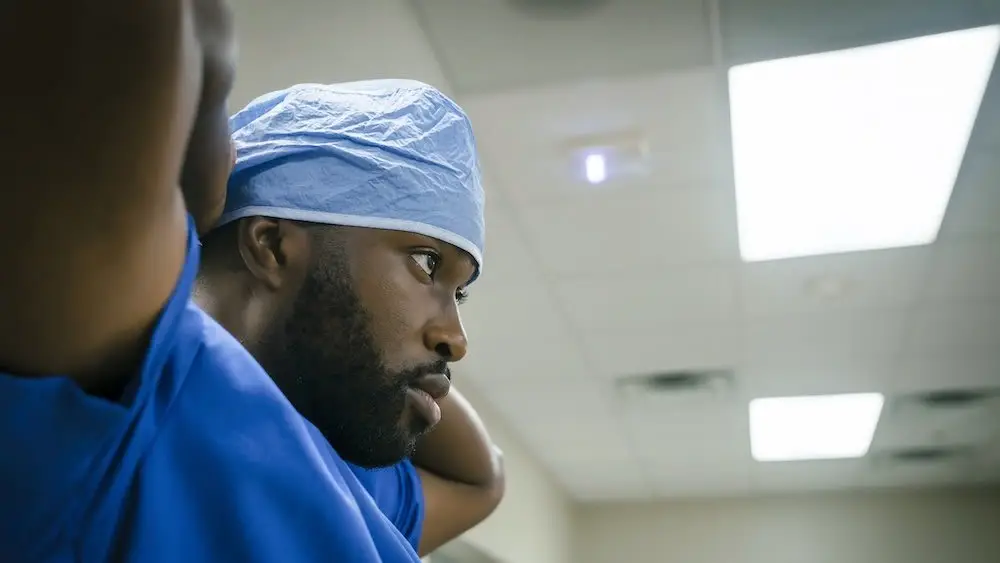
It’s just football, not life and death, so why do I care? I care because I am a Black doctor and researcher who has devoted my life to health equity for underserved minorities, which is a life and death struggle. Yet, the dynamic in my profession too closely mirrors the NFL, which has just ended another season under fire because only one of its 32 head coaches is Black. This is a disgrace. But the far bigger and more consequential travesty is that only 5% of this nation’s doctors are Black.
The dearth of Black doctors in this country isn’t simply an issue of grossly unequal representation. It impacts the care — or more accurately, lack of care — Black people receive. Myriad studies have demonstrated that historic mistrust of the majority white medical establishment, which for generations routinely used Black patients as guinea pigs, persists to this day. Recent data demonstrate that Black American mistrust is not misplaced. Mainstream medical students, for example, still cling to the myth that Black people do not feel pain to the degree of white people. I and others among the Black medical establishment have long known this and are working to change it.
One of our areas of focus is the interrelated fields of nephrology (kidneys) and organ transplantation, where the NFL analogy really applies. The vast majority of people on the 100,000+ organ transplant waitlist, a full 85% percent, need a kidney transplant. Black people are disproportionately represented on this list — although Black people are 13% of the total population, they make up 31% of people waiting for a kidney. Yet, the number of Black nephrologists is less than 7% of the total and transplant surgeons are 5.5%.
Overwhelmingly, white doctors are responsible for caring for Black patients on dialysis or talking with them about transplantation, which is the only cure for kidney failure. These doctors, though well-intentioned, are often poorly informed about why Black people may be more hesitant than whites to have another person’s organ placed into their bodies. Consequently, doctors’ failure to empathize furthers an atmosphere of mistrust, and Black kidney patients tend to opt for the devil they know (dialysis) over the one they don’t (transplant).
Dr. Clive Callender, professor of surgery at HBCU Howard University’s College of Medicine, is to transplant surgery what Mike Tomlin, coach of the Pittsburgh Steelers, is to the NFL — a longstanding paragon of excellence in transplantation who has, for far too many procedures, been the only Black doctor on the surgical team. He defined barriers to Black organ donation in the 1990s and partnered with the nation’s organ procurement organizations (OPOs) — the nonprofits responsible for recovering organs for transplant — to create national programming to increase the number of Black donors. According to national data, their efforts are working. Since 2000, the number of Black deceased donors has increased 203%, far outpacing the 103% increase in the number of white donors over the same period. Now, Dr. Callender and some of those same OPOs are joining with the nation’s four Historically Black Medical Schools to tackle the dearth of Black doctors and medical professionals in the two fields where, without change, the significant increase that is needed in transplants for Black kidney patients will not happen.
Our plans include creating opportunities for Black medical and nursing students to shadow at OPOs, transplant centers and dialysis clinics, thereby generating interest in pursuing careers in these fields; arranging for Black donation, transplant and nephrology professionals to speak to students in majority-minority schools to not only spur interest but break taboos on the subject; and creating culturally sensitive materials about transplantation for Black dialysis patients. These methods have been identified as ways to advance the number of Black physicians.
Importantly, we also will offer coaching for white nephrologists and transplant surgeons about minority patients’ particular concerns. It is imperative, we believe, for mainstream America and mainstream American medicine to begin to understand their crucial role in bridging an equity gap that has been so long in the making. This work will take time and can’t be solved just with nods to Black achievers.
Every February my phone starts ringing and my inbox fills up with interview requests from mainstream news outlets wishing to speak on Black History Month. Like Black NFL players and sidelined coaches, we are not going to wait for systemic change but are going to make it instead. Nephrology and transplant are critical areas of focus, but we do not intend to stop there. And we welcome partners and allies who will walk with us 12 months a year. The stakes are too high to do otherwise; Black health equity is not a game.
____
Dr. Hildreth is the President and CEO of HBCU Meharry Medical College in Nashville, Tennessee.
[ad_2]
Source link
Trending Topics

Features
- Drive Toolkit
Download and distribute powerful vaccination QI resources for your community.
- Health Champions
Sign up now to support health equity and sustainable health outcomes in your community.
- Cancer Early Detection
MCED tests use a simple blood draw to screen for many kinds of cancer at once.
- PR
FYHN is a bridge connecting health information providers to BIPOC communities in a trusted environment.
- Medicare
Discover an honest look at our Medicare system.
- Alliance for Representative Clinical Trials
ARC was launched to create a network of community clinicians to diversify and bring clinical trials to communities of color and other communities that have been underrepresented.
- Reducing Patient Risk
The single most important purpose of our healthcare system is to reduce patient risk for an acute event.
- Jessica Wilson
- Victor Mejia
- Jessica Wilson