










[ad_1]
WARNING: This story contains references to suicide.
A jury of four has made 38 recommendations in the coroner’s inquest examining the jail death of Delilah Blair, including recognition that inmates phoning loved ones shouldn’t be viewed as a privilege.
Blair died by hanging as an inmate at the South West Detention Centre (SWDC) in Windsor, Ont., on May 21, 2017. She was in the mental health unit.
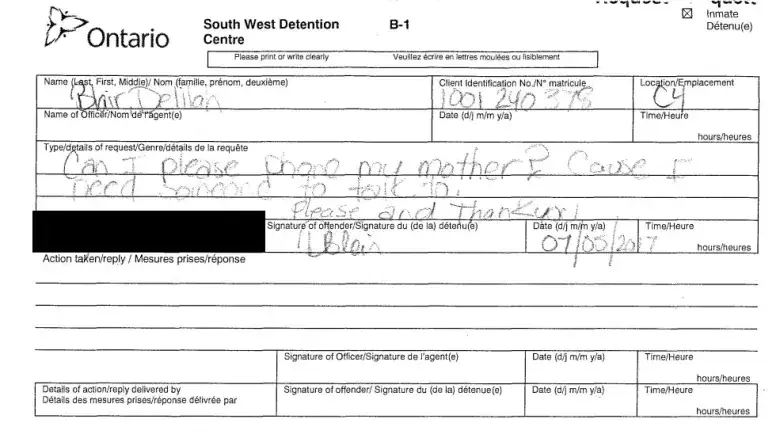
The jury heard Blair, a 30-year-old mother of four, made at least two written requests to speak with her mother, Selina McIntyre, in the weeks before her death. McIntyre lived more than 4,000 kilometres away in Hay River, N.W.T., in the weeks before her daughter’s death. Blair was an Indigenous woman of Cree ancestry with an Inuit upbringing.

Those requests weren’t fulfilled and McIntyre testified the first time she even knew her daughter was in jail was when someone called to say she was dead.
“My daughter was going to tell me something and I’ll never hear those words from her. It seemed to be she was silenced for some reason,” McIntyre previously told CBC News.
WATCH | Delilah Blair’s mother speaks about daughter’s death:

Delilah Blair, 30, died by suicide in May, 2017 while she was an inmate at the South West Detention Centre. Her death is the subject of a coroner’s inquest.
The jury has recommended the Ministry of the Solicitor General, which oversees jails, to update policies so an inmate’s access to a phone is not considered a privilege. In addition, any inmate who cannot reach a family member using a jail-issued calling card should be given priority access to a separate phone in order to be able to call family, the jury found.
Kate Forget, co-counsel to the coroner and legal counsel with the Indigenous Justice Division of the Ministry of the Attorney General, stressed the importance of the issue during closing submissions on Thursday.
“Knowing that she made this request while she was located in a female mental health unit by today’s standards would be considered segregation,” Forget said.
“[It] makes this all the more heartbreaking.”

Jail staff didn’t know Delilah Blair was Indigenous
The jury heard none of the several jail staff who testified at the inquest knew Blair was an Indigenous woman.

There also wasn’t any Indigenous programming being offered to inmates in the female mental health unit, no access to spiritual elders or knowledge keepers and at the time, the institution didn’t have a Native Inmate Liaison Officer (NILO).
Many witnesses who testified, including some correctional staff, said they acknowledged the needs of Indigenous peoples, particularly women in custody, are unique when considering a deep connection to culture.
The jury made the following recommendations to improve conditions for Indigenous people in jails across Ontario:
- Indigenous people must be able to access spiritual rights as well as programs with regularity and without unreasonable delay.
- The ministry should revise policies to recognize cultural and spiritual support as a fundamental health care right to all.
- The ministry should engage in community consultation on the development of Indigenous core programming with Indigenous leadership.
- The SWDC and the ministry should increase Indigenous-specific training to all fron-tline workers.
The inquest heard from 17 witnesses over nine days. The lawyers involved in the proceedings proposed 47 recommendations to the jury.
An inmate care plan outlined a number of mental health concerns jail staff should be aware of when monitoring Blair, including anxiety, depression and withdrawal. Correctional officers who testified during the inquest said they didn’t know how to access an inmate care plan, even in 2022.
The SWDC “has some work to do” in actively “getting workers engaged” and understanding inmate care plans, testified Linda Ogilvie, a corporate health-care manager with the Ministry of the Solicitor General.
The jury recommended the ministry “ensure that all correctional officers are trained on the importance of inmate care plans.”
Family believes death was accidental
The jury also came to the conclusion that Blair died by suicide. She was found in her cell with a ripped, knotted bed sheet around her neck that was fastened to a floating bookshelf in her locked cell.
However, the family believes her death was accidental.
Christa Big Canoe, the family’s lawyer and legal director of Aboriginal Legal Services, said Blair’s mental state at the time was unknown and therefore the intent to end her life was not clear. The lawyer also points to the fact that there was no suicide note found.

The family also points to security camera footage where Blair could be seen skipping around the women’s mental health unit and dancing in the common area within an hour of her body being found without vital signs in her cell.
“Those who love her have been left with many questions since her death,” said Big Canoe.
The SWDC is a relatively new facility that opened in 2014. However, the jury saw photos that compared the male mental health unit to the female mental health unit and noticed many differences.
The men are under direct supervision, which means officers are directly in the unit at all times. Meanwhile, women in the mental health section are under indirect supervision. At the time, correctional officers would check on them twice an hour. Much of the social contact from those jail guards was done through the meal slot in Blair’s door.
The jury recommended several changes to improve these conditions:
- The SWDC shall make best efforts to ensure the female mental health unit is directly supervised.
- When designing new correctional facilities, the ministry shall consider needs-based housing for women and woman-identifying mental health clients.
Jail staff weren’t prepared for emergency
None of the several correctional officers or jail healthcare staff who responded to Blair’s emergency came equipped with what’s known as a “911 knife” to cut through the sheet or a defibrillator to help revive her, the jury heard. Neither life-saving item were in any of the emergency equipment bags at the jail. Paramedics arrived with an automated external defibrillator (AED) 12 minutes after she was found unresponsive.
The jury made the following recommendations to help prevent similar deaths in the future:
- Review bookshelves in the female mental health unit to determine whether they should be retrofitted to reduce suicide risk.
- Consult with the federal government and other provinces about the possibility of bedding that is less susceptible to tearing for use by persons in custody not on suicide watch. If there are viable options, the government shall implement the new bedding at all provincial institutions.
- The ministry shall include AEDs in nurses’ equipment bags.
- The SWDC/ministry shall ensure that the first sergeant responding to a medical emergency is responsible for ensuring that a 911 knife is brought to the scene of the emergency.
Blair had been at the SWDC for less than two months awaiting sentencing after pleading guilty to a robbery offence. For many years prior, she struggled with an addiction to crack cocaine. As an inmate at the SWDC, she requested addiction services without receiving them.
The jury also recommended the ministry provide “timely access” to addiction services and supports for inmates.
A coroner’s inquest is required by law when an inmate dies in custody.
Although the Ministry of the Solicitor General isn’t required to implement any of the recommendations, government lawyer Aisha Amode said they are carefully considered. The province is also required to respond to each one of the jury’s 38 recommendations.
[ad_2]
Source link