












National Hispanic Heritage Month: Caring for Hispanic patients

[ad_1]

Diversity Matters

During National Hispanic Heritage Month, I am reflecting on my own Hispanic heritage and my experience working with Hispanic patients.

September 15 through October 15 is National Hispanic Heritage Month, a time to reflect on the contributions Hispanic Americans have made to the U.S. culture and economy. According to the latest statistics, there are roughly 62 million Hispanics living in the United States.

Hispanics are people who have descended from Spain or Spanish-speaking countries. You may have also heard the terms Latino, Latina and Latinx. These are people who are descendants from Latin American countries, many of whom also identify as Hispanic.

With that in mind, how can physicians deliver quality healthcare to Hispanics and other Latinxs when they become your patients?

Physicians can greatly improve medical care for their Hispanic patients by using Spanish language translators to communicate treatment plans. It is especially important at the end of the office visit to ask the patients if they understood instructions, and in some cases to repeat back what they learned. The directions on how to take the medications should be written in Spanish for those who don’t know English as well. Marking the bottles for what medications are used to treat specific conditions helps too, i.e., “metoprolol succinate para PRESSION.”

Also, giving patients a print-out of their medication list can increase compliance when taking their meds. Schedule more frequent appointments to develop a strong rapport because some Hispanic patients are wary of the U.S. health care system. Lastly, maintain curiosity about their culture, respect their work ethic and learn from them.

Hispanic patients still experience limits to necessary medical care

Recent surveys of Hispanic patients have revealed information about how they view health care in the U.S.

Health care for Hispanic patients has improved over the last two decades, but there are still challenges to overcome. Many Hispanic patients remain uninsured, which greatly limits access to preventive medical care services. Overall, Hispanics have worse medical outcomes than their non-Hispanic white and Black counterparts because they sometimes work in low-income jobs that do not provide them with insurance. The percentage of Hispanics who work is roughly equal to white Americans, but the difference in average household income is staggering. Many low-paying jobs in this country often do not offer health insurance to their essential workers.

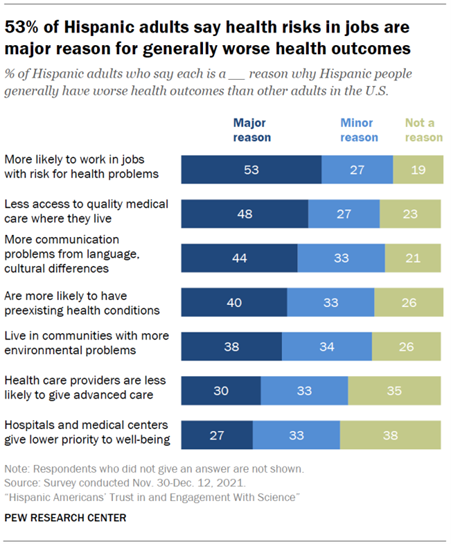
The Pew Research Center conducted a survey of Hispanic Americans to determine their beliefs as to why there is still such a disparity in health outcomes. The top reason they found for poorer health care among Hispanics was working in jobs that put them at risk for health problems, while the second reason was less access to quality medical care in their neighborhoods.

Many Hispanic patients live in underserved areas where access to medical care is harder to come by. Other top reasons included language and communication barriers, higher incidence of pre-existing health conditions and living in areas with environmental problems. Of note, 30% of Hispanics cite differential treatment by health care providers as a reason for disparities in health care outcomes.

At my employer, Aunt Martha’s Clinic in Carpentersville, Illinois, the majority of our patients are Hispanics of Mexican-American origin who work in traditional blue-collar jobs and are all too often uninsured. The patients will forego certain medications, imaging studies or seeing specialists for their chronic medical conditions because of treatment costs.

Without being able to manage their health adequately, the disease outcomes are worse, and they might end up needing to go to the ER for treatment. However, the ER typically deals with acute issues and does not manage chronic diseases; hence patients are given a Band-Aid for medical problems that could otherwise be dealt with on an outpatient basis.
Facing the challenges full force

We do not give up hope though, and tackle our Hispanic patients’ health care issues head on. Patients are given instructional materials on changing their lifestyle habits and encouraged to partake in healthier eating and exercise. Follow-up appointments are scheduled by clinical providers and staff reinforce treatment plans in Spanish.

Our front desk staff now also offer assistance in obtaining state medical insurance for any patients who are 42 years of age and older and have maintained a qualifying immigration status. There is a dedicated referral coordinator for our region who schedules imaging studies with local hospitals and books appointments for specialists. Consult notes are requested from specialists to coordinate continuity of care for chronic medical conditions. Clinical staff calls local specialists for urgent consultations. Pharmacies help by offering low-cost meds or letting patients know that they can apply to the 340b program for meds.

Therefore, during National Hispanic Heritage Month, when I reflect on my own Spanish/Latin American heritage, I am really proud of my patients and value their contributions to the country immensely. The food we eat, the Amazon boxes at my door, the pipes for my plumbing, the candy from the local factory – my people are in it with the rest of the U.S. workers to make all these things available to us. For that, I am forever grateful, and at Aunt Martha’s Clinic, we recognize their efforts and give back to them with our hearts fully vested.

Related reading:

How kidney testing is affected by racial bias

My journey as an underrepresented minority in medicine with mentors who guided me along the way

Editor’s note: The views expressed in this article are the author’s own and do not necessarily represent the views of The DO or the AOA.

[ad_2]

Source link

Trending Topics

Features

Download and distribute powerful vaccination QI resources for your community.

Sign up now to support health equity and sustainable health outcomes in your community.

MCED tests use a simple blood draw to screen for many kinds of cancer at once.

FYHN is a bridge connecting health information providers to BIPOC communities in a trusted environment.

Discover an honest look at our Medicare system.

ARC was launched to create a network of community clinicians to diversify and bring clinical trials to communities of color and other communities that have been underrepresented.

The single most important purpose of our healthcare system is to reduce patient risk for an acute event.

Related Posts
How NMQF Advances Minority Health Through Data, Research and Health Access
Early Cancer Detection Is Entering a New Era. Flint Is Helping Lead the Way.
Why Your “Ozempic” May Not Be Ozempic: FDA Warnings Highlight Growing Risks of Unregulated GLP-1 Drugs
Scroll to Top
Featured Articles
How NMQF Advances Minority Health Through Data, Research and Health Access
Early Cancer Detection Is Entering a New Era. Flint Is Helping Lead the Way.
Why Your “Ozempic” May Not Be Ozempic: FDA Warnings Highlight Growing Risks of Unregulated GLP-1 Drugs
Why Your “Ozempic” May Not Be Ozempic: FDA Warnings Highlight Growing Risks o...
The Communities Most Burdened by Disease Should Be the First to Benefit from Artificial Intelligence
The Communities Most Burdened by Disease Should Be the First to Benefit from ...
Cancer Pain Care Access Gap Hits Black, Asian Patients
Black and Asian Cancer Patients Wait Longer for Pain Relief in New Study
What Is Cyclosporiasis Symptoms, Food Safety, and Reasons
What Is Cyclosporiasis? The Foodborne Illness Showing Up in the News
Categories
AI
ATTR-CM
BIPOC News
Cancer
Clinical Trials
Covid19
Diseases of the Body
Environment
Health Data
Health Equity Events
Health Policy
Health Tips
Subscribe to our newsletter to receive our latest news​
All Stories
How NMQF Advances Minority Health Through Data, Research and Health Access
Early Cancer Detection Is Entering a New Era. Flint Is Helping Lead the Way.
Why Your “Ozempic” May Not Be Ozempic: FDA Warnings Highlight Growing Risks of Unregulated GLP-1 Drugs
Why Your “Ozempic” May Not Be Ozempic: FDA Warnings Highlight Growing Risks o...
BIPOC News
How NMQF Advances Minority Health Through Data, Research and Health Access
Early Cancer Detection Is Entering a New Era. Flint Is Helping Lead the Way.
The Communities Most Burdened by Disease Should Be the First to Benefit from Artificial Intelligence
The Communities Most Burdened by Disease Should Be the First to Benefit from ...
Environment
UV Safety Awareness Month Raises Urgency on Skin Cancer Prevention and Sun Protection Equity
UV Safety Awareness Month Raises Urgency on Skin Cancer Prevention and Sun Pr...
Extreme Heat Safety Tips 5 Ways to Protect Your Health This Summer fyh.news
5 Heat Safety Tips That Could Protect Your Health This Summer
Lupus Awareness Event in Baltimore Aims to Support Research and Shine a Light on Health Disparities
Lupus Awareness Event in Baltimore Aims to Support Research and Shine a Light...
Work Force
A multigenerational Black and Hispanic family sitting together in a park, showing how Social Security helps support older adults, people with disabilities, and families across generations.
Millions of Older Americans Could Face Smaller Social Security Checks by 2032...
dreamstime_s_243253251
The Caregiver Journey: The Hidden Backbone of American Healthcare
Families gather at a Bronx community festival with live music, kids’ activities, and health booths sharing SOMOS social care resources and free screenings.
Celebrating Hispanic heritage while learning about health care

[xyz-ips snippet=”Output-Source-Name”]

Clinical Trials
Early Cancer Detection Is Entering a New Era. Flint Is Helping Lead the Way.
Why Your “Ozempic” May Not Be Ozempic: FDA Warnings Highlight Growing Risks of Unregulated GLP-1 Drugs
Why Your “Ozempic” May Not Be Ozempic: FDA Warnings Highlight Growing Risks o...
Clinical Trial Diversity Remains a Critical Challenge in Alzheimer’s Research
Vaccines and Outbreaks
A parent checking a child's temperature during summer, illustrating the changing RSV patterns and year-round respiratory virus risks.
Can You Get RSV During the Summer?
Michelle Lam, MBA, of NYC Health + Hospitals/Elmhurst & Amy Harris of NYC Health + Hospitals/Elmhurst
Healthcare Leaders Spotlight Vaccine Equity and Adult Immunization Strategies...
Measles Outbreaks Surge: Essential Facts and Prevention Strategies
Other Categories
AI
Read the latest AI News stories trending around the world
ATTR-CM
Cancer
Read the latest Cancer stories trending around the world
Covid19
Diseases of the Body
Read about the latest Diseases of the Body trending around the world
Friday Webinars
Every Friday, we bring you insightful webinars covering critical topics in healthcare, data equity, and policy reform.
Health Data
Read the latest Health Data stories trending around the world
Health Equity Events
Read the best Health Equity Events around the country.
Health Policy
Read the latest Health Policy stories trending around the world
Health Tips
Heart Health
Read the latest on Heart Health News, Stories and Tips.
kidney Health
Read more trending News about Kidney Health, Stories and Tips.



