














[ad_1]
It would hit Alina Black in the snack aisle at Trader Joe’s, a wave of guilt and shame that made her skin crawl.
Something as simple as nuts. They came wrapped in plastic, often in layers of it, that she imagined leaving her house and travelling to a landfill, where it would remain through her lifetime and the lifetime of her children.
She longed, really longed, to make less of a mark on the Earth. But she had also had a baby in nappies, and a full-time job, and a five-year-old who wanted snacks. At the age of 37, she felt conflicting forces that were slowly closing on her, like a set of jaws.
In the early-morning hours, after nursing the baby, she would slip down a rabbit hole, scrolling through news reports of droughts, fires, mass extinction. Then she would stare into the dark.

Caroline Wiese, who experienced ‘multiday panic episodes’ over climate data, in New York.
It was for this reason that, around six months ago, she searched “climate anxiety” and pulled up the name of Thomas J Doherty, a Portland psychologist who specialises in climate.
A decade ago, Dr Doherty and a colleague, Susan Clayton, a professor of psychology at the College of Wooster in Ohio, published a paper proposing a new idea.
They argued that climate change would have a powerful psychological effect — not just on the people bearing the brunt of it, but on people following it through news and research. At the time, the notion was seen as speculative.
That scepticism is fading. Eco-anxiety, a concept introduced by young activists, has entered mainstream vocabulary. And professional organisations are hurrying to catch up, exploring approaches to treating anxiety that is both existential and, many would argue, rational.
Though there is little empirical data on effective treatments, the field is expanding swiftly. The Climate Psychology Alliance provides an online directory of climate-aware therapists; the Good Grief Network, a peer support network modelled on 12-step addiction programmes, has spawned more than 50 groups; professional certification programmes in climate psychology have begun to appear.

Alina Black, who sought a therapist who specialised in climate anxiety to address her mounting panics, in Portland, Oregon.
As for Dr Doherty, so many people now come to him for this problem that he has built an entire practice around them: an 18-year-old student who sometimes experiences panic attacks so severe that she can’t get out of bed; a 69-year-old glacial geologist who is sometimes overwhelmed with sadness when he looks at his grandchildren; a man in his 50s who erupts in frustration over his friends’ consumption choices, unable to tolerate their chatter about vacations in Tuscany, Italy.
The field’s emergence has met resistance, for various reasons. Therapists have long been trained to keep their own views out of their practices. And many leaders in mental health maintain that anxiety over climate change is no different, clinically, from anxiety caused by other societal threats, like terrorism or school shootings. Some climate activists, meanwhile, are leery of viewing anxiety over climate as dysfunctional thinking — to be soothed or, worse, cured.
But Ms Black was not interested in theoretical arguments; she needed help right away.
She was no Greta Thunberg type, but a busy, sleep-deprived working mum. Two years of wildfires and heat waves in Portland had stirred up something sleeping inside her, a compulsion to prepare for disaster. She found herself up at night, pricing out water purification systems. For her birthday, she asked for a generator.
She understands how privileged she is; she describes her anxiety as a “luxury problem”. But still: the disposable nappies made her anxious. She began to ask herself, what is the relationship between the nappies and the wildfires?
“I feel like I have developed a phobia to my way of life,” she said.
An Idea on the Edge
Last fall, Ms Black logged on for her first meeting with Dr Doherty, who sat, on video, in front of a large, glossy photograph of evergreens.
At 56, he is one of the most visible authorities on climate in psychotherapy, and he hosts a podcast, Climate Change and Happiness . In his clinical practice, he reaches beyond standard treatments for anxiety, like cognitive behavioural therapy, to more obscure ones, like existential therapy, conceived to help people fight off despair, and ecotherapy, which explores the client’s relationship to the natural world.
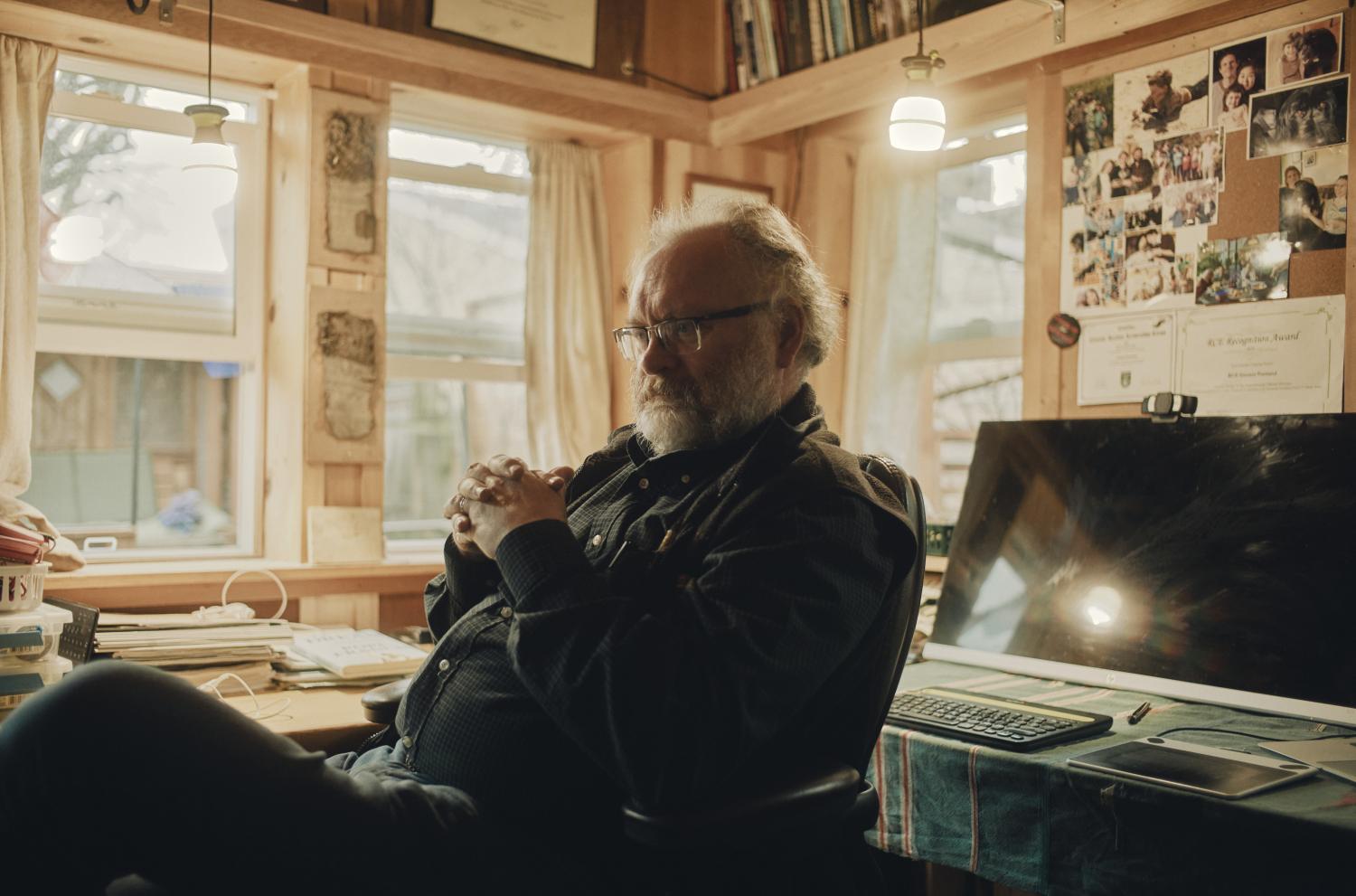
Frank Granshaw, a retired glacial geologist who sees a psychologist who is well versed on climate issues, in Portland, Oregon.
He did not take the usual route to psychology; after graduating from New York’s Columbia University, he hitchhiked across the country to work on fishing boats in Alaska, then as a whitewater rafting guide — “the whole Jack London thing” — and as a Greenpeace fundraiser. Entering graduate school in his 30s, he fell in naturally with the discipline of “ecopsychology”.
At the time, ecopsychology was, as he put it, a “woo-woo area”, with colleagues delving into shamanic rituals and Jungian deep ecology. Dr Doherty had a more conventional focus, on the physiological effects of anxiety. But he had picked up on an idea that was, at that time, novel: that people could be affected by environmental decay even if they were not physically caught in a disaster.
Recent research has left little doubt that this is happening. A 10-country survey of 10,000 people aged 16 to 25 published last month in The Lancet found startling rates of pessimism. Forty-five percent of respondents said worry about climate negatively affected their daily life. Three-quarters said they believed “the future is frightening”, and 56% said “humanity is doomed”.
The blow to young people’s confidence appears to be more profound than with previous threats, such as nuclear war, Dr Clayton said. “We’ve definitely faced big problems before, but climate change is described as an existential threat,” she said. “It undermines people’s sense of security in a basic way.”
Caitlin Ecklund, 37, a Portland therapist who finished graduate school in 2016, said that nothing in her training — in subjects like buried trauma, family systems, cultural competence and attachment theory — had prepared her to help the young women who began coming to her describing hopelessness and grief over climate. She looks back on those first interactions as “misses”.
“Climate stuff is really scary, so I went more toward soothing or normalising,” said Ms Ecklund, who is part of a group of therapists convened by Dr Doherty to discuss approaches to climate. It has meant, she said, “deconstructing some of that formal old-school counselling that has implicitly made things people’s individual problems”.
Many of Dr Doherty’s clients sought him out after finding it difficult to discuss climate with a previous therapist.
Caroline Wiese, 18, described her previous therapist as “a typical New Yorker who likes to follow politics and would read The New York Times , but also really didn’t know what a Keeling Curve was”, referring to the daily record of carbon dioxide concentration.
Ms Wiese had little interest in “Freudian BS”. She sought out Dr Doherty for help with a specific problem: the data she was reading was sending her into “multiday panic episodes” that interfered with her schoolwork.
In their sessions, she has worked to carefully manage what she reads, something she says she needs to sustain herself for a lifetime of work on climate. “Obviously, it would be nice to be happy,” she said, “but my goal is more than to just be able to function.”
Frank Granshaw, 69, a retired professor of geology, wanted help hanging on to what he calls “realistic hope”.
He recalls a morning, years ago, when his granddaughter crawled into his lap and fell asleep, and he found himself overwhelmed with emotion, considering the changes that would occur in her lifetime.
These feelings, he said, are simply easier to unpack with a psychologist who is well versed on climate. “I appreciate the fact that he is dealing with emotions that are tied into physical events,” he said.
As for Ms Black, she had never quite accepted her previous therapist’s vague reassurances. Once she made an appointment Dr Doherty, she counted the days. She had a wild hope that he would say something that would simply cause the weight to lift.
That didn’t happen. Much of their first session was devoted to her doomscrolling, especially during the night-time hours. It felt like a baby step.
“Do I need to read this tenth article about the climate summit?” she practised asking herself. “Probably not.”
A Knot Loosens
Several sessions came and went before something really happened.
Ms Black remembers going into an appointment feeling distraught. She had been listening to radio coverage of the Intergovernmental Panel on Climate Change meeting in Glasgow, Scotland, and heard a scientist interviewed. What she perceived in his voice was flat resignation.
That summer, Portland had been trapped under a high-pressure system known as a “heat dome,” sending temperatures soaring. Looking at her own children, terrible images flashed through her head, like a field of fire. She wondered aloud: Were they doomed?
Dr Doherty listened quietly. Then he told her, choosing his words carefully, that the rate of climate change suggested by the data was not as swift as what she was envisioning.
“In the future, even with worst-case scenarios, there will be good days,” he told her, according to his notes. “Disasters will happen in certain places. But, around the world, there will be good days. Your children will also have good days.”
At this, Ms Black began to cry.
She is a contained person — she tends to deflect frightening thoughts with dark humour — so this was unusual. She recalled the exchange later as a threshold moment, the point when the knot in her chest began to loosen.
“I really trust that when I hear information from him, it’s coming from a deep well of knowledge,” she said. “And that gives me a lot of peace.”
Dr Doherty recalled the conversation as “cathartic in a basic way”. It was not unusual, in his practice; many clients harbour dark fears about the future and have no way to express them. “It is a terrible place to be,” he said.
A big part of his practice is helping people manage guilt over consumption: he takes a critical view of the notion of a climate footprint, a construct he says was created by corporations in order to shift the burden to individuals.
He uses elements of cognitive behavioural therapy, like training clients to manage their news intake and look critically at their assumptions.
He also draws on logotherapy, or existential therapy, a field founded by Viktor E Frankl, who survived German concentration camps and then wrote Man’s Search for Meaning , which described how prisoners in Auschwitz were able to live fulfilling lives.
At times, over the last few months, Ms Black could feel some of the stress easing. Her goal is not to be released from her fears about the warming planet, or paralysed by them, but something in between: she compares it to someone with a fear of flying, who learns to manage their fear well enough to fly. “On a very personal level,” she said, “the small victory is not thinking about this all the time.”
[ad_2]
Source link



