










[ad_1]
A MATERNITY crisis sparked by closing labor wards is proving fatal for mothers and babies across the United States, healthcare providers have warned.
Speaking exclusively to The U.S. Sun, the Chair of the Alabama State Board of Midwifery, Noel Leithart, and midwife Rebekah Myrick highlighted the severity of the situation in Alabama.

6

6

6

6
As of November 15, three Alabama Hospitals lost their maternity wards in just one month.
Shelby Baptist Medical Center and Princeton Baptist Medical Center closed their maternity services on October 25.
This was then followed on November 15 with Monroe County Hospital suspending its maternity ward.
Alabama Midwife Rebekah Myrick told The U.S. Sun: “Alabama is in a maternity care crisis of greater than the national average.
“It is ranked the worst state in the US in which to give birth and the epidemic of closing maternity units is only contributing to this statistic.”
“I can’t comprehend why they would do this,” Noel Leithart, Chair of the Alabama State Board of Midwifery added.
According to the Alabama Department of Public Health (ADPH), the state’s maternal mortality rate is higher than the national average.
In 2020 it reported a rate of 36.4 deaths per 100,000 live births, the third highest in the country.
The state also has the sixth-highest infant mortality rate across the U.S. and mothers also suffer high rates of preterm birth and low birth weight which are risk factors for infant deaths.
According to investigations conducted by ADPH, the majority of maternal deaths in Alabama are preventable, and black mothers are disproportionately impacted by both maternal and infant deaths.
Black children account for almost half of all infant deaths in the state.
This is not just an issue in Alabama but across a number of states.
According to the CDC, almost 20,000 infants died across the country in 2020.
Non-Hispanic Black infants top the statistics for mortality rates by race and ethnicity across the US at 10.6 deaths per 1,000 live births.
The American Civil Liberties Union (ACLU) filed a lawsuit against ADPH on August 8 following a “de facto ban” on freestanding birth centers across the state due to licensing legislation.
Such centers tend to cater to low-risk pregnancies and help free up spaces in hospitals for those deemed to be of higher risk.
“In the midst of one of the most severe maternal and infant health crises in the entire country ADPH and Scott Harris, State Health Officer are prohibiting Plaintiffs from offering critically needed, high-quality prenatal, birthing, and postpartum care that is proven to offer substantial benefits to the health of pregnant people and their babies,” the lawsuit alleged.
“As of July 2023, there are only 29 licensed CNMs (Certified Nurse Midwife) and 22 licensed CPMs (Certified Practicing Midwives) in the entire state.”
It added that “hospital-based services in Alabama are insufficient” and that “hospital-based labor and delivery units, especially in rural hospitals, are closing at an alarming rate,” as shown by the three closures in just three weeks.
Myrick joined other midwives and physicians to honor Princeton‘s labor and delivery ward as workers ended their last shift after 100 years of serving mothers and babies.
“Nearly every eye was wet with tears,” she said.
“Shelby Baptist [was] the only hospital in the quickly growing county that [offered] maternity services.
“Monroe County Hospital [was] the only hospital with maternity services between Mobile and Montgomery.
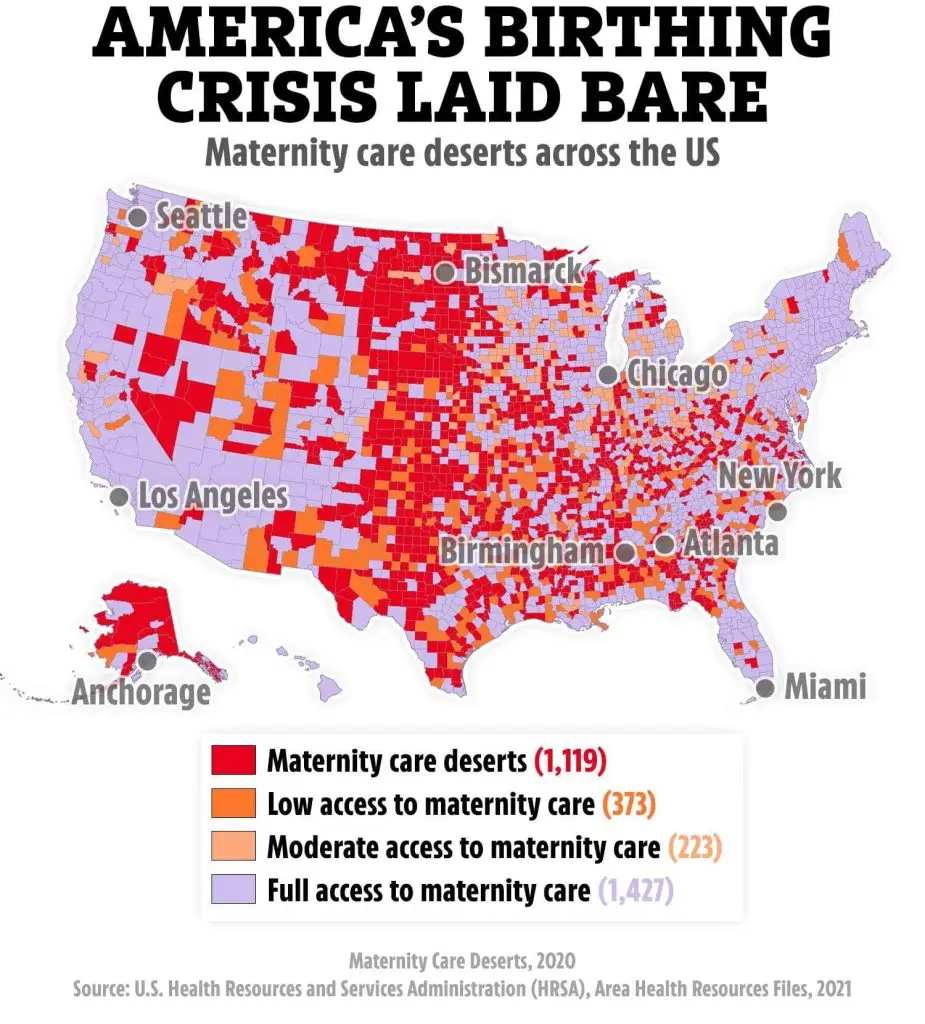
“Now childbearing women will have to up to 100 miles to access care. These two hospital closures leave two more counties as maternity care deserts.”
The best and worst states to give birth in the US revealed

According to the latest data compiled from the CDC in 2021, these are the best and worst states to give birth in relation to infant mortality rates.
Leading causes of death were birth defects, preterm birth and low birth weight, sudden infant death syndrome, injuries, and maternal pregnancy complications.
The top three best-ranked states:
- North Dakota, 2.77 deaths
- Massachusetts, 3.23 deaths
- New Jersey, 3.57 deaths
The three worst-ranked states:
- Mississippi, 9.39 deaths
- Arkansas, 8.59 deaths
- Alabama, 7.56 deaths
*Infant deaths per 1,000 live births
The lawsuit declared a “critical need” for increased access to maternity care in the state “where nearly 40% of counties are classified as ‘maternity care deserts.'”
Dr Stephanie Mitchell, a board-certified nurse midwife who founded Birthing Sanctuary a biting center in Sumter County, a maternity care desert, highlighted the terrifying “life and death” reality mothers are facing.
At a press conference, she said: “Having to drive that far can be a serious obstacle and may prevent some people from getting care during their pregnancy at all.
“People shouldn’t be forced to go without pregnancy care.
“Expanding access to midwifery and birth centers in places like Sumter County is a life and death situation for many families.”
Myrick noted that sprawling maternity care deserts may cause more mothers to opt for inductions or planned cesareans, “both of which increase risks to mothers and babies.”
A Tulane University study found that mothers in these so-called “deserts” are potentially three times more likely to die of pregnancy-related causes.
“Babies born in maternity care deserts also face a far higher risk of health complications and death,” Myrick added.
According to ADPH, more than one in four pregnant mothers in Alabama receive inadequate prenatal care during pregnancy
Leithart explained how the shuttered hospitals were providing help on the edge of care desserts.
“Two hospitals shut in Birmingham are actually on the edge so they could have handled women who are coming from just beyond that boundary and so now the women coming in have to come even further into the city to get care,” she said.
“I just don’t understand reasons why they would do this.
“The difficult thing to me is if they are going to shut them down why are they also inhibiting another provider from being able to help them?”
The lawsuit outlined the work of the Oasis Family Birthing Center (OFBC) which was opened to patients in September 2022 by Dr Heather Skanes.
It detailed that 22 patients received care from OFBC between its opening and its forced closure.
Six of these patients were found through assessments to have risk factors making them ineligible for giving birth at the center and two others elected to deliver in the hospital but received prenatal care at OFBC.
Dr Skanes took on these patients and helped them successfully deliver in the hospital with the remaining 14 having births without complications at OFBC which were attended by a CPM and with assistance from student midwives.
The suit added that “no patients were transferred to hospital-based care during labor, delivery, or the postpartum period.
“All mothers and babies treated by OFBC to date are healthy and doing well.”
Following the filing, the Fifteenth Judicial Circuit Court ruled against the ADPH for preventing the operation of birth centers led by midwives in Alabama.
ACLU celebrated the news saying: “The ruling means Oasis Family Birthing Center in Birmingham, Alabama Birth Center in Huntsville, Birth Sanctuary in Gainesville, and any other birth center complying with standards set by the American Association of Birth Centers can secure licenses from ADPH to operate — and providers will be able to resume serving pregnant Alabamians with much-needed pregnancy care.”
Despite this welcome news, Myrick shared the thoughts of an anonymous sister-midwife with The U.S. Sun which stated: “The closure of hospitals is evidence that the powers that be are much more concerned about money than the lives of Alabama mothers and our newest most vulnerable citizens.”

6

6
[ad_2]
Source link