[ad_1]
INTRODUCTION
Section:


Clinical trials investigating novel treatments for pancreatic ductal adenocarcinoma (PDAC) are troubled with under-representation of diverse participants. After adjusting for disease prevalence, Black, Asian or Pacific Islander, American Indian or Alaskan Native, and Hispanic patients have been significantly under-enrolled in PDAC clinical trials in the United States.1 In 2017, Congress issued a federal regulation (42 CFR Part 11) that led to increased reporting of clinical trial participants’ race/ethnicity.2 However, enrollment of more diverse participants has not been demonstrated.1 Thus, the standard of care in cancer treatment is informed by studies conducted with predominantly non-Hispanic White participants.
CONTEXT
-
Key Objective
-
To determine the impact of eligibility criteria on disparities in pancreatic cancer clinical trial candidacy among Black and White patients.
-
Knowledge Generated
-
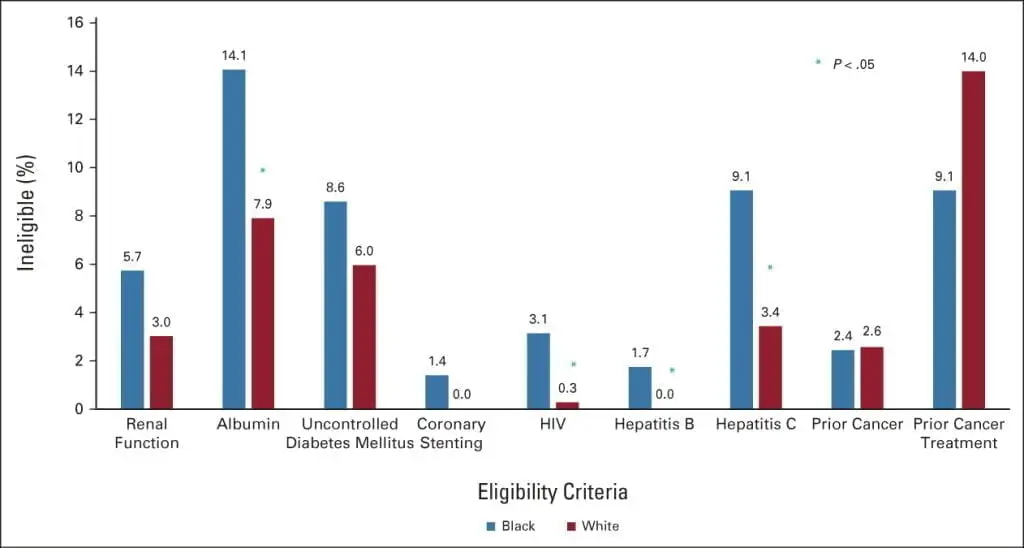
In this cross-sectional study, common eligibility criteria for phase II and III trials were applied to a cohort of patients with pancreatic cancer from a single institution to simulate the clinical trial screening process, demonstrating that Black patients had an overall rate of eligibility that was 9% lower than White patients, mostly attributable to malnutrition and infectious diseases. By implementing medically reasonable revised criteria, rates of ineligibility decreased for both Black and White patients, but notably equalized ineligibility rates between racial groups, thereby eliminating the eligibility gap on the basis of medical conditions and organ dysfunction.
-
Relevance
-
Revision of eligibility criteria is one potential means to improve representation of diverse patients in clinical trials and advance the generalizability of results to reflect real-world treatment of pancreatic cancer.
In addition to social justice concerns about equitable access to investigational therapeutics, there are biologic reasons necessitating diverse participation in trials. Drug-metabolizing enzymes have different distributions in African, Asian, and White populations, influencing pharmacokinetics.3–5 Somatic and germline mutations, as well as alternative RNA splicing, vary among populations, which may affect pharmacokinetics, therapeutic resistance, response, and toxicity to targeted therapies.6–8 Postmarketing data revealing divergent efficacy and toxicity profiles have even led to race-specific/ethnicity-specific dosing guidelines.6,7 Although currently actionable molecular alterations are uncommon,9 matching targeted therapies to actionable alterations through precision medicine can improve survival.10 However, knowledge of possible differences in molecular profiles across populations is limited by inclusion of racial/ethnic minority participants in studies. Lack of diverse trial participants leaves providers with incomplete data on safety and efficacy of cancer therapeutics, potentially exacerbating disparities in survivorship, where one-year relative survival in 2017 was lower for Black patients (58.1% localized, 51.7% regional, and 15.3% distant) compared with White patients (63.9% localized, 58.5% regional, and 21.8% distant), regardless of stage.11
Although the reasons for under-representation in clinical trials are complex (mistrust in the medical system, systemic racism, differential access to care and centers conducting clinical trials, socioeconomic factors, lack of diversity among clinicians conducting trials, implicit bias, etc), one factor that has not been fully investigated is eligibility criteria.12–14 Intended to standardize participation for efficacy assessments and minimize risks, these criteria are set by trial sponsors but supported by regulatory authorities. However, some medical conditions may preferentially exclude minorities from trial participation without strong medical rationale. ASCO and Friends of Cancer Research (Friends), in collaboration with the US Food and Drug Administration (FDA), issued statements in 2017 to address the concern that restrictive eligibility criteria lead to reduced generalizability of study results. Modernized criteria were proposed, with revised guidelines on organ dysfunction, prior or current malignancy, and comorbidities.15–17 These statements highlighted the importance of expanded eligibility criteria for experimental therapies, but fell short of acknowledging the effects of restrictive criteria on racial/ethnic disparities in trial participation. To our knowledge, the magnitude of potential impact of expanded eligibility criteria on improving racial/ethnic disparities in eligibility has not been well studied. We sought to investigate the impact of traditional criteria on potential trial participation by race/ethnicity among a diverse patient population with PDAC. We hypothesize t
hat traditional eligibility criteria lead to racial/ethnic disparities in potential participation in PDAC clinical trials and that eligibility among racial/ethnic minority patients may be significantly improved by implementing selectively less restrictive criteria.
DISCUSSION
Section:
The results of this study demonstrate that traditional eligibility criteria for PDAC clinical trials disproportionately exclude Black patients from eligibility on the basis of medical conditions. Although these criteria are intended to reduce risk and define a homogenous study population, they have potential to create bias. Restrictive criteria not only limit generalizability of results to the healthiest patients, but many medical conditions that exclude patients from eligibility are also associated with health disparities. Infectious diseases, such as HIV and hepatitis, disproportionately affect Black patients.22–25 Similarly, chronic kidney disease, diabetes mellitus, heart disease, and obesity are more prevalent in Black and Hispanic populations.26–31 This leads to a double-hit phenomenon whereby patients with PDAC from minority backgrounds are less healthy and unlikely to be provided opportunities to participate in trials. Through revised eligibility criteria, there is potential to improve equitable eligibility for clinical trial participation, thus producing more generalizable results and reducing disparities in access to treatment.
To date, few studies have investigated the effect of eligibility criteria on enrollment of underserved populations. A study conducted at Howard University, in which consecutively diagnosed African-American patients with cancer were assessed for clinical trial eligibility, found that only 8.5% of patients were eligible, and among those ineligible, 17.1% were due to comorbidities.32 Our results likely overestimate eligibility as we applied only a subset of criteria discretely available from the medical record. In comparing ineligibility rates between Black and White patients, results have varied. A study conducted at an NCI-designated cancer center reported no difference in clinical trial eligibility on the basis of race/ethnicity.33 However, Langford et al,34 investigated patients treated at 16 NCI Community Cancer Center Program sites from 2009 to 2012, finding that non-Hispanic Black patients were approximately 1.5 times more likely to be ineligible for clinical trial participation than non-Hispanic White patients because of comorbidities, but not abnormal labs or organ dysfunction. Penberthy, et al35 evaluated reasons for ineligibility in cancer clinical trials from 2006 to 2010, reporting that comorbidities were the most common reason for ineligibility. Notably, they found no difference in rates of ineligibility between African American and White patients on the basis of comorbidities. However, African Americans were more likely to be ineligible because of mental status and anticipated noncompliance, highlighting the possible impact of implicit bias with subjective eligibility criteria.35 Although few studies assessing differential clinical trial eligibility for Black patients have identified discrepant contributing factors, racial/ethnic disparities in eligibility were consistent.
Differences in demographics, insurance provider, and disease stage between Black and White patients in our study were not surprising as Black patients tend to be diagnosed with PDAC at a younger age and more advanced stage.36 This aligns with fewer Black patients having Medicare coverage. Higher rates of Medicaid and no insurance coverage among Black patients likely reflect higher rates of financial vulnerability. Even if medically eligible, variable Medicaid coverage of testing and treatment within clinical trials may contribute to disparities in participation. In our study population, rates of renal dysfunction and diabetes mellitus were not significantly higher in Black compared with White patients. Higher prevalence of infectious diseases among Black patients in this study is consistent with national data,22–25 but in the era of highly effective therapies to control or cure these conditions, the absolute contraindication may be reconsidered. The condition independently leading to the highest number of ineligible Black patients was hypoalbuminemia, suggesting more malnutrition, poor protein nutritional intake, or renal-associated protein loss in Black patients. The rationale for ineligibility because of hypoalbuminemia is reasonable, but higher rates among patients with PDAC, particularly Black patients, underscore the need for nutritional optimization and effective therapies for cancer-associated cachexia.37 Given the lethality of PDAC, real-world treatment would not necessarily be withheld for medical conditions such as hypoalbuminemia, diabetes mellitus, HIV, hepatitis, or some cardiovascular diseases. Indeed, newer FDA-approved therapies for PDAC are administered to patients despite the absence of such patients in registration enabling clinical trials.38 Rather, specialists who can manage comorbidities may allow for safe enrollment of these patients. These results are likely translatable to clinical trials for other cancer types as they reflect common eligibility criteria barriers that are not specific to PDAC.
The exclusion criterion of uncont
rolled diabetes mellitus is particularly troubling in PDAC trials. Some pancreatic tumors are diabetogenic, and surgical resection through pancreatectomy can contribute to endocrine insufficiency, which may be challenging to tightly control. We propose that diabetes mellitus status should not exclude any patient from a clinical trial if they are agreeable to close glucose management by a nononcology specialist or primary care provider, concurrent with anticancer therapy. Diabetes mellitus can be well controlled in a relatively short period of time for a majority of patients. However, poorly controlled diabetes mellitus may reflect the impact of underlying social determinants of health and inadequate access to care, and thus, clinical trial centers may need to facilitate diabetes mellitus care with providers in local communities or via telehealth. Regarding recent coronary stenting, if the patient is asymptomatic with adequate cardiac function, it is medically reasonable to allow for participation with cardiology approval. Infectious diseases, such as HIV and hepatitis, are successfully managed and suppressed with antiviral medications, and patients are now experiencing near-normal life expectancy. Collaboration with infectious disease experts is warranted to determine patient eligibility, with consideration of their disease status and alternative antiviral medications with less drug-drug interactions. Regarding renal dysfunction, controversy surrounds the use of historical markers of renal function that contain race modifiers or were developed from cohorts lacking diverse patients.39 Black patients tend to have higher baseline serum creatinine, possibly attributable to differences in glomerular filtration rates (GFR), tubular secretion of creatinine, and body composition affecting endogenous creatinine generation.40–42 Creatinine clearance, an estimate of GFR, has been considered the standard measure of renal function;43 however, these calculations are imperfect and updated measures are being standardized.39,44 Regardless, if a study therapy is not affected by renal metabolism or excretion, reasonable renal function should support trial participation. The summative effect of removing or modifying these criteria is profound and has potential to reduce bias in offering more equitable patient participation. Other barriers to participation include adequate insurance coverage, which may necessitate policy reform, and access to clinical trials. Hybrid or decentralized study designs, bringing trials to the patients, may improve accessibility.45,46 Although community engagement to increase awareness and acceptance of clinical trials continues,47 if eligibility criteria disproportionately exclude patients on the basis of comorbidities, then the impact on achieving equitable representation will continue to fall short of our goals.
Eligibility criteria standardization is shared by multiple stakeholders, extending beyond individual researchers’ influence. Updated statements acknowledging the impact of eligibility criteria on racial/ethnic disparities are justified. Patient advocacy groups and professional societies have the voice to demand policy change. Funders should require eligibility criteria justification before providing support. Regulatory authorities should scrutinize the medical necessity of eligibility criteria. Stakeholders should be held accountable for their role as collective effort can create impactful results.
This study is subject to information bias given its retrospective design. Objective definitions were created for criteria if not stated explicitly on ClinicalTrials.gov, but these definitions may not accurately reflect the real-world interpretation by other clinicians. Data were limited to billing codes and discrete values within the medical record, contributing to possible information bias and subsequently misclassification of eligibility. Subjective eligibility criteria including illicit substance use, alcohol abuse, and uncontrolled psychiatric illness were removed from this analysis, which likely underestimates the impact that implicit bias adds to enrollment bias. As a single-center study, our findings may not be representative of other settings. However, the catchment area of VCU is richly diverse, with Black patients comprising a large proportion of the population. Our analysis of Hispanic/Latinx patients and other minority racial groups was limited by few cases and was not the focus of this analysis. The list of eligibility criteria selected for this simulated study was not comprehensive and may overestimate true eligibility in the real-world setting although our results likely reflect the majority of conditions that may contribute to disparities in eligibility. Similarly, the revised criteria proposed will need to take into consideration the unique toxicities and risks associated with novel therapeutics and may not represent a one-size-fits-all approach to disparity reduction. Finally, this work establishes the foundation that eligibility criteria may contribute to racial disparities in clinical trial participation, paving the way for future investigation on trends in modernized eligibility criteria implementation and their influence on disparities in eligibility, which extends beyond the scope of this study.
In conclusion, traditional clinical trial eligibility criteria disproportionately exclude Black patients, leading to reduced opportunities to participate in PDAC clinical trials. These restrictive criteria perpetuate disparities in clinical trial participation, limit the generalizability of results, and may not be medically justifiable. Careful consideration of the medical necessity of each criterion is needed on a trial-by-trial basis. In addition, more input from medical specialists may be indicated for the assessment of benefit versus risk for patient participation and comanagement throughout the trial. Together, these could have a profound effect on increasing eligibility of underserved populations, reducing disparities in clinical trial participation, and creating results that are more reflective of the patients that we serve.
Conception and design: Andrea N. Riner, Kelly M. Herremans, Thomas J. George, Jose G. Trevino
Financial support: Andrea N. Riner, Jose G. Trevino
Administrative support: Nitai Mukhopadhyay
Provision of study materials or patients: Tamas S. Gal
Collection and assembly of data: Andrea N. Riner, Selamawit Girma, Vignesh Vudatha, Nitai Mukhopadhyay, Nevena Skoro, Tamas S. Gal, Jose G. Trevino
Data analysis and interpretation: Andrea N. Riner, Nitai Mukhopadhyay, Nevena Skoro, Tamas S. Gal, Devon C. Freudenberger, Thomas J. George, Jose G. Trevino
Manuscript writing: All authors
Final approval of manuscript: All authors
Accountable for all aspects of the work: All a
uthors
edline, Google Scholar
[ad_2]
Source link