










- By FYH News Team
[ad_1]
Question
Among urban-residing American Indian and Alaska Native peoples, what types of coping behaviors and social support were associated with better emotional health outcomes during the COVID-19 pandemic?
Findings
In this cross-sectional study including 1164 American Indian and Alaska Native participants from 6 states, using problem-solving coping skills and receiving more emotional and functional support were associated with better emotional health.
Meaning
During social upheavals, strengths-based American Indian and Alaska Native community approaches focusing on problem-solving coping and varied social supports may be associated with better emotional health.
Importance
The COVID-19 pandemic has placed a burden on the health of many people, including significant disparities in American Indian and Alaska Native communities.
Objective
This study examines the associations between coping behaviors, social support, and emotional health among American Indian and Alaska Native peoples during the COVID-19 pandemic.
Design, Setting, and Participants
This cross-sectional study included survey data collected from November 2021 to May 2022 from American Indian and Alaska Native adults aged 18 years or older without dementia or other serious cognitive impairments who were seen at 6 urban health organizations primarily in urban settings (in New Mexico, Alaska, Colorado, Minnesota, Utah, and Kansas) in the year prior to the survey.
Exposures
Exposures of interest included avoidant and direct problem-solving coping behaviors and functional and emotional social support.
Main Outcome and Measures
The study outcome was self-reported change in emotional health since COVID-19 pandemic onset. Poisson regression was used to model adjusted multivariate associations. Data were weighted to account for age, nonresponse, and disproportionate representation by clinic population.
Results
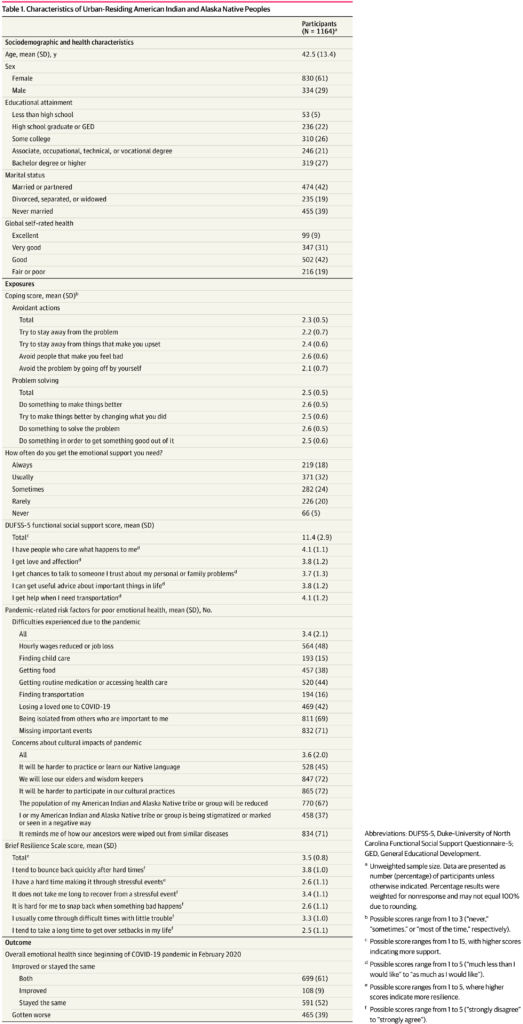
A total of 1164 participants were included in the analysis, with a mean (SD) age of 42.5 (13.4) years; 830 (61%, weighted sample percentage) were female. Since COVID-19 pandemic onset, 465 patients (39% weighted) reported worsened emotional health. Problem-solving coping mean (SD) utilization score was 2.5 (0.5), avoidant coping mean (SD) utilization score was 2.3 (0.5), mean (SD) functional social support score was 11.4 (2.9), and 219 participants (18% weighted) reported that emotional support was always available. Using problem-solving coping skills was associated with better emotional health (adjusted prevalence ratio [APR], 0.66 [95% CI, 0.54-0.81] for highest vs lowest tertile), as was always (vs never or rarely) getting emotional support (APR, 0.40; 95% CI, 0.30-0.55) and having more functional support (APR, 0.90 [95% CI, 0.87-0.92] per 1-unit increase in functional social support). In examination of psychological resilience potentially modifying primary exposure associations, no interactions were statistically significant.
Conclusions and Relevance
In this cross-sectional study of urban American Indian and Alaska Native peoples, problem-solving coping skills and more social support were associated with better emotional health during the COVID-19 pandemic. These findings can be used to identify strengths-based approaches to support community emotional health during social upheavals.
The COVID-19 pandemic placed a burden on the physical and emotional well-being of all people, including American Indian and Alaska Native communities. This highlighted protective factors, such as American Indian and Alaska Native community public health achievements, with some of the highest COVID-19 vaccination rates in the US.1 American Indian and Alaska Native strengths-based approaches warrant evaluation, as they attenuated the confluence of COVID-19 and emotional health disparities.2–7 The authors of this study acknowledge further considerations for research partnered with American Indian and Alaska Native peoples, including intergenerational implications of assimilation, boarding schools, cultural suppression, and limited access to health care.8,9 Early in the pandemic, elevated COVID-19 incidence, morbidity, and mortality rates were elevated in American Indian and Alaska Native peoples.10,11 Prior work revealed worsened emotional health in 46% of American Indian and Alaska Native peoples that was associated with pandemic-related life disruptions and concern for cultural impacts.12 Emotional health disparities in American Indian and Alaska Native communities preceded the pandemic, with elevated prior-year and lifetime mental illness diagnoses and suicide rates.4,5,13 Despite known COVID-19 and emotional health disparities among American Indian and Alaska Native peoples, there is minimal research on mitigating detrimental outcomes, especially among the majority residing in urban areas.
Coping behaviors may be associated with improved emotional health in the face of pandemic stressors.14 The Transactional Theory of Stress and Coping informs the examination of coping, resilience, and well-being during the COVID-19 pandemic.15,16 Steps include identifying a stressor, evaluating one’s resources, and adopting coping mechanisms. In problem-solving coping, one directly resolves or reduces a stressor by,17 for example, doing something to solve the problem.18 Avoidant coping minimizes focus on the stressor without resolution by,17 for example, trying to stay away or wishing that things were better.18 While neither approach is inherently best, problem-solving coping has been associated with mitigated risk of depression and posttraumatic stress disorder.19 To our knowledge, problem-solving and avoidant coping benefits have not been established in American Indian and Alaska Native peoples’ COVID-19 pandemic experiences.20
In addition to individual behavior, social connectedness may be associated with improved emotional health.21,22 In American Indian and Alaska Native communities, social support is associated with youth resilience23 and reduced depression in adults24,25 through cultural values.26 A prior study of urban American Indian and Alaska Native peoples revealed that COVID-19–related life impacts and concern for cultural impacts were associated with worsened emotional health.12 In the present study, these factors were compared with potential protective factors, coping behaviors, and social support.
The aim of this study was to describe coping behaviors and social supports among urban American Indian and Alaska Native peoples during the COVID-19 pandemic and examine associations with emotional health. Drawing on a cross-sectional survey of American Indian and Alaska Native patients seen at 6 large health organizations that serve urban-residing people, this study hypothesized that problem-focused coping and greater social support would be associated with better emotional health during the pandemic.
Community Organizations for Natives: COVID-19 Epidemiology, Research, Testing, and Services (CONCERTS) was a cross-sectional study designed to identify and remove barriers to COVID-19 testing among urban-residing American Indian and Alaska Native peoples and to address COVID-19 health disparities; study details are described elsewhere.12 In partnership with 6 health organizations serving primarily urban-residing American Indian and Alaska Native peoples, the CONCERTS team constructed cross-sectional surveys to identify barriers, facilitators, and attitudes related to COVID-19 testing and vaccination. These organizations provide a range of services, including health promotion, outreach, medical, behavioral, and dental health care to patients in Albuquerque, New Mexico; Anchorage, Alaska; Denver, Colorado; Minneapolis–St. Paul, Minnesota; Salt Lake City, Utah; and Wichita, Kansas. This study was approved by the Washington State University institutional review board, local review boards of the participating clinics, and the Indian Health Service national institutional review board. This study followed the Strengthening the Reporting of Observational Studies in Epidemiology (STROBE) reporting guideline for cross-sectional studies whenever able. Participants provided written informed consent.
Patients eligible for study inclusion were seen at any of the 6 clinics in the year prior to enrollment and survey completion (November 2021 to May 2022), were at least 18 years of age, were American Indian or Alaska Native, and did not have a diagnosis of dementia or serious cognitive illness. To ensure adequate enrollment of older adults, sampling was stratified by age (18-54 vs ≥55 years). Participant race was concordant between self-reported and clinic-identified American Indian or Alaska Native identity; further racial or ethnic subcategories were not available. For random sampling, each clinic generated a list of eligible patients from their electronic health records. Patients were invited to participate by their clinic; those with an email address were sent an invitation to participate with informed consent documentation and a link to an online REDCap survey, and those without an email address received physical mail. Up to 4 contact attempts were made over 14 days. Patients individually completed the survey via self-report and were compensated $100. There was a minimum goal of 150 patient participants per clinic, and all received a full study description. CONCERTS study size was determined by balancing feasibility of recruitment and maximizing power for a range of possible outcomes in CONCERTS substudies.
Survey Development and Measures
The survey was designed to collect information about sociodemographic characteristics, health conditions, social determinants of health, access to care, pandemic effects on health and quality of life, attitudes toward COVID-19, and receipt of and barriers to COVID-19 testing and vaccination. Survey questions were developed based on the National Institutes of Health RADx-UP Common Data Elements and PhenX Toolkit, and when necessary, questions were modified for cultural appropriateness or to better reflect study aims. Staff at each clinic provided feedback on the appropriateness, comprehensibility, community priority, and relevance of survey questions to their populations.
The primary outcome was self-reported change in emotional health since the pandemic started in February 2020, described as the same, better, or worse. Consistent with prior CONCERTS work and highlighting the relative positive outcome of maintaining emotional health during the pandemic, groups reporting worsened emotional health were compared with a group of those with the same or better emotional health as reference.12 Coping was operationalized in 2 measures, avoidant and problem-solving coping, adapted from the Ayers coping scale subscales,17,18 which have been previously used in American Indian and Alaska Native population studies.27,28 Mean summary scores for avoidant and problem-solving domains, ranging from 1 to 3 (use of the strategy “never,” “sometimes,” or “most of the time,” respectively), were categorized approximately into tertiles based on the sample distribution. Tertiles were used to allow for nonlinear associations. Functional social support was assessed using the mean response to 5 questions in the Duke–University of North Carolina Functional Social Support Questionnaire–5 (DUFSS-5),29 with possible scores ranging from 1 to 15 (higher scores indicate more support). Emotional social support was reported in terms of a 5-point, Likert-type scale of frequency ranging from “never” to “always.” Pandemic-related risk factors for poor emotional health identified from an earlier CONCERTS publication were included comparatively with protective factors.12 COVID-19 life disruption was assessed with a count of 8 possible impacts endorsed; quartiles were constructed for groups with 0 to 1, 2 to 3, 4 to 5, or 6 to 8 endorsed impacts. Concern for cultural impacts was assessed using a count of the number of 6 possible impacts endorsed. These questions addressed potential difficulties practicing or losses of Native languages, loss of elders and wisdom keepers, diminished participation in cultural practices, loss of tribal population, stigma, and similarity to historical illnesses. Covariates included age, sex, marital status (married or partnered; divorced, separated, or widowed; or never married), educational attainment, and global self-rated assessment of health (4-point Likert scale: “poor to fair,” “good,” “very good,” or “excellent”). Sex (male, female) was more consistently reported than gender, and a review of responses indicated concordance when both were available. Psychological resilience was assessed as a potential modifier of associations and was constructed from patient-reported agreement on a 5-point scale adapted from the Brief Resilience Scale (higher scores indicate greater resilience).30 Based on the sample distribution, tertiles were created to indicate low, moderate, and high resilience (cut points, ≤3 or ≥4). Cronbach α was calculated to examine reliability of grouped items: problem-solving coping, α = 0.81; avoidant coping, α = 0.73; functional social support, α = 0.90; Brief Resilience Scale, α = 0.85.
Descriptive statistics were computed, including means, SDs, and frequencies. Poisson regression models were fit to estimate prevalence ratios (PRs) and 95% CIs. Separate Poisson regression models were estimated for the association of the coping and social support measures with emotional health. Two models were fit for each of the 4 exposures; the first examined unadjusted bivariate associations, and the second examined the association of each exposure variable adjusted for all sociodemographic variables, purposefully selected a priori, including sociodemographic and health variables: age, sex, educational attainment, marital status, and self-rated health.
Modification of associations was assessed by fitting the aforementioned adjusted models, including resilience and the product term for the primary exposures and resilience. Poisson models were selected to avoid biased estimates in logistic regression due to the nonrare outcomes.31 All analyses incorporated inverse probability weights to account for age-based sampling, nonresponse according to age and sex, and equal weighting for all 6 clinics to prevent disproportionate representation by larger populations. Two-sided P ≤ .05 was considered significant. Analyses were conducted with Stata, version 17.0 (StataCorp LLC).32
The patient populations of the included health care organizations ranged from 1269 to 25 043 people seen in 2019. Of 1450 patients in this study, 1164 (80%) had complete data and were included in the analysis, and following inverse probability weighting, the mean (SD) age was 42.5 (13.4) years. A total of 830 patients (61%, weighted sample percentage) were female and 334 (39% weighted) male, 319 (27% weighted) had an educational attainment of college degree or higher, 474 (42% weighted) were married or partnered, and 948 (82% weighted) reported global health as good or better (Table 1). The eTable in Supplement 1 describes characteristics of participants included and excluded from analysis. Most patients (699 [61% weighted]) reported that their emotional health improved or stayed the same since pandemic onset: improved, 108 (9% weighted); same, 591 (52% weighted); and worsened, 465 (39% weighted). Problem-solving coping behaviors were used slightly more frequently than avoidance, with mean (SD) scores of 2.5 (0.5) and 2.3 (0.5), respectively, of a 3.0 maximum score. Overall, 590 patients (50% weighted) reported usually or always having emotional social support, and 219 participants (18% weighted) reported that emotional support was always available. Functional social support was common, with a mean (SD) score of 11.4 (2.9) of 15.0 maximum. When examining previously described pandemic-related risk factors for poor emotional health, concerns about cultural impacts were reported in a mean (SD) of 3.6 (2.0) of 6.0 possible responses. Of 8 possible difficulties experienced due to the pandemic, the mean (SD) reported number was 3.4 (2.1) of 8.0. The mean (SD) Brief Resilience Scale score was 3.5 (0.8) of 5.
Coping and Social Support
In analyses adjusted for sociodemographic and health covariates, problem-solving coping behaviors were associated with better outcomes or lower prevalence of worsened emotional health (highest tertile: adjusted PR [APR], 0.66 [95% CI, 0.54-0.81], with the lowest tertile as the reference) (Table 2). Avoidance coping behaviors had a nonlinear association in adjusted analysis, with a higher prevalence of worsened emotional health at moderate levels of avoidant actions (middle tertile: APR, 1.38 [95% CI, 1.13-1.68], with the lowest tertile as the reference) (Figure 1). Higher levels of emotional social support were associated with lower prevalence of worsened emotional health (“always”: APR, 0.40 [95% CI, 0.30-0.55], with “never or rarely” as the reference). Higher levels of functional social support were associated with lower prevalence of worsened emotional health (APR, 0.90 [95% CI, 0.87-0.92] per 1-unit increase in functional social support).
Pandemic-Related Risk Factors
Previously identified risk factors for poor pandemic emotional health had detrimental associations with mental health in this cohort. Higher prevalence of worsened emotional health was found with more difficulties experienced (most vs least: APR, 3.40; 95% CI, 2.37-4.88) and more concerns about pandemic cultural impacts (APR, 1.11 [95% CI, 1.06-1.16] per 1-unit increase in number of concerns).
Psychological Resilience Modification Analysis
In adjusted models with an interaction term for resilience, no modification of the primary exposure association was revealed (Table 3). As shown in Figure 2, the subgroup with low resilience had the worst rates of emotional health in most categories regardless of primary exposure responses; 230 of the 384 reporting low resilience (60%) also endorsed worsened emotional health (Figure 2, adjusted estimates). Modification of associations by resilience for concerns about cultural impacts of the pandemic was found, with only low resilience not having a significant association with cultural concerns (APR, 1.03; 95% CI, 0.97-1.09) (Table 3).
In this cross-sectional study among urban-residing American Indian and Alaska Native peoples receiving health care at 6 urban health organizations, participants reported using problem-solving coping behaviors more often than avoidance, and only the former had associations with better emotional health. Greater levels of emotional and functional social support were associated with better emotional health. These associations were presented in comparison with known factors of pandemic-related stressors and concern for cultural impacts associated with worsened emotional health during the pandemic.12
Higher utilization of problem-solving but not avoidance coping behaviors was associated with better emotional health. In a different population of American Indian and Alaska Native peoples, problem-focused coping techniques were common during the COVID-19 pandemic.33 In a study of US individuals during the early pandemic, emotion regulation skills, problem solving, and distraction coping were associated with lower depression, anxiety, and stress.34 Positive reframing and problem-solving coping during the pandemic have been associated with lower levels of depression.35 Resilience, adaptive coping, and social support have all been shown as important for mitigating the association of the pandemic with developing acute stress disorder.36 Neither avoidant nor problem-solving coping behaviors are inherently good or bad, but they are situation dependent. This study interpreted problem-solving and avoidant coping through the lens of the COVID-19 pandemic; these forms of coping are not mutually exclusive, and flexibility in use and a wider range of coping skills warrant further study.
Emotional and functional social support were associated with better emotional health outcomes. Social support is an important factor in coping with stress, as reaffirmed in context of the COVID-19 pandemic.36,37 Although emotional support may directly benefit emotional health, functional support is critical in alleviating daily barriers to care, including obtaining transportation, child care, food, and necessities.38 In a study of older American Indian adults, individuals with more social support reported fewer depressive symptoms.24 The COVID-19 pandemic has led to social isolation and related distress39; this study reaffirms the importance of social support and mobilization of American Indian and Alaska Native community strengths to improve health outcomes.
A prior CONCERTS survey of American Indian and Alaska Native peoples spanning January to May 2021 revealed life disruptions during the pandemic, and concern for cultural impacts was associated with worsened emotional health.12 After accounting for such measures, having COVID-19 was not associated with changes in emotional health.12 Although drawn from the same clinic populations, CONCERTS is not longitudinal, and patients in the 2 surveys differed. Over time, people may have adapted to changes engendered by the pandemic, although these risk factors remain. Problem-solving coping and social support hold promise for mitigating negative associations.
Psychological resilience modification analyses were performed to examine the complex dynamic among coping, social support, and emotional health. Degree of resilience did not modify protective associations of coping or social support. Resilience has been considered as either a personality trait or a dynamic state, with some disagreement in the literature.40 The coping survey questions captured dynamic behaviors, whereas the Brief Resilience Scale describes general traits. Resilience in this study may reflect an overall response to adversity, with coping behaviors as actualized efforts; the 2 may function independently. Regardless of coping or social support, 60% of the subgroup with low resilience reported worsened emotional health; those endorsing higher levels of resilience had better emotional health. Similarly, 1 study found that resilience may mitigate pandemic-related associations with posttraumatic stress disorder symptoms.41
Resilience training can protect an individual from trauma-related disruptions of emotional health.42 Mindfulness and relaxation activities, self-care behaviors, and connecting with social support have been deployed by health care organizations during the pandemic, with beneficial associations.43 A study describing psychological first aid highlighted themes for best practices pertinent to health care workers serving American Indian and Alaska Native communities. Examples include strengths-based approaches and language, acknowledgment of the historical influence of pandemics, accommodating differences between urban and rural communities, and promoting connectedness to ameliorate social and cultural isolation.44
A statistically significant modification by resilience of the association with concerns about cultural impacts of the pandemic was observed; paradoxically, patients reporting low resilience were the only group with no association between cultural concerns and emotional health. Because resilience is conceptually nuanced and heterogeneous in the literature,40 interstudy comparison is challenging. There is a literature gap in the study of pandemic impacts, with minimal examination of culture relevant to American Indian and Alaska Native communities, limiting generalizability. American Indian and Alaska Native community resilience acknowledges a collective nature to resilience, with group strengths and interpersonal relationships influencing individual resilience45; this study’s resilience measure did not integrate social domains. Furthermore, subgroup analysis of a categorical Brief Resilience Scale measure introduced smaller sample sizes and the possibility of statistical artifact. Because the subgroup that reported less resilience had a higher prevalence of worse emotional health and resilience did not modify associations with pandemic life disruptions, this subgroup may prioritize immediate life impacts over potential impacts to culture. Nuances of the interface between resilience and pandemic cultural concerns warrant further exploration.
The cross-sectional survey design of this study includes limitations not permitting causal attribution; however, the outcome was phrased to imply temporality to now vs before the COVID-19 pandemic. Emotional health, coping, and social support are dynamic, and the survey represents a snapshot of health. Patient-reported change in emotional health carries significance for communities but is not equivalent to nuanced measures of mental health or a substitute for a clinical examination. Individuals experiencing barriers to care may have been less likely to participate, and those seeking care during or immediately preceding the pandemic may have characteristics dissimilar to those in a different period. Coping behaviors likely have evolved during the pandemic and therefore are best examined in a longitudinal design. Additionally, cross-sectional outcome-exposure associations could have reverse causal directionality. Individuals with worsened emotional health may experience recall bias and view coping behaviors and social support negatively. While the sample size was robust for a study of American Indian and Alaska Native peoples (N = 1164), it may have limited power to detect findings, such as null findings in the modification analysis. Generalizability should be carefully considered given substantial diversity among tribal populations and urban and rural differences. In addition, the response rate in this survey was relatively low, raising the possibility of selection bias.
In this cross-sectional study of urban-residing American Indian and Alaska Native peoples, problem-solving coping behaviors and more social support were associated with better emotional health during the COVID-19 pandemic. Previously described detrimental associations of emotional health with pandemic life disruptions and concern for cultural impacts persisted,12 although the prevalence of worsened emotional health decreased relative to the earlier study. These results highlight the importance of interventions to bolster beneficial coping behaviors and draw on American Indian and Alaska Native community strengths and social support to improve emotional health during the COVID-19 pandemic.
Accepted for Publication: September 30, 2024.
Published: November 22, 2024. doi:10.1001/jamanetworkopen.2024.46901
Open Access: This is an open access article distributed under the terms of the CC-BY License. © 2024 Haskins C et al. JAMA Network Open.
Corresponding Author: Cole Haskins, MD, PhD, Department of Behavioral Health Services, Denver Health Medical Center, 777 Bannock St, Pavilion A Mail Code 0116, Denver, CO 80204 (Cole.Haskins@cuanschutz.edu).
Author Contributions: Dr Haskins and Ms Noonan had full access to all of the data in the study and take responsibility for the integrity of the data and the accuracy of the data analysis.
Concept and design: Haskins, MacLehose, Manson.
Acquisition, analysis, or interpretation of data: All authors.
Drafting of the manuscript: Haskins, Noonan, Collier, Manson.
Critical review of the manuscript for important intellectual content: Haskins, Collier, MacLehose, Buchwald, Manson.
Statistical analysis: Haskins, Noonan.
Obtained funding: MacLehose, Buchwald, Manson.
Administrative, technical, or material support: Collier, Buchwald, Manson.
Supervision: Haskins, Buchwald, Manson.
Conflict of Interest Disclosures: Dr Haskins reported receiving grants from the National Institutes of Health (NIH) as a member of the Pathways Resident Research Track, Department of Psychiatry, University of Colorado School of Medicine, during residency training. Dr Buchwald reported receiving grants for COVID-19 research from the NIH to Washington State University during the conduct of the study. Dr Manson reported receiving grants from the NIH during the conduct of the study. No other disclosures were reported.
Funding/Support: Research reported in this Rapid Acceleration of Diagnostics–Underserved Populations (RADx-UP) publication was supported by award number 3U54MD011240-06S1 from the NIH and by grant R25MH125758 from the National Institute of Mental Health, NIH.
Role of the Funder/Sponsor: The NIH initially reviewed proposed CONCERTS aims, including design and conduct of the study and collection and management of the data. The NIH did not directly influence analysis and interpretation of the data; preparation, review, or approval of the manuscript; or the decision to submit the manuscript for publication. Partnering community clinic research review boards were involved in review and approval of the manuscript.
Data Sharing Statement: See Supplement 2.
Additional Contributions: Community Organizations for Natives: COVID-19 Epidemiology, Research, Testing, and Services (CONCERTS) would not have been possible without the extraordinary efforts of the clinic staff, administrators, practitioners, and patients from each of the partnering urban health organizations. We are extremely grateful for their hard work and commitment to CONCERTS. The CONCERTS Collaborative included Dedra Buchwald, MD; Richard MacLehose, PhD; Spero Manson, PhD; Odile Madesclaire, MPH; Katie Nelson, MS; Austin Henderson, PhD; Carolyn Noonan, MS; Talia Quandelacey, PhD; the Southcentral Foundation; Denver Indian Health and Family Services; the Indian Health Board of Minneapolis; First Nations Community Healthsource; the Hunter Health Clinic; and the Urban Indian Center of Salt Lake. Drs Buchwald, MacLehose, and Manson received funding as co–principal investigators of award 3U54MD011240-06S1 from the NIH; no additional or external compensation was received.
J, Manson
SM, Whitesell
NR,
et al. Prevalence of major depressive episode in two American Indian reservation populations: unexpected findings with a structured interview. Am J Psychiatry. 2005;162(9):1713-1722. doi:10.1176/appi.ajp.162.9.1713 PubMedGoogle ScholarCrossref
J, Novins
DK, Whitesell
NR, Spicer
P, Mitchell
CM, Manson
SM. Prevalence of mental disorders and utilization of mental health services in two American Indian reservation populations: mental health disparities in a national context. Am J Psychiatry. 2005;162(9):1723-1732. doi:10.1176/appi.ajp.162.9.1723 PubMedGoogle ScholarCrossref
MYH, Lewis-Fernández
R, Beals
J,
et al. Psychiatric disorders and mental health treatment in American Indians and Alaska Natives: results of the National Epidemiologic Survey on Alcohol and Related Conditions. Soc Psychiatry Psychiatr Epidemiol. 2016;51(7):1033-1046. doi:10.1007/s00127-016-1225-4 PubMedGoogle ScholarCrossref
NR, Beals
J, Crow
CB, Mitchell
CM, Novins
DK. Epidemiology and etiology of substance use among American Indians and Alaska Natives: risk, protection, and implications for prevention. Am J Drug Alcohol Abuse. 2012;38(5):376-382. doi:10.3109/00952990.2012.694527 PubMedGoogle ScholarCrossref
MC, Gonzalez
VM, Gameon
JA,
et al. Health disparities research with American Indian communities: the importance of trust and transparency. Am J Community Psychol. 2020;66(3-4):302-313. doi:10.1002/ajcp.12445PubMedGoogle ScholarCrossref
J, Masiello
MM, Joshi
S,
et al. COVID-19 mortality among American Indian and Alaska Native persons—14 states, January–June 2020. MMWR Morb Mortal Wkly Rep. 2020;69(49):1853-1856. doi:10.15585/mmwr.mm6949a3 PubMedGoogle ScholarCrossref
C, Noonan
C, MacLehose
R, Buchwald
D, Manson
SM. COVID-19 pandemic effects on emotional health and substance use among urban American Indian and Alaska Native people. J Psychosom Res. 2023;172(111424):111424. doi:10.1016/j.jpsychores.2023.111424 PubMedGoogle ScholarCrossref
S, Sharma
A. Resilience and psychological well-being of higher education students during COVID-19: the mediating role of perceived distress. J Health Manag. 2020;22(4):606-617. doi:10.1177/0972063420983111 Google ScholarCrossref
Ayers TS, Sandler IN, West SG, Roosa MW. Children’s Coping Strategies Checklist (CCSC, CCSC-R1) [database record]. APA PsycTests; 1991.
CL, Finkelstein-Fox
L, Russell
BS, Fendrich
M, Hutchison
M, Becker
J. Psychological resilience early in the COVID-19 pandemic: stressors, resources, and coping strategies in a national sample of Americans. Am Psychol. 2021;76(5):715-728. doi:10.1037/amp0000813 PubMedGoogle ScholarCrossref
AK, Cruwys
T, Barlow
FK, Stronge
S, Sibley
CG. Social connectedness improves public mental health: investigating bidirectional relationships in the New Zealand attitudes and values survey. Aust N Z J Psychiatry. 2018;52(4):365-374. doi:10.1177/0004867417723990 PubMedGoogle ScholarCrossref
A, Afzali
MH, Chapman
C, Sunderland
M, Slade
T. The relationship between social support networks and depression in the 2007 National Survey of Mental Health and Well-being. Soc Psychiatry Psychiatr Epidemiol. 2017;52(12):1463-1473. doi:10.1007/s00127-017-1440-7 PubMedGoogle ScholarCrossref
G, Romans
JS. Resilience among urban American Indian adolescents: exploration into the role of culture, self-esteem, subjective well-being, and social support. Am Indian Alsk Native Ment Health Res. 2012;19(2):1-19. doi:10.5820/aian.1902.2012.1 PubMedGoogle ScholarCrossref
S, Burnette
CE, Lee
KH, Lee
YS, Easton
SD, Lawler
MJ. Risk and protective factors for depressive symptoms among American Indian older adults: adverse childhood experiences and social support. Aging Ment Health. 2015;19(4):371-380. doi:10.1080/13607863.2014.938603 PubMedGoogle ScholarCrossref
LB, McMorris
BJ, Hoyt
DR, Stubben
JD, Lafromboise
T. Perceived discrimination, traditional practices, and depressive symptoms among American Indians in the upper Midwest. J Health Soc Behav. 2002;43(4):400-418. doi:10.2307/3090234 PubMedGoogle ScholarCrossref
R, Kolva
E, Rosenfeld
B, Breitbart
W. Measuring social support in patients with advanced medical illnesses: an analysis of the Duke-UNC Functional Social Support Questionnaire. Palliat Support Care. 2015;13(5):1153-1163. doi:10.1017/S1478951514000996 PubMedGoogle ScholarCrossref
Stata Statistical Software. Release 17. StataCorp LLC; 2021.
T, Adlam
JE, Murphy-Belcaster
M,
et al. Stress and coping among American Indian and Alaska Natives in the age of COVID-19. Am Indian Cult Res J. 2020;44(2):49-70. doi:10.17953/AICRJ.44.2.BURTON Google ScholarCrossref
CL, Finkelstein-Fox
L, Russell
BS, Fendrich
M, Hutchison
M, Becker
J. Americans’ distress early in the COVID-19 pandemic: protective resources and coping strategies. Psychol Trauma. 2021;13(4):422-431. doi:10.1037/tra0000931 PubMedGoogle ScholarCrossref
L, MacDonald
B, Rollins
L,
et al. Sharing positive behavior change made during COVID-19 lockdown: a mixed-methods coproduction study. Health Psychol. 2021;40(10):655-665. doi:10.1037/hea0001130 PubMedGoogle ScholarCrossref
Z, Yang
X, Zeng
C,
et al. Resilience, social support, and coping as mediators between COVID-19-related stressful experiences and acute stress disorder among college students in China. Appl Psychol Health Well Being. 2020;12(4):1074-1094. doi:10.1111/aphw.12211 PubMedGoogle ScholarCrossref
TC, Caleon
IS, Shaik Kadir
MB, Chua
J, Ilham
NQ. Navigating challenges during COVID-19 pandemic: experiences and coping strategies of Singapore students. Educational and Developmental Psychologist. 2022;40(1):63-73. doi:10.1080/20590776.2022.2079405Google ScholarCrossref
SE, Bountress
KE, Denckla
CA, Vassileva
J, Dick
DM, Amstadter
AB; Spit for Science Working Group. A longitudinal investigation of resilience as a protective factor during the COVID-19 pandemic. Traumatology (Tallahass Fla). 2022;28(3):403-410. doi:10.1037/trm0000397 PubMedGoogle ScholarCrossref
F, Uys
M, Bezuidenhout
D, Mullane
SL, Bristol
C. Improving healthcare worker resilience and well-being during COVID-19 using a self-directed e-learning intervention. Front Psychol. 2021;12:748133. doi:10.3389/fpsyg.2021.748133 PubMedGoogle ScholarCrossref
F, Maudrie
TL, Neuner
S,
et al. Development and cultural adaptation of psychological first aid for COVID-19 frontline workers in American Indian/Alaska Native communities. J Prev (2022). 2022;43(5):697-717. doi:10.1007/s10935-022-00695-y PubMedGoogle ScholarCrossref
NI, Tippens
JA, McCrary
HC, Ehiri
JE, Sanderson
PR. Resilience in American Indian and Alaska Native public health: an underexplored framework. Am J Health Promot. 2018;32(2):274-281. doi:10.1177/0890117116664708 PubMedGoogle ScholarCrossref
[ad_2]
Source link
Trending Topics

Features
- Drive Toolkit
Download and distribute powerful vaccination QI resources for your community.
- Health Champions
Sign up now to support health equity and sustainable health outcomes in your community.
- Cancer Early Detection
MCED tests use a simple blood draw to screen for many kinds of cancer at once.
- PR
FYHN is a bridge connecting health information providers to BIPOC communities in a trusted environment.
- Medicare
Discover an honest look at our Medicare system.
- Alliance for Representative Clinical Trials
ARC was launched to create a network of community clinicians to diversify and bring clinical trials to communities of color and other communities that have been underrepresented.
- Reducing Patient Risk
The single most important purpose of our healthcare system is to reduce patient risk for an acute event.
- Jessica Wilson
- Subash Kafle