












- By FYH News Team
[ad_1]
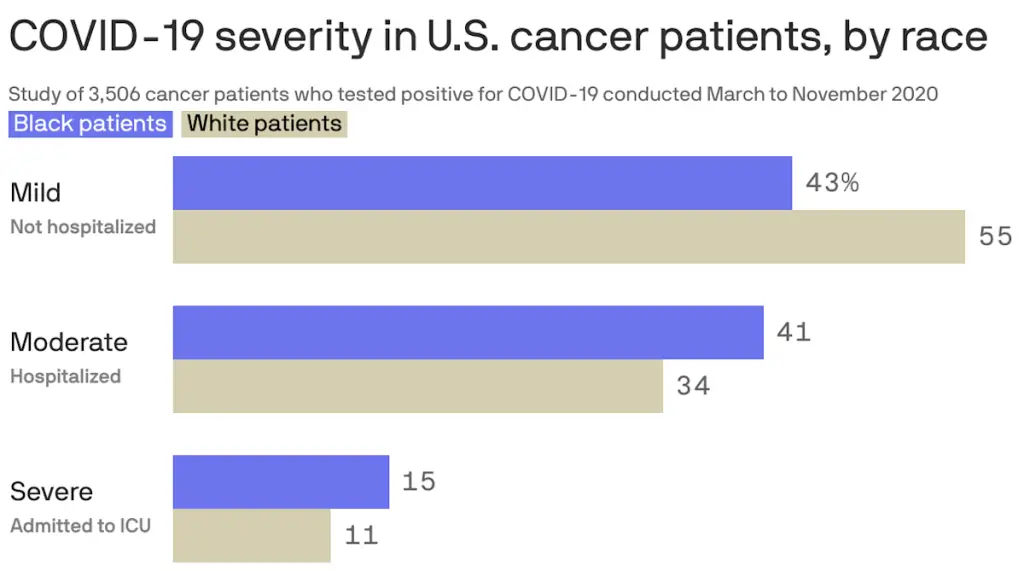
Data: Fu, et al., 2022, “Racial Disparities in COVID-19 Outcomes Among Black and White Patients With Cancer“; Chart: Kavya Beheraj/Axios
Health disparities among cancer patients — a known ongoing issue in America — were exacerbated by the COVID pandemic.
The latest: A study out earlier this week of 3,506 cancer patients shows “significantly higher COVID-19 severity” among African American than white cancer patients, bolstering similar findings from an earlier 2020 study of 73.4 million electronic health records.
Stay on top of the latest market trends and economic insights with Axios Markets. Subscribe for free
-
Black cancer patients also experienced delays in radiotherapy sessions and in access to novel anti-COVID therapies like remdesivir — instead often receiving hydroxychloroquine, later found to be ineffective.
-
“Unfortunately, if these same racial inequities in access to medical care hold for cancer screening, in the near future, we are likely to see worsening disparities in rates of advanced stage cancers at diagnosis,” the co-authors wrote.
Between the lines: Many factors play a role in why people of different racial and ethnic backgrounds face disparities in the diagnosis and treatment of cancers. They can be affected by differences in income, access to health care, diet, environment, and genetics.
Genetics may play a large role, but that’s not the only driver of the differences.
-
For example, hepatitis C, which can lead to liver cancer, was rising in multiple populations. Once an effective treatment was released, liver cancers dropped for those populations who could afford it, Marcia Cruz-Correa, physician-scientist at the University of Puerto Rico Comprehensive Cancer Center, tells Axios.
-
But “once we started to realize there was a disproportional access for one group of people versus the other, then health policy came into place” as Medicare, Medicaid and other insurance systems started to cover the expensive hepatitis C drug.
-
That helped alleviate the disparity in the Hispanic community, said Cruz-Correa, who also is a member of the American Association for Cancer Research board of directors.
“A large problem is that on average less than 5% of clinical trial participants are from a diverse population,” Cruz-Correa says.
-
For diseases that have a higher prevalence in certain populations, there should be an FDA policy to require participant representation of at least that level of proportion in the trial participants, Cruz-Correa says.
-
“It’s not an accident that those same populations who are underrepresented in these studies are also from many of the groups with the worst outcomes,” says William Oh, an oncologist and chief medical science officer at Sema4, a health intelligence company.
-
Sema4 aims to enroll 5,000 advanced-stage cancer patients from diverse populations in comprehensive genetic and genomic testing.
What’s next: Besides improving representation in trials, students of color need to be enticed to health care, and diverse populations should be targeted in the collection of Big Data that informs therapeutic and other research, says Karriem Watson, chief engagement officer of NIH’s All of Us research program.
-
The All of Us research program is collecting health data from 1 million participants, primarily from underrepresented backgrounds, because “representation matters when you think about genomics and precision medicine,” Watson says.
Go deeper:
More from Axios: Sign up to get the latest market trends with Axios Markets. Subscribe for free
[ad_2]
Source link
Trending Topics
Features
- Drive Toolkit
Download and distribute powerful vaccination QI resources for your community.
- Health Champions
Sign up now to support health equity and sustainable health outcomes in your community.
- Cancer Early Detection
MCED tests use a simple blood draw to screen for many kinds of cancer at once.
- PR
FYHN is a bridge connecting health information providers to BIPOC communities in a trusted environment.
- Medicare
Discover an honest look at our Medicare system.
- Alliance for Representative Clinical Trials
ARC was launched to create a network of community clinicians to diversify and bring clinical trials to communities of color and other communities that have been underrepresented.
- Reducing Patient Risk
The single most important purpose of our healthcare system is to reduce patient risk for an acute event.
- Victor Mejia
- Jessica Wilson
- Trish Tabor