
Abstract and Introduction
Introduction
Breast cancer is commonly diagnosed among women, accounting for approximately 30% of all cancer cases reported among women.* A slight annual increase in breast cancer incidence occurred in the United States during 2013–2017.[1] To examine trends in breast cancer incidence among women aged ≥20 years by race/ethnicity and age, CDC analyzed data from U.S. Cancer Statistics (USCS) during 1999–2018. Overall, breast cancer incidence rates among women decreased an average of 0.3% per year, decreasing 2.1% per year during 1999–2004 and increasing 0.3% per year during 2004–2018. Incidence increased among non-Hispanic Asian or Pacific Islander women and women aged 20–39 years and decreased among non-Hispanic White women and women aged 50–64 and ≥75 years. The U.S. Preventive Services Task Force currently recommends biennial screening mammography for women aged 50–74 years.[2] These findings suggest that women aged 20–49 years might benefit from discussing potential breast cancer risk and ways to reduce risk with their health care providers. Further examination of breast cancer trends by demographic characteristics might help tailor breast cancer prevention and control programs to address state- or county-level incidence rates† and help prevent health disparities.
USCS includes incidence data from central cancer registries reporting to CDC’s National Program of Cancer Registries and National Cancer Institute’s Surveillance, Epidemiology, and End Results (SEER) Program.§ All malignant cases of breast cancer¶ diagnosed in women during 1999–2018 were selected from registries with high quality data covering 97% of the U.S. population.** Trends in breast cancer incidence per 100,000 U.S. 2000 standard population were examined for women aged ≥20 years by race/ethnicity for five mutually exclusive groups (non-Hispanic American Indian or Alaska Native, non-Hispanic Asian or Pacific Islander, non-Hispanic Black, Hispanic, and non-Hispanic White) and age group (20–39, 40–49, 50–64, 65–74, and ≥75 years). Annual percent change (APC) and average annual percent change (AAPC) in incidence were estimated using joinpoint regression, with a maximum of three joinpoints (up to four-line segments) allowed.†† Two-sided statistically significant differences from zero were determined using a t-test for APCs and AAPCs from linear regressions with zero joinpoints and a z-test for AAPCs from linear regressions with one or more joinpoints. APC and AAPC were considered to be >0 or <0 if p<0.05, otherwise, rates were considered stable. Incidence rates were calculated with SEER*Stat software (version 8.3.8; National Cancer Institute) and APC and AAPC were calculated in Joinpoint software (version 4.6.00; National Cancer Institute).§§ This activity was reviewed by CDC and was conducted consistent with applicable federal law and CDC policy.¶¶
During 1999–2018, breast cancer incidence among women aged ≥20 years decreased an average of 0.3% per year, decreasing 2.1% per year during 1999–2004 and increasing 0.3% per year during 2004–2018 (Table). Incidence trends varied by racial and ethnic group (Figure 1). Incidence among non-Hispanic White women, among whom rates were highest, decreased an average of 0.3% per year from 198.0 to 186.5 per 100,000 population, decreasing 2.3% per year during 1999–2004 and increasing 0.4% per year during 2004–2018. Incidence among non-Hispanic Black women did not change significantly during 1999–2018. Incidence among Hispanic women decreased an average of 1.6% per year during 1999–2004, then increased an average of 0.4% per year during 2004–2018. Incidence among non-Hispanic American Indian or Alaska Native women increased an average of 1.4% per year during 1999–2016 then stabilized during 2016–2018. Among non-Hispanic Asian or Pacific Islander women, incidence was stable during 1999–2005 and increased 1.4% per year during 2005–2018, increasing an average of 0.8% per year during 1999–2018.
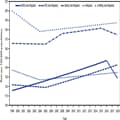
Figure 1.
Trends* in breast cancer incidence† among women aged ≥20 years, by race/ethnicity§,¶ — United States, 1999–2018
Abbreviations: AAPC = average annual percent change; AI/AN = American Indian or Alaska Native; A/PI = Asian or Pacific Islander.
*Trends were estimated using joinpoint regression, with a maximum of three joinpoints (up to four-line segments) allowed; the year at which slopes changed could vary by age and race/ethnicity. Data displayed are the modeled age-adjusted rates.
†Cancer incidence data were compiled from cancer registries that meet U.S. Cancer Statistics data quality criteria (https://www.cdc.gov/cancer/npcr/standards.htm), covering 97% of the U.S. population.
§Mutually exclusive racial/ethnic groups are based on information about race/ethnicity that was collected separately and combined for this report. Race/ethnicity were grouped as non-Hispanic AI/AN, non-Hispanic A/PI, non-Hispanic Black, Hispanic, and non-Hispanic White. Hispanic persons can be any race. Data are not presented for those with unknown or other race or unknown ethnicity.
¶AAPC was significantly different from zero at the α = 0.05 level for non-Hispanic A/PI and non-Hispanic White persons.
Among women aged <50 years, breast cancer incidence increased 0.7% per year during 2010–2018 among those aged 20–39 years and 0.4% per year during 2002–2018 among those aged 40–49 years (Table). In contrast, incidence among women aged 50–64 years stabilized during 2005–2018 after decreasing 2.8% per year during 1999–2005. Incidence among women aged 65–74 years decreased 2.8% per year during 1999–2004, increased 1.5% per year during 2004–2013, then stabilized during 2013–2018. Incidence among women aged ≥75 years decreased 2.4% per year during 1999–2004, was stable during 2004–2009, then decreased 0.4% per year during 2009–2018.
Among women aged 20–39 and 40–49 years, incidence was stable among non-Hispanic Black and Hispanic women but increased for other racial and ethnic groups (Figure 2). Incidence among non-Hispanic White women aged 50–64 years decreased an average of 0.8% per year, the largest decrease among any race/ethnicity and age group. Incidence among non-Hispanic American Indian or Alaska Native women aged 40–49 years increased an average of 1.9% per year, the largest increase among any racial/ethnic and age group.
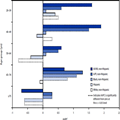
Figure 2.
Average annual percent change* in breast cancer incidence† among women aged ≥20 years by race/ethnicity§ and age group — United States, 1999–2018
Abbreviations: AAPC = average annual percent change; AI/AN = American Indian or Alaska Native; A/PI = Asian or Pacific Islander.
*AAPC is the weighted average of the annual percent change during 1999–2018. To determine whether AAPC was significantly different from zero, a t-test was used if the joinpoint regression model had zero joinpoints, and a z-test was used if the joinpoint regression model had ≥1 joinpoint.
†Cancer incidence data were compiled from cancer registries that meet U.S. Cancer Statistics data quality criteria (https://www.cdc.gov/cancer/npcr/standards.htm), covering 97% of the U.S. population.
§Mutually exclusive racial/ethnic groups are based on information about race/ethnicity that was collected separately and combined for this report. Race/ethnicity were grouped as non-Hispanic AI/AN, non-Hispanic A/PI, non-Hispanic Black, Hispanic, and non-Hispanic White. Hispanic persons can be any race. Data are not presented for those with unknown or other race or unknown ethnicity.