










- By FYH News Team
[ad_1]
Question
With the emergence of the COVID-19 pandemic, a catastrophic adverse event that has disproportionately impacted Black communities, layered on top of deep-rooted historical inequities (ie, syndemic), how has the postpartum mental health of Black birthing individuals been affected?
Findings
In this cohort study of 151 Black participants, perinatal syndemic exposure was associated with negative postpartum mental health outcomes. Specifically, more negative COVID-19 experiences and higher racism scores were associated with increased risk for postpartum depression and anxiety.
Meaning
Black birthing individuals already face significant challenges throughout the peripartum period, with adverse associations with mental health, which worsened during the COVID-19 pandemic.
Importance
The intersection of endemic structural racism and the global health crisis secondary to the COVID-19 pandemic represents a syndemic, defined as the aggregation of 2 or more endemic and epidemic conditions leading to adverse repercussions for health. Long-standing inequities have placed Black individuals at disproportionate risk for negative postpartum mental health outcomes. Studies are urgently needed to understand how the COVID-19 pandemic has added to this risk (eg, syndemic associations).
Objective
To examine the association between the syndemic and the postpartum mental health of Black birthing individuals.
Design, Setting, and Participants
A longitudinal cohort of Black birthing individuals were followed up from pregnancy (April 17 to July 8, 2020) through the early postpartum period (August 11, 2020, to March 2, 2021) from urban university medical center prenatal clinics. Pregnant Black participants were recruited via email and completed 2 online surveys.
Main Outcomes and Measures
Composite variables capturing negative experiences of the COVID-19 pandemic and racism (structural racism [general], structural racism [neighborhood], and interpersonal racism) were created. Logistic regressions examined main and interactive associations between these variables and postpartum depression (Edinburgh Postnatal Depression Scale) and anxiety (Generalized Anxiety Disorder 7-item scale).
Results
The mean (SD) age of 151 Black participants was 30.18 (5.65) years. The association between higher negative COVID-19 pandemic experiences and postpartum depression may be influenced by experiences of interpersonal racism and general systemic racism. Negative COVID-19 pandemic experiences were associated with greater likelihood of screening positive for depression only at higher levels of systemic racism (odds ratio, 2.52; 95% CI, 1.38-4.60) and interpersonal racism (odds ratio, 1.90; 95% CI, 1.04-3.48) but not at lower levels of systemic or interpersonal racism. Similarly, negative COVID-19 experiences were associated with anxiety only at higher levels of interpersonal racism (odds ratio, 1.85; 95% CI, 0.86-4.01) but not at lower levels of interpersonal racism. Overall, 44 (29%) met screening criteria for postpartum depression and 20 (13%) for postpartum anxiety.
Conclusions and Relevance
In this longitudinal cohort study of Black birthing individuals, the experience of the syndemic was associated with negative postpartum mental health. Associations between interpersonal racism, structural racism, and negative COVID-19 pandemic experiences were associated with greater risk for postpartum depression and anxiety. Research is needed to address how systemic racism perturbs biobehavioral pathways to magnify associations between acute stressors and mental health. Such research can inform the creation of effective, culturally informed preventive interventions to improve the postpartum mental health of Black individuals.
The COVID-19 pandemic has exposed our limited knowledge of how current experiences of acute adversity act in concert with long-standing disparities to affect mental health. In the US, the COVID-19 pandemic has disproportionately impacted Black communities,1 who have experienced higher rates of infection, morbidity and mortality,2,3 unemployment,4 housing and food insecurity,2 and adverse mental health outcomes.5,6 This crisis—the coupling of the COVID-19 pandemic and underlying racialized historical and social inequities—has been conceptualized as a syndemic, defined as the aggregation of 2 or more endemic and epidemic conditions leading to adverse repercussions for health.7–9 Specifically, researchers have leveraged the original syndemic framework by Singer10 to understand the health consequences arising from the COVID-19 pandemic exacerbating preexisting inequitable endemic factors.8,9,11 In leveraging this framework, we aimed to examine how the joint associations of structural and interpersonal racism (2 endemic conditions) and the COVID-19 pandemic (epidemic condition) contributed to postpartum anxiety and depression in Black individuals.
Before the COVID-19 pandemic, Black birthing individuals had documented disparate reproductive health experiences compared with non-Latinx White peers that are linked to racism,12 including obstetric racism (eg, beliefs and practices that harm the reproducing Black body),13 higher rates of untreated mental health disorders, including postpartum depression,14 and 3 times greater likelihood of perinatal complications15 and pregnancy-related mortality.16,17 During the COVID-19 pandemic, Black individuals have also faced particular difficulties, including more worry about COVID-19,18 food and job insecurity,4 challenges during pregnancy and postdelivery,19 and mental health adversity.20 Our data, collected early in the COVID-19 pandemic, showed that compared with non-Latinx White participants, pregnant Black participants reported higher rates of depression and anxiety. Black participants also endorsed more COVID-19–specific worries, including worries about giving birth and childcare.18 While studies have begun to explore the factors affecting birthing individuals during the COVID-19 pandemic,18,21 a paucity of evidence exists from studies that have used a syndemic framework7 to explore the intersection of race,21 racism, and COVID-1922 on the postpartum mental health of Black individuals.18,23,24
Historically, race has been confounded with racism, resulting in the use of phenotypic appearance as a major variable in illness and health.8 The context in which individuals live, work, and play has largely been ignored, resulting in failures to acknowledge that health disparities are secondary to endemic racist systems and barriers.25 Structural racism, defined as “practices that maintain or exacerbate unfair inequalities in power, resources or underlying systemic racist conditions,”26 is embedded within experiences of health care, housing, employment, and education.27 These experiences confer negative health consequences for Black individuals, which the COVID-19 pandemic has exacerbated. For example, in the 1930s, the Home Owners’ Loan Corporation (HOLC) created a systematic appraisal that graded neighborhoods based on quality of housing, proximity to industry, and characteristics of residents in the neighborhood.28 These grades commonly redlined Black communities, deeming them high-risk to mortgage lenders.29 Redlining created restrictive covenants where Black families could live, which undermined their ability to build wealth29–32 and left a persistent and quantifiable legacy of negative health effects.28,33 Additionally, interpersonal or personally mediated racism represents prejudiced assumptions assigned to an individual’s abilities, motives, aptitude, and intentions based solely on race.34 Interpersonal racism confers heightened states of psychological and physiological stress, which has been linked to poor health outcomes.35
The clinical care that Black individuals receive during pregnancy represents a vital determinant of long-term health and is susceptible to both structural and interpersonal racism.26,36,37 More broadly, pregnancy can be a vulnerable period for psychological well-being,38 and studies have established negative trajectories of mental health among parents during the COVID-19 pandemic.39 Thus, when considering the COVID-19 pandemic in the context of postpartum mental health in Black birthing individuals,40 it is imperative to understand how multiple types of racism are associated with negative experiences. We assessed Black participants from a prospective longitudinal study to explore how the syndemic was associated with postpartum mental health. Specifically, we developed multidimensional measures of racism and negative COVID-19 pandemic experiences during the peripartum period (eg, syndemic) and explored associations with risk for postpartum depression and anxiety.
This observational study followed Strengthening the Reporting of Observational Studies in Epidemiology (STROBE) reporting guideline41 and included Black participants from a longitudinal cohort study examining the perinatal period during the COVID-19 pandemic.18,23 Participants from all gestational ages who received prenatal care at 1 of 2 urban hospitals in the University of Pennsylvania Health System in Philadelphia were recruited by email, without exclusionary criteria. The study was approved by the university institutional review board. After obtaining written informed consent, participants completed an online REDCap survey about their experiences of the COVID-19 pandemic. Data were also collected on childbirth through electronic medical records and a follow-up online REDCap survey completed during the postpartum period. Participant race (African American/Black, Asian, Latina [not otherwise specified], Native Hawaiian/Pacific Islander, White, declined, other, and unknown) and ethnicity (Hispanic/Latina, non-Hispanic/non-Latina, declined, unknown) data were collected from the electronic medical records.
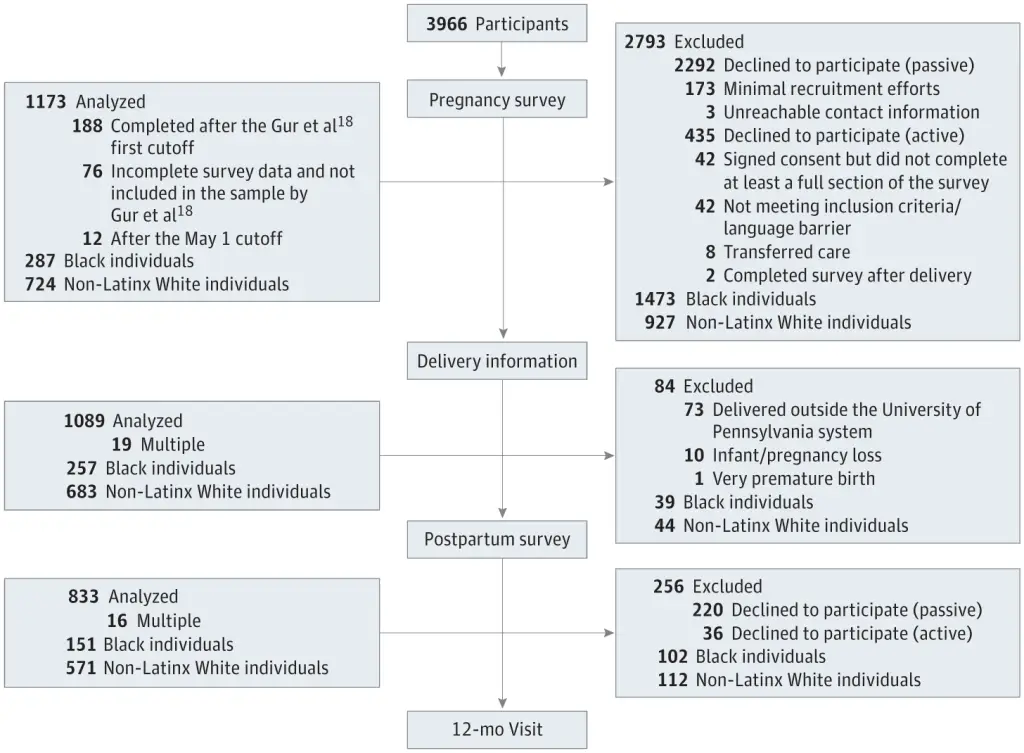
The pregnancy survey (mean [SD] gestational age, 25.3 [7.8] weeks) was completed during a statewide stay-at-home order, a period of high community spread of COVID-19 (April 17 to July 8, 2020). The postpartum survey (mean [SD] gestational age, 12.7 [5.5] weeks) was completed between August 11, 2020, and March 2, 2021. Participants completed each survey in about 20 minutes, although not all survey sections were completed by all participants. Figure 1 presents recruitment flowchart and attrition, and eTable 1 in the Supplement provides comparison of Black and non-Latinx White individuals, which were the 2 groups powered for further analysis owing to sample size. Participants received $25 gift cards for completing the postpartum survey.
COVID-19 Pandemic Variables
At both assessments, participants were asked about 3 COVID-19–related stressors: how the COVID-19 pandemic had affected their lives (eg, job loss, knew someone who had passed away from COVID-19 complications). Participants also completed 4 items assessing how the COVID-19 pandemic had impacted their birthing and postpartum experience (postpartum survey) and if they were worse off financially because of the pandemic (postpartum survey). Participants rated their worries about 6 general COVID-19 stressors42 (pregnancy and postpartum surveys) and 4 COVID-19 stressors specific to pregnancy (pregnancy survey) (eTable 2 in the Supplement).
Information from electronic medical records and participant report was used to assess income inequality (below vs above $20 000 annually), education (no college vs partial college graduate degree), insurance type (private vs public/Medicaid), relationship status (married/living with partner vs other),43 parity, and house ownership (own vs other). Additionally, a HOLC-informed Philadelphia measure of structural racism–based redlining was used based on prior digitized HOLC boundaries.44 Each participant received a risk grade from A (minimal) to D (hazardous) based on their street address.44 A census-based neighborhood socioeconomic status composite variable45 was also created using census-based geocoding of neighborhood-based variables (eg, percentage of residence in poverty, percentage married, percentage with <high school education, median family income) based on participant zip codes. Neighborhoods were blocked into census groups, generally containing 600 to 3000 persons.
Participants completed 2 scales: the 10-item Everyday Discrimination Scale46,47 and 6-item Major Experiences of Discrimination Scale.46,48
Prenatal and Postpartum Mental Health Measures
Prenatal anxiety was assessed using the Generalized Anxiety Disorder 7-item scale,49 and prenatal depression was assessed using the Patient Health Questionnaire 2.50 Postpartum anxiety was assessed using the Generalized Anxiety Disorder 7-item scale, and postpartum depression was assessed using a 9-item Edinburgh Postnatal Depression Scale.51,52 We removed item 10, which assesses self-harm, given the difficulty of monitoring self-harm endorsements in online surveys. Consistent with prior studies, we used clinical cutoffs of 10 or higher for postpartum depression52,53 and 11 or higher for postpartum anxiety.54
Data reduction techniques were used to create composites to capture experiences of the COVID-19 pandemic and racism. First, to create a summary score reflecting negative pandemic experiences, all COVID-19–related items (detailed above) were summed together. Variables were recoded such that 1 indicated negative experiences and 0 indicated absence/neutral COVID-19 experiences. For items rated on a Likert scale (eg, COVID-19 pandemic worries), endorsement of higher values (eg, moderate, a lot, a great deal) were recoded as 1, with other response options (eg, a little, not at all) coded as 0 (eTable 2 in the Supplement provides frequencies for each response option prior to creating binary scores). For other items (eg, positive COVID-19 test), a yes response was coded as 1 and no as 0. A composite factor was created by summing all items, with higher scores reflecting more negative COVID-19 pandemic experiences. Second, to capture the multidimensional experience of racism, all racism variables were subjected to Exploratory Factor Analysis55 in Mplus56 using the mean- and variance-adjusted weighted least squares (wlsmv) estimator57 and oblimin rotation. Items with fewer than 4 response categories (including binary items) were treated as ordinal in the analysis; all others were treated as continuous. Additionally, the number of factors (3) was determined by parallel analysis with Glorfeld correction58 at a 0.95 threshold using the ‘psych’ package in R version 2.1.3 (R Foundation).59
Next, a series of logistic regression analyses examined the associations of negative COVID-19 pandemic experiences and racism with postpartum depression and anxiety. In each regression model, data were entered in 3 blocks. Block 1 included maternal age, parity, gestational weeks at prenatal assessment, and weeks post partum at the postpartum survey. In block 2, we entered the negative COVID-19 pandemic experience and racism factors to examine their unique associations with postpartum outcomes. To reduce multicollinearity across the racism and COVID-19 pandemic factors, all factors were regressed out of each other. In block 3, we entered 2-way associations between the pandemic factor with each racism factor, which together represented syndemic measures. To probe significant interactions, logistic regressions were rerun at high and low levels of the racism factor scores (median split). Supplemental analyses examined (1) models only using the redlining measure (HOLC grades) and perceived discrimination as measures of racism, controlling for socioeconomic status and (2) models using only COVID-19 worries and the 3 racism variables. Cronbach α were acceptable for all scales (eTable 3 in the Supplement). Two-sided P values were significant at .05 or less.
A total of 151 Black participants (5 also identified as Latinx/Hispanic) were analyzed. The mean (SD) gestational age was 25.3 (7.8) weeks (range, 10-39 weeks).
Negative COVID-19 Pandemic Experiences
Table 1 presents summary statistics for variables that contributed to the negative COVID-19 pandemic experiences factor. For the 6 general COVID-19 worries, 87% (n = 132) of participants endorsed at least 1 significant worry (eg, ≥moderate) at the pregnancy assessment and 71% (n = 107) endorsed at least 1 significant worry at the postpartum survey. For pregnancy-related COVID-19 worries, 91% (n = 137) endorsed at least 1 significant worry. For delivery-related and postpartum-related pandemic worries, 81% (n = 121) endorsed at least a moderate concern for at least 1 item. The negative COVID-19 pandemic experiences factor (summing across all 27 pandemic-related variables) yielded a mean (SD) score of 14.1 (5.9) (skewness, –0.18; kurtosis, –0.89; range, 2-25; eFigure in the Supplement).
Systemic and Interpersonal Racism
Table 1 presents descriptive statistics for each of the racism variables. Two participants (1.3%) received a HOLC risk grade of A; 26 (17.2%), grade B; 38 (25.2%), grade C; and 51 (33.8%), grade D (Figure 2). HOLC grades were missing from 34 participants. The Exploratory Factor Analysis suggested the existence of 3 latent factors (eTable 4 in the Supplement): factor 1, systemic racism (general), captured individual-level systemic racism (income inequality, education, insurance); factor 2, systemic racism (neighborhood), reflected broader neighborhood level systemic racism (HOLC grades, neighborhood socioeconomic status, relationship status); and factor 3, interpersonal racism, captured perceived discrimination (Major Experiences of Discrimination Scale and Everyday Discrimination Scale scores).
The Syndemic and Postpartum Depression
Overall, 44 participants (29%) screened positive for postpartum depression. Logistic regression revealed that more negative COVID-19 pandemic experiences (odds ratio [OR], 1.88; 95% CI, 1.22-2.88) and higher interpersonal racism (OR, 1.60; 95% CI, 1.05-2.36) were independently associated with higher likelihood of screening for postpartum depression (Table 2). There were also significant associations between negative COVID-19 experiences and both systemic racism (general) and interpersonal racism. Negative COVID-19 pandemic experiences were significantly associated with postpartum depression among participants who reported high levels of systemic racism (general) (OR, 2.52; 95% CI, 1.38-4.60) but not low systemic racism (general) (OR, 1.03; 95% CI, 0.59-1.78; Figure 3A). Negative COVID-19 pandemic experiences were also associated with postpartum depression specifically among participants reporting high interpersonal racism (OR, 1.90; 95% CI, 1.04-3.48) but not low interpersonal racism (OR, 1.26; 95% CI, 0.72-2.21; Figure 3B). The associations (of COVID-19 pandemic experiences and interpersonal racism) remained significant after controlling for prenatal depression (eTable 5 in the Supplement).
The Syndemic and Postpartum Anxiety
A total of 20 participants (13%) met screening criteria for postpartum anxiety. There were no main associations of COVID-19 pandemic experiences or racism with risk for postpartum anxiety. However, as with postpartum depression, there was a significant association between negative COVID-19 pandemic experiences and interpersonal racism. Negative pandemic experiences were associated with postpartum anxiety for those reporting high interpersonal racism (OR, 1.85; 95% CI, 0.86-4.01) but not low levels (OR, 0.94; 95% CI, 0.43-2.02; Figure 3C). The associations remained significant after controlling for prenatal anxiety (eTable 5 in the Supplement).
No epidemic has impacted the global community for such a protracted period of time as the COVID-19 pandemic.60 Because the COVID-19 pandemic is ongoing, understanding its disproportional association with vulnerability of Black birthing individuals is critical.61 Historically, Black individuals have been more vulnerable to develop postpartum depression compared with non-Latinx White counterparts62 but are less likely than other racial and ethnic groups to receive treatment.14,63 Studies conducted during the COVID-19 pandemic have similarly reported that more than one-third of Black pregnant individuals report levels of anxiety and depression that are clinically significant.64 Our focus on Black birthing individuals, drawn from a longitudinal study examining the association of the COVID-19 pandemic with peripartum experiences, engenders a deeper understanding of structural racism that is persistently negatively associated with mental health in Black communities in the US.65 Consistent with other recent reports, 29% of our sample met screening criteria for postpartum depressive symptoms.66,67
These estimates highlight the possibility that the COVID-19 pandemic, when combined with structural endemic racism, has created syndemic forces that have worsened conditions for Black communities.8,9,11 In addressing this question among peripartum Black individuals, we hypothesized that the syndemic would have created extra burden and increased risk of postpartum depression and anxiety.40 In line with our hypotheses, worse experiences during the COVID-19 pandemic, interpersonal racism, and living in an area of greater historical redlining, were all uniquely associated with postpartum depression (eTable 7 in the Supplement). Moreover, significant associations between racism and adverse postpartum mental health outcomes were magnified with more negative COVID-19 pandemic experiences. Specifically, individuals with more negative COVID-19 experiences combined with higher interpersonal and systemic general racism scores were at highest risk of meeting screening criteria for postpartum depression and anxiety. These findings are commensurate with the growing literature linking racism with maternal health and well-being,68 which COVID-19 has worsened.
The findings extend data on health inequities and deepen understanding of Black birthing individuals’ disparate experiences during the syndemic. Our understanding and prevention of future syndemics can be viewed through a public health framework with need for wide-reaching changes that target larger structural factors that contribute to adverse mental health outcomes, including postpartum depression and anxiety, in Black individuals. Importantly, Black individuals face significant challenges and disadvantages during pregnancy and after delivery, with adverse associations with maternal mental health, which have only worsened during the COVID-19 pandemic.
We have articulated the specific challenges faced by Black individuals and, in the face of the ongoing COVID-19 pandemic, are hopeful that the field can meet this moment by collaborating across disciplines to ensure that those most at risk have equitable access to immediate assessment throughout the peripartum period; ensuring rapid and equitable treatment; and maintaining continued vigilance postdelivery. Furthermore, we urgently need to engage larger numbers of Black participants in research efforts and investigate how different forms of racism might be differentially associated with behavioral and mental health. If we are able to collectively work toward these goals, we can effectively support Black birthing individuals’ mental health in 2022 and beyond.
The study has several limitations. First, the sample is relatively small and there was attrition of Black participants from pregnancy to postpartum assessments. Although participants lost to follow-up did not report higher depression or anxiety in pregnancy, our findings may underestimate associations between negative COVID-19 experiences, racism, and risk for depression and anxiety. Second, because of our sample size, we assessed separate outcome measures of postpartum depression and anxiety, which represents only a snapshot of how the syndemic could be associated with mental health of Black birthing individuals (eg, larger samples could more fully explore depression and anxiety associations). We also did not screen for other mental health disorders. Third, we found no main associations of the COVID-19 experience or racism variables with the clinical screening measure for anxiety. However, the pattern of findings was similar to that for depression risk and both COVID-19 experiences and interpersonal racism were significantly associated with anxiety in models using a continuous symptom measure (eTable 6 in the Supplement). Overall, given the lower rate of participants meeting criteria for postpartum anxiety (20 [13%]) relative to depression, we may have been underpowered to detect associations using a binary screening measure. Alternatively, COVID-19 pandemic experiences and different dimensions of racism (eg, structural vs interpersonal) could differentially influence postpartum anxiety vs depression. Fourth, we used self-report surveys for our clinical measures, necessitating replication with comprehensive diagnostic assessments. Fifth, race and ethnicity assessments were based on electronic medical records, which is less accurate than patients self-identifying.69 Finally, we did not compare syndemic experiences among a non-Black comparison group. However, by limiting the sample, we were fully able to explore the depth and diversity of the mental health and reproductive experiences of Black individuals in the midst of a global pandemic.
In this longitudinal cohort study of Black birthing individuals, experience of the syndemic was associated with negative postpartum mental health. Long-standing structural inequities have been negatively associated with every aspect of Black individuals’ lives from neighborhood quality to nutrition, medical care, and related services. These findings underscore the importance of early detection of prenatal mood disorders and point to an urgent need for policy developments to mitigate downstream mental health effects of COVID-19, which may be disproportionately associated with Black birthing individuals. The results suggest that the key to better serving Black individuals includes an improved understanding of the intertwining issues that many of the participants faced, namely, that structural racism produces a cascade of linked inequities surrounding wealth, wages, housing, educational attainment, and mental health.
Accepted for Publication: February 15, 2022.
Published Online: April 13, 2022. doi:10.1001/jamapsychiatry.2022.0597
Corresponding Author: Wanjikũ F. M. Njoroge, MD, Department of Psychiatry, Perelman School of Medicine at the University of Pennsylvania, Diversity, Equity, Inclusion, Department of Child and Adolescent Psychiatry and Behavioral Sciences, Children’s Hospital of Philadelphia, Roberts Center for Pediatric Research, 2716 South St, 8th Floor, Philadelphia, PA 19146 (njorogew@chop.edu).
Author Contributions: Drs Njoroge and White had full access to all of the data in the study and take responsibility for the integrity of the data and the accuracy of the data analysis.
Concept and design: Njoroge, White, Forkpa, Morgan, Chaiyachati, Kornfield, Riis, Elovitz, Gur.
Acquisition, analysis, or interpretation of data: Njoroge, White, Waller, Himes, Seidlitz, Barzilay, Kornfield, Parish-Morris, Rodriguez, Riis, Burris, Elovitz, Gur.
Drafting of the manuscript: Njoroge, White, Forkpa, Himes, Morgan, Seidlitz, Gur.
Critical revision of the manuscript for important intellectual content: Njoroge, White, Waller, Morgan, Seidlitz, Chaiyachati, Barzilay, Kornfield, Parish-Morris, Rodriguez, Riis, Burris, Elovitz, Gur.
Statistical analysis: White, Waller, Seidlitz, Barzilay, Gur.
Obtained funding: Njoroge, Gur.
Administrative, technical, or material support: Njoroge, Himes, Barzilay, Rodriguez, Riis, Elovitz, Gur.
Supervision: White, Morgan, Riis, Elovitz, Gur.
Conflict of Interest Disclosures: Dr Chaiyachati reported grants from the National Institute of Mental Health during the conduct of the study. Dr Barzilay reported grants from the National Institute of Mental Health during the conduct of the study and other from Taliaz Health (serves on the scientific board, holds equity, and receives consulting fees) outside the submitted work. Dr Burris reported grants from Highmark Blue Cross Blue Shield Delaware’s donor-advised fund, BluePrints for the Community, and Independence Blue Cross Foundation outside the submitted work. No other disclosures were reported.
Funding/Support: Drs Njoroge and White were supported by the Lifespan Brain Institute of Penn Medicine and Children’s Hospital of Philadelphia. Dr Barzilay was supported by the National Institutes of Health (NIH) (grant K23-MH120437). Drs Chaiyachati and Seidlitz were supported by the NIH (grant T32-MH019112). Dr Elovitz was supported by the NIH (grant NR014784). Dr Gur was supported by the NIH (R01-MH119219).
Role of the Funder/Sponsor: The funders had no role in the design and conduct of the study; collection, management, analysis, and interpretation of the data; preparation, review, or approval of the manuscript; and decision to submit the manuscript for publication.
Additional Contributions: We thank the participants for their contribution. We wish to thank Nina Laney, MSEd, Lifespan Brain Institute, Children’s Hospital of Philadelphia and Penn Medicine, University of Pennsylvania, for her assistance with institutional review board preparation. We also wish to thank Gina Cahill, MPh, PolicyLab and Lifespan Brain Institute, Children’s Hospital of Philadelphia, for her assistance with manuscript preparation. These individuals were not compensated.
DBG, Shah
A, Doubeni
CA, Sia
IG, Wieland
ML. The disproportionate impact of COVID-19 on racial and ethnic minorities in the United States. Clin Infect Dis. 2021;72(4):703-706. doi:10.1093/cid/ciaa815PubMedGoogle ScholarCrossref
DP, Frank
R. Unequal burdens: assessing the determinants of elevated COVID-19 case and death rates in New York City’s racial/ethnic minority neighbourhoods. J Epidemiol Community Health. 2020;75(4):321-326. doi:10.1136/jech-2020-215280PubMedGoogle ScholarCrossref
MÉ, Lane
RI, Petrosky
E,
et al. Mental health, substance use, and suicidal ideation during the COVID-19 pandemic–United States, June 24-30, 2020. MMWR Morb Mortal Wkly Rep. 2020;69(32):1049-1057. doi:10.15585/mmwr.mm6932a1PubMedGoogle ScholarCrossref
M. A dose of drugs, a touch of violence, a case of AIDS: conceptualizing the SAVA syndemic. Free Inq Creat Sociol. 1994;24:99-110.Google Scholar
L, Earnshaw
VA, Moore
JM,
et al. Intergenerational consequences: women’s experiences of discrimination in pregnancy predict infant social-emotional development at 6 months and 1 year. J Dev Behav Pediatr. 2018;39(3):228-237. doi:10.1097/DBP.0000000000000529PubMedGoogle ScholarCrossref
KA, Davis
D. Obstetric racism: naming and identifying a way out of black women’s adverse medical experiences. Am Anthropol. 2021;123(3):681-684. doi:10.1111/aman.13559Google ScholarCrossref
TS, Alnajjar
E, Mulekar
M, Spiryda
LB. Mommy meltdown: understanding racial differences between Black and White women in attitudes about postpartum depression and treatment modalities. J Clin Gynecol Obstet. 2020;9(3):37-42. doi:10.14740/jcgo664PubMedGoogle ScholarCrossref
EE, Davis
NL, Goodman
D,
et al. Vital signs: pregnancy-related deaths, United States, 2011-2015, and strategies for prevention, 13 States, 2013-2017. MMWR Morb Mortal Wkly Rep. 2019;68(18):423-429. doi:10.15585/mmwr.mm6818e1PubMedGoogle ScholarCrossref
H, Wuermli
AJ, Britto
PR,
et al. Effects of the global coronavirus disease-2019 pandemic on early childhood development: short- and long-term risks and mitigating program and policy actions. J Pediatr. 2020;223:188-193. doi:10.1016/j.jpeds.2020.05.020PubMedGoogle ScholarCrossref
MJ, Rochelson
B, Prasannan
L,
et al. Racial and ethnic disparity and spatiotemporal trends in severe acute respiratory syndrome coronavirus 2 prevalence on obstetrical units in New York. Am J Obstet Gynecol MFM. 2020;2(4):100212. doi:10.1016/j.ajogmf.2020.100212PubMedGoogle Scholar
JS, Hill
J, Reddy
A,
et al. Epidemiology of coronavirus disease 2019 in pregnancy: risk factors and associations with adverse maternal and neonatal outcomes. Am J Obstet Gynecol. 2021;224(4):389.e1-389.e9. doi:10.1016/j.ajog.2020.09.043PubMedGoogle ScholarCrossref
CH, Koire
A, Erdei
C, Mittal
L. Unexpected changes in birth experiences during the COVID-19 pandemic: Implications for maternal mental health. Arch Gynecol Obstet. Published online November 1, 2021. doi:10.1007/s00404-021-06310-5PubMedGoogle Scholar
WJ, Chapman
MV, Lee
KM,
et al. Implicit racial/ethnic bias among health care professionals and its influence on health care outcomes: a systematic review. Am J Public Health. 2015;105(12):e60-e76. doi:10.2105/AJPH.2015.302903PubMedGoogle ScholarCrossref
D, Faber
J, Hartley
D, Mazumder
B, Sharkey
P. The long-run effects of the 1930s HOLC “redlining” maps on place-based measures of economic opportunity and socioeconomic success. Reg Sci Urban Econ. 2021;86:103622. doi:10.1016/j.regsciurbeco.2020.103622Google Scholar
B, Franco
J. HOLC “redlining” maps: the persistent structure of segregation and economic inequality. National Community Reinvestment Coalition. Published March 20, 2018. Accessed January 12, 2022. https://ncrc.org/holc/
AT, Hicken
M, Keene
D, Bound
J. “Weathering” and age patterns of allostatic load scores among blacks and whites in the United States. Am J Public Health. 2006;96(5):826-833. doi:10.2105/AJPH.2004.060749PubMedGoogle ScholarCrossref
RR, Karbeah
J, Kozhimannil
KB. Applying a critical race lens to relationship-centered care in pregnancy and childbirth: an antidote to structural racism. Birth. 2020;47(1):3-7. doi:10.1111/birt.12462PubMedGoogle ScholarCrossref
SW, Henkhaus
LE, Zickafoose
JS,
et al. Well-being of parents and children during the COVID-19 pandemic: a national survey. Pediatrics. 2020;146(4):e2020016824. doi:10.1542/peds.2020-016824PubMedGoogle Scholar
E, Altman
DG, Egger
M, Pocock
SJ, Gøtzsche
PC, Vandenbroucke
JP; STROBE Initiative. Strengthening the Reporting of Observational Studies in Epidemiology (STROBE) statement: guidelines for reporting observational studies. BMJ. 2007;335(7624):806-808. doi:10.1136/bmj.39335.541782.ADPubMedGoogle ScholarCrossref
R, Moore
TM, Greenberg
DM,
et al. Resilience, COVID-19-related stress, anxiety and depression during the pandemic in a large population enriched for healthcare providers. Transl Psychiatry. 2020;10(1):291. doi:10.1038/s41398-020-00982-4PubMedGoogle ScholarCrossref
TM, Martin
IK, Gur
OM,
et al. Characterizing social environment’s association with neurocognition using census and crime data linked to the Philadelphia Neurodevelopmental Cohort. Psychol Med. 2016;46(3):599-610. doi:10.1017/S0033291715002111PubMedGoogle ScholarCrossref
B, Goodyear-Smith
F, Crengle
S,
et al. Validation of PHQ-2 and PHQ-9 to screen for major depression in the primary care population. Ann Fam Med. 2010;8(4):348-353. doi:10.1370/afm.1139PubMedGoogle ScholarCrossref
SA, Luft
MJ, Schroeder
HK,
et al. The Generalized Anxiety Disorder 7-item scale in adolescents with generalized anxiety disorder: signal detection and validation. Ann Clin Psychiatry. 2017;29(4):227-234A.PubMedGoogle Scholar
Muthen
LK, Muthen
BO. Mplus User’s Guide. 7th ed. Muthen & Muthen; 1998.
B, Du Toit
SH, Spisic
D. Robust inference using weighted least squares and quadratic estimating equations in latent variable modeling with categorical and continuous outcomes. Psychometrika. 1997;75:1-45.Google Scholar
E, Kupzyk
K, Moore
T. Postpartum stress and protective factors in women who gave birth in the United States during the COVID-19 pandemic. Womens Health (Lond). 2021;17:17455065211042190. doi:10.1177/17455065211042190PubMedGoogle Scholar
BL, Ko
JY, Cox
S,
et al. Vital signs: postpartum depressive symptoms and provider discussions about perinatal depression–United States, 2018. MMWR Morb Mortal Wkly Rep. 2020;69(19):575-581. doi:10.15585/mmwr.mm6919a2PubMedGoogle ScholarCrossref
SED, Hennessey
EP, Hoffman
MC, Grote
NK, Davis
EP, Hankin
BL. Mental health of pregnant and postpartum women in response to the COVID-19 pandemic. J Affect Disord Rep. 2021;4:100123. doi:10.1016/j.jadr.2021.100123PubMedGoogle Scholar
B, Hill
PD, McNeal
JM, Petersen
MA, Swanberg
D, Delaney
KR. Implementation of trauma-informed care and brief solution-focused therapy: a quality improvement project aimed at increasing engagement on an inpatient psychiatric unit. J Psychosoc Nurs Ment Health Serv. 2018;56(8):16-22. doi:10.3928/02793695-20180305-02PubMedGoogle ScholarCrossref
H, Ding
Y, Guo
W. Mental health of pregnant and postpartum women during the coronavirus disease 2019 pandemic: a systematic review and meta-analysis. Front Psychol. 2020;11:617001. doi:10.3389/fpsyg.2020.617001PubMedGoogle Scholar
AT. The weathering hypothesis and the health of African-American women and infants: evidence and speculations. Ethn Dis. 1992;2(3):207-221.PubMedGoogle Scholar
[ad_2]
Source link
Trending Topics
Features
- Drive Toolkit
Download and distribute powerful vaccination QI resources for your community.
- Health Champions
Sign up now to support health equity and sustainable health outcomes in your community.
- Cancer Early Detection
MCED tests use a simple blood draw to screen for many kinds of cancer at once.
- PR
FYHN is a bridge connecting health information providers to BIPOC communities in a trusted environment.
- Medicare
Discover an honest look at our Medicare system.
- Alliance for Representative Clinical Trials
ARC was launched to create a network of community clinicians to diversify and bring clinical trials to communities of color and other communities that have been underrepresented.
- Reducing Patient Risk
The single most important purpose of our healthcare system is to reduce patient risk for an acute event.
- Jessica Wilson
- Victor Mejia
- Subash Kafle