










BLOG — Rethinking the Medicaid Managed Care Entitlement

[ad_1]

Guest blog by Brendan Harris, Vice President of UPMC Community HealthChoices

UPMC is one of three Medicaid Managed Care Organizations (MCOs) participating in Pennsylvania’s statewide Community HealthChoices (CHC) program. Many of our UPMC CHC members have been diagnosed with chronic illnesses, frequently with multiple comorbidities, and are low-income, making them “dually eligible” for coverage through both Medicare and Medicaid. Eighty-six percent of our dually eligible members are from traditionally underserved communities (both rural and urban) and communities of color. Less than 10 percent of dually eligible beneficiaries are enrolled in plans that “align” their Medicare and Medicaid coverage.  The remaining duals have separate Medicare and Medicaid coverage, that varies by state. The health care needs of this population are complex, and MCOs must think differently about how to best serve these individuals. Fortunately, there is a solution and the successes we have seen with our dually eligible members provides a clear road map to state and nation policymakers: With more alignment between managed care coverage under Medicare and Medicaid, you can truly and effectively serve this very vulnerable and underserved population.

Unlike traditional Medicaid, UPMC CHC coordinates non-traditional benefits, including long-term care and home- and community-based services (HCBS) for individuals with chronic, complex health conditions. HCBS can include personal care, adult day care, home-delivered meals and transportation services. Ensuring access to these services not only promotes a healthier, more independent life; it also reduces costly, avoidable hospitalizations and health care emergencies by focusing heavily upon preventative care and chronic condition management. HCBS also makes it easier for vulnerable individuals to “age in place” at home instead of having institutional care as their only option for long-term care. For members who wish to remain at home, HCBS can enhance quality of life and support greater independence. This refreshingly common-sense approach is becoming an increasingly important part of how we provide health care to low-income individuals living with chronic conditions.

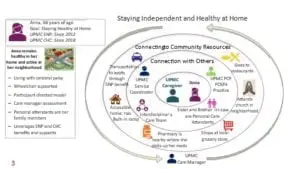
UPMC CHC also is unique, in that we have more than 32,000 participants enrolled who also are enrolled in one of our Medicare products. As our UPMC Community HealthChoices Success Stories demonstrates, our integrated, clinically driven model of care makes UPMC CHC, and other similarly situated MCOs, uniquely qualified to offer a creative, “whole-person care” approach to best meet the needs of our members. This process starts with a comprehensive health assessment of each member that is reviewed by an interdisciplinary care team. This team develops a customized care plan that leverages our strong community-based relationships to enable access to all services necessary for independent living. UPMC CHC prioritizes long-term success by providing continued check-ins and communication to ensure each member’s needs are fully met and to proactively identify and address any emerging obstacles to care and independence. The infographic below illustrates how our teams harness numerous services and supports that may not be part of the traditional Medicaid program but that have major effects on our members’ health and wellness, independence and quality of life.
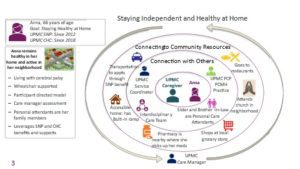
This example does not reflect one individual member; it is a composite example highlighting common needs, services and characteristics of program members.

State and national policymakers are recognizing the value of this integrated approach. Pennsylvania’s CHC program has been operational since 2018, and more than half of all states now offer Medicaid coverage that includes access to long-term services and supports, like HCBS. This approach to coordinating care and HCBS is changing the conversation about how to best provide health care and support for underserved, vulnerable populations. With whole person care that aligns Medicare and Medicaid, you can de-fragment health care, but then when you include HCBS, it changes the fundamental nature of the Medicaid program, shifting it from a disjointed and institutional-based care driven model to one that also provides resources to give individuals the option to remain safe and healthy at home and in their community.

Ongoing discussions related to the “Build Back Better” reconciliation package include significant investments in HCBS—investments on top of the dollars committed to HCBS in the COVID relief packages passed during the height of the pandemic. These investments have and will continue to improve access, care and affordability, and otherwise help close health-equity gaps for many individuals located in underserved, rural areas, communities of color, seniors and the chronically ill. Programs like Pennsylvania’s CHC work to better and more cost-effectively support these vulnerable populations.

 

Brendan Harris is Vice President of UPMC Community HealthChoices (UPMC CHC), the state’s Managed Long-Term Services and Supports program for UPMC Insurance Services. Prior to joining UPMC, Harris served as a core member of the Department of Human Services (DHS) team for over a decade—a department that serves more than 3 million Pennsylvanians, operates with a $39 billion budget, and has over 16,000 employees.

[ad_2]

Source link

Trending Topics

Features

Download and distribute powerful vaccination QI resources for your community.

Sign up now to support health equity and sustainable health outcomes in your community.

MCED tests use a simple blood draw to screen for many kinds of cancer at once.

FYHN is a bridge connecting health information providers to BIPOC communities in a trusted environment.

Discover an honest look at our Medicare system.

ARC was launched to create a network of community clinicians to diversify and bring clinical trials to communities of color and other communities that have been underrepresented.

The single most important purpose of our healthcare system is to reduce patient risk for an acute event.

Related Posts
Early Cancer Detection Is Entering a New Era. Flint Is Helping Lead the Way.
Why Your “Ozempic” May Not Be Ozempic: FDA Warnings Highlight Growing Risks of Unregulated GLP-1 Drugs
The Communities Most Burdened by Disease Should Be the First to Benefit from Artificial Intelligence
Scroll to Top
Featured Articles
Early Cancer Detection Is Entering a New Era. Flint Is Helping Lead the Way.
Why Your “Ozempic” May Not Be Ozempic: FDA Warnings Highlight Growing Risks of Unregulated GLP-1 Drugs
Why Your “Ozempic” May Not Be Ozempic: FDA Warnings Highlight Growing Risks o...
The Communities Most Burdened by Disease Should Be the First to Benefit from Artificial Intelligence
The Communities Most Burdened by Disease Should Be the First to Benefit from ...
Cancer Pain Care Access Gap Hits Black, Asian Patients
Black and Asian Cancer Patients Wait Longer for Pain Relief in New Study
What Is Cyclosporiasis Symptoms, Food Safety, and Reasons
What Is Cyclosporiasis? The Foodborne Illness Showing Up in the News
Why Minority Mental Health Awareness Month Matters More Than Ever
Categories
AI
ATTR-CM
BIPOC News
Cancer
Clinical Trials
Covid19
Diseases of the Body
Environment
Health Data
Health Equity Events
Health Policy
Health Tips
Subscribe to our newsletter to receive our latest news​
All Stories
Early Cancer Detection Is Entering a New Era. Flint Is Helping Lead the Way.
Why Your “Ozempic” May Not Be Ozempic: FDA Warnings Highlight Growing Risks of Unregulated GLP-1 Drugs
Why Your “Ozempic” May Not Be Ozempic: FDA Warnings Highlight Growing Risks o...
The Communities Most Burdened by Disease Should Be the First to Benefit from Artificial Intelligence
The Communities Most Burdened by Disease Should Be the First to Benefit from ...
BIPOC News
Early Cancer Detection Is Entering a New Era. Flint Is Helping Lead the Way.
The Communities Most Burdened by Disease Should Be the First to Benefit from Artificial Intelligence
The Communities Most Burdened by Disease Should Be the First to Benefit from ...
Why Minority Mental Health Awareness Month Matters More Than Ever
Environment
UV Safety Awareness Month Raises Urgency on Skin Cancer Prevention and Sun Protection Equity
UV Safety Awareness Month Raises Urgency on Skin Cancer Prevention and Sun Pr...
Extreme Heat Safety Tips 5 Ways to Protect Your Health This Summer fyh.news
5 Heat Safety Tips That Could Protect Your Health This Summer
Lupus Awareness Event in Baltimore Aims to Support Research and Shine a Light on Health Disparities
Lupus Awareness Event in Baltimore Aims to Support Research and Shine a Light...
Work Force
A multigenerational Black and Hispanic family sitting together in a park, showing how Social Security helps support older adults, people with disabilities, and families across generations.
Millions of Older Americans Could Face Smaller Social Security Checks by 2032...
dreamstime_s_243253251
The Caregiver Journey: The Hidden Backbone of American Healthcare
Families gather at a Bronx community festival with live music, kids’ activities, and health booths sharing SOMOS social care resources and free screenings.
Celebrating Hispanic heritage while learning about health care

[xyz-ips snippet=”Output-Source-Name”]

Clinical Trials
Early Cancer Detection Is Entering a New Era. Flint Is Helping Lead the Way.
Why Your “Ozempic” May Not Be Ozempic: FDA Warnings Highlight Growing Risks of Unregulated GLP-1 Drugs
Why Your “Ozempic” May Not Be Ozempic: FDA Warnings Highlight Growing Risks o...
Clinical Trial Diversity Remains a Critical Challenge in Alzheimer’s Research
Vaccines and Outbreaks
A parent checking a child's temperature during summer, illustrating the changing RSV patterns and year-round respiratory virus risks.
Can You Get RSV During the Summer?
Michelle Lam, MBA, of NYC Health + Hospitals/Elmhurst & Amy Harris of NYC Health + Hospitals/Elmhurst
Healthcare Leaders Spotlight Vaccine Equity and Adult Immunization Strategies...
Measles Outbreaks Surge: Essential Facts and Prevention Strategies
Other Categories
AI
Read the latest AI News stories trending around the world
ATTR-CM
Cancer
Read the latest Cancer stories trending around the world
Covid19
Diseases of the Body
Read about the latest Diseases of the Body trending around the world
Friday Webinars
Every Friday, we bring you insightful webinars covering critical topics in healthcare, data equity, and policy reform.
Health Data
Read the latest Health Data stories trending around the world
Health Equity Events
Read the best Health Equity Events around the country.
Health Policy
Read the latest Health Policy stories trending around the world
Health Tips
Heart Health
Read the latest on Heart Health News, Stories and Tips.
kidney Health
Read more trending News about Kidney Health, Stories and Tips.