








SPARTANBURG COUNTY, S.C. — A growing measles outbreak in South Carolina has sickened 126 people and placed more than 300 exposed residents under quarantine, state officials said Friday, as the United States heads toward its worst measles year in decades and public health leaders warn that falling vaccination coverage is leaving more communities vulnerable.
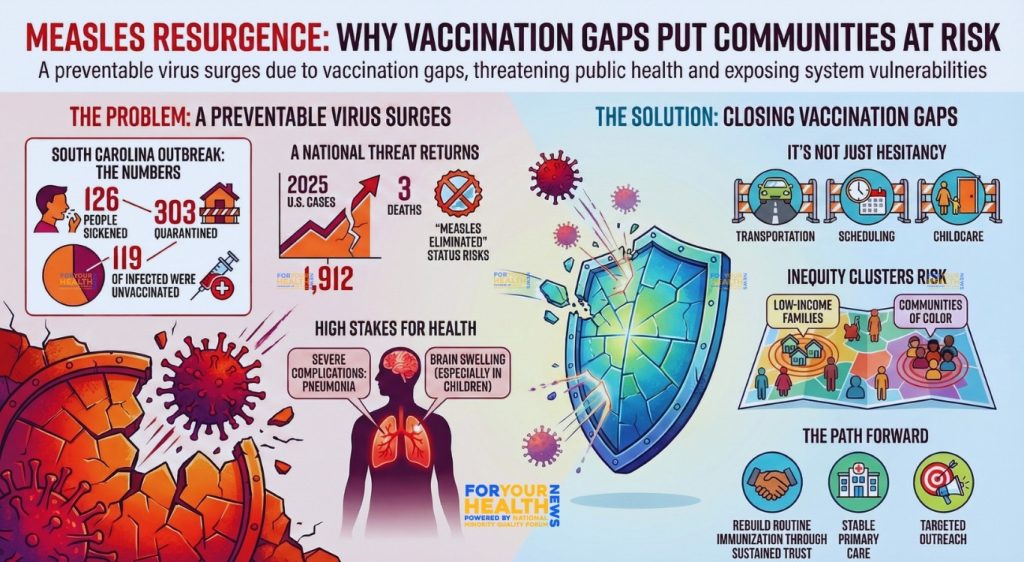
South Carolina’s Department of Public Health said 15 new cases were confirmed since earlier in the week, with most infections reported in the state’s northwest. Officials said 303 people who were exposed have been quarantined and 13 infected people have been isolated in an effort to slow transmission. Reuters reported that 119 of the infected people were unvaccinated, with only a small number partially or fully vaccinated.
The outbreak is part of a larger national rebound. The CDC reported 1,912 confirmed measles cases in the United States as of December 9, 2025, with 47 outbreaks recorded this year and 88% of cases tied to outbreak spread. The agency also confirmed three measles deaths in 2025.
Health officials say the South Carolina measles outbreak is spreading quickly across the Upstate, prompting quarantines and renewed vaccination outreach.
Measles was declared eliminated in the U.S. in 2000, meaning the virus was no longer spreading continuously inside the country. Now, national and state officials say that status is at risk if transmission continues for a full year, especially as large outbreaks seeded earlier in 2025 continue to generate new chains of infection.
Why vaccination gaps matter—and who can be left behind
Measles was declared eliminated in the United States in the early two-thousands, a milestone that depended on consistently high vaccination coverage. Health experts warn that when routine immunization slips, outbreaks can become harder to contain and can threaten that elimination status. In reporting on South Carolina’s outbreak, Reuters quoted University of Chicago Medicine infectious disease specialist Dr. Emily Landon as emphasizing that stopping sustained spread requires very high coverage in young children.

While the debate around vaccines often focuses on hesitancy, public health researchers stress that access barriers also play a major role in who gets protected on time. Studies of childhood immunization in the United States have documented practical obstacles that can include transportation challenges, difficulty getting appointments, limited paid leave, lack of childcare during clinic visits, and confusion about timing for vaccine schedules—burdens that can fall hardest on families with low incomes, unstable housing, or limited English proficiency.
Those barriers matter for health equity because they can cluster risk in specific neighborhoods and groups, including communities of color. Research from the University of Minnesota has highlighted how aggregated racial categories can hide major differences in vaccination patterns. In a Minnesota analysis, children born to Somali and Ethiopian parents had markedly lower on-time MMR coverage than several other groups, and the authors argued that disaggregated data are essential for understanding vaccine inequities and tailoring outreach.
Public health agencies say targeted outreach must be paired with services that meet people where they are. In South Carolina, state officials have pointed to mobile health resources and partnerships that can bring vaccination to communities, but recent reporting also suggests that demand for some mobile vaccine events has been limited—an indication that trust, communication, and convenience must move together for outreach to work.
Medical authorities stress that the stakes are high. The CDC notes that measles can lead to severe complications, including pneumonia and swelling of the brain, and that hospitalization is common among unvaccinated people who become infected. The agency also warns that measles can be especially dangerous for young children and people with weakened immune systems.
For families trying to make sense of the surge, doctors say prevention is still the clearest message: measles is among the most contagious viruses, but it is also vaccine-preventable. As state and federal investigators track exposures and try to slow transmission, the outbreak is also putting renewed pressure on health systems to close gaps that leave some communities more exposed than others. The path forward, experts say, will depend on rebuilding routine immunization and making it easier—logistically and culturally—for every family to access timely care and reliable information before the next exposure becomes the next cluster.
Closing a measles outbreak is rarely about a single policy or a single clinic day. It is about sustained trust, stable access to primary care, and public health capacity that can respond quickly across schools and neighborhoods. In South Carolina, officials say they are continuing to identify exposures and encourage vaccination, while nationally the resurgence is prompting new warnings that the country’s hard-won measles protections can erode when gaps—whether driven by access or confidence—are allowed to widen.
Stay Informed. Stay Empowered.
NMQF’s COVID-19 awareness and misinformation response campaign
Also Read: Hepatitis A and B Vaccination: Closing the Access Gap