











Association of Race and Ethnicity With Incidence of Dementia Among Older Adults | Dementia and Cognitive Impairment | JAMA

[ad_1]


Key Points

Question 
Is there a difference in incidence of dementia by race and ethnicity among enrollees in the US Veterans Health Administration (VHA)?

Findings 
In this retrospective cohort study of 1 869 090 older adults receiving care at VHA medical centers, the age-adjusted incidence of dementia per 1000 person-years over a mean follow-up of 10.1 years was 14.2 for American Indian or Alaska Native participants, 12.4 for Asian participants, 19.4 for Black participants, 20.7 for Hispanic participants, and 11.5 for White participants. After adjustment, the hazard ratios compared with White participants were significantly higher in all subgroups except among American Indian or Alaska Native participants.

Meaning 
Among adults who received care at VHA medical centers, significant differences in dementia incidence existed based on race and ethnicity.

Importance 
The racial and ethnic diversity of the US, including among patients receiving their care at the Veterans Health Administration (VHA), is increasing. Dementia is a significant public health challenge and may have greater incidence among older adults from underrepresented racial and ethnic minority groups.

Objective 
To determine dementia incidence across 5 racial and ethnic groups and by US geographical region within a large, diverse, national cohort of older veterans who received care in the largest integrated health care system in the US.

Design, Setting, and Participants 
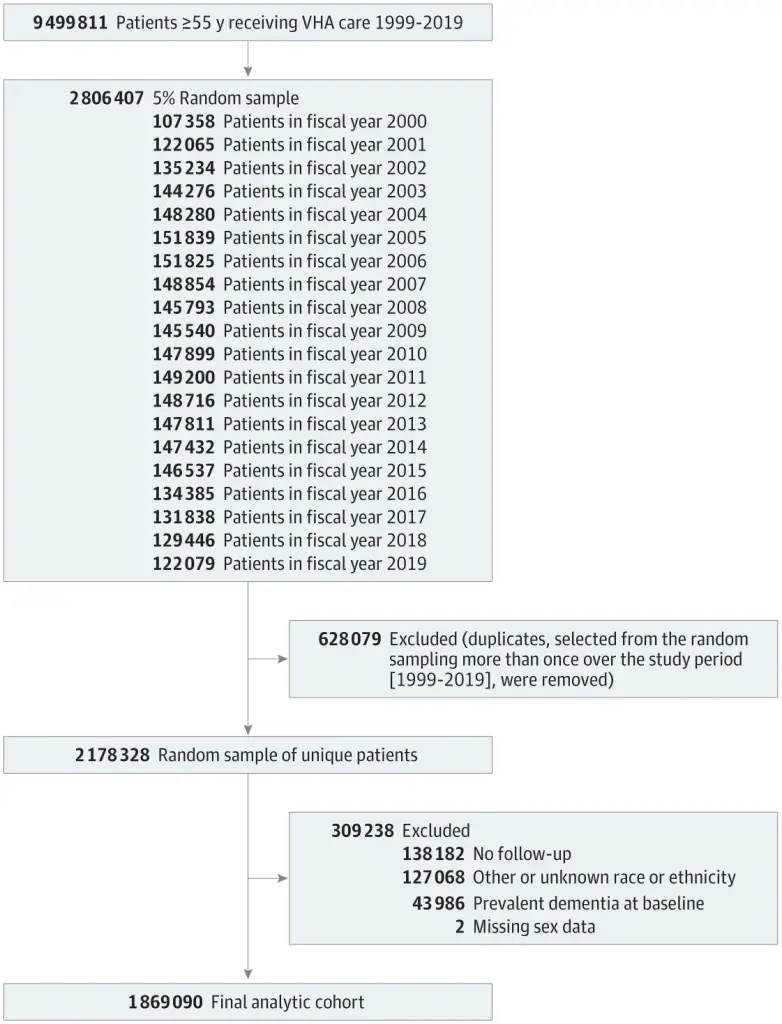
Retrospective cohort study within the VHA of a random sample (5% sample selected for each fiscal year) of 1 869 090 participants aged 55 years or older evaluated from October 1, 1999, to September 30, 2019 (the date of final follow-up).

Exposures 
Self-reported racial and ethnic data were obtained from the National Patient Care Database. US region was determined using Centers for Disease Control and Prevention (CDC) regions from residential zip codes.

Main Outcomes and Measures 
Incident diagnosis of dementia (9th and 10th editions of the International Classification of Diseases). Fine-Gray proportional hazards models were used to examine time to diagnosis, with age as the time scale and accounting for competing risk of death.

Results 
Among the 1 869 090 study participants (mean age, 69.4 [SD, 7.9] years; 42 870 women [2%]; 6865 American Indian or Alaska Native [0.4%], 9391 Asian [0.5%], 176 795 Black [9.5%], 20 663 Hispanic [1.0%], and 1 655 376 White [88.6%]), 13% received a diagnosis of dementia over a mean follow-up of 10.1 years. Age-adjusted incidence of dementia per 1000 person-years was 14.2 (95% CI, 13.3-15.1) for American Indian or Alaska Native participants, 12.4 (95% CI, 11.7-13.1) for Asian participants, 19.4 (95% CI, 19.2-19.6) for Black participants, 20.7 (95% CI, 20.1-21.3) for Hispanic participants, and 11.5 (95% CI, 11.4-11.6) for White participants. Compared with White participants, the fully adjusted hazard ratios were 1.05 (95% CI, 0.98-1.13) for American Indian or Alaska Native participants, 1.20 (95% CI, 1.13-1.28) for Asian participants, 1.54 (95% CI, 1.51-1.57) for Black participants, and 1.92 (95% CI, 1.82-2.02) for Hispanic participants. Across most US regions, age-adjusted dementia incidence rates were highest for Black and Hispanic participants, with rates similar among American Indian or Alaska Native, Asian, and White participants.

Conclusions and Relevance 
Among older adults who received care at VHA medical centers, there were significant differences in dementia incidence based on race and ethnicity. Further research is needed to understand the mechanisms responsible for these differences.

[ad_2]

Source link

Trending Topics

Features

Download and distribute powerful vaccination QI resources for your community.

Sign up now to support health equity and sustainable health outcomes in your community.

MCED tests use a simple blood draw to screen for many kinds of cancer at once.

FYHN is a bridge connecting health information providers to BIPOC communities in a trusted environment.

Discover an honest look at our Medicare system.

ARC was launched to create a network of community clinicians to diversify and bring clinical trials to communities of color and other communities that have been underrepresented.

The single most important purpose of our healthcare system is to reduce patient risk for an acute event.

Related Posts
Early Cancer Detection Is Entering a New Era. Flint Is Helping Lead the Way.
Why Your “Ozempic” May Not Be Ozempic: FDA Warnings Highlight Growing Risks of Unregulated GLP-1 Drugs
The Communities Most Burdened by Disease Should Be the First to Benefit from Artificial Intelligence
Scroll to Top
Featured Articles
Early Cancer Detection Is Entering a New Era. Flint Is Helping Lead the Way.
Why Your “Ozempic” May Not Be Ozempic: FDA Warnings Highlight Growing Risks of Unregulated GLP-1 Drugs
Why Your “Ozempic” May Not Be Ozempic: FDA Warnings Highlight Growing Risks o...
The Communities Most Burdened by Disease Should Be the First to Benefit from Artificial Intelligence
The Communities Most Burdened by Disease Should Be the First to Benefit from ...
Cancer Pain Care Access Gap Hits Black, Asian Patients
Black and Asian Cancer Patients Wait Longer for Pain Relief in New Study
What Is Cyclosporiasis Symptoms, Food Safety, and Reasons
What Is Cyclosporiasis? The Foodborne Illness Showing Up in the News
Why Minority Mental Health Awareness Month Matters More Than Ever
Categories
AI
ATTR-CM
BIPOC News
Cancer
Clinical Trials
Covid19
Diseases of the Body
Environment
Health Data
Health Equity Events
Health Policy
Health Tips
Subscribe to our newsletter to receive our latest news​
All Stories
Early Cancer Detection Is Entering a New Era. Flint Is Helping Lead the Way.
Why Your “Ozempic” May Not Be Ozempic: FDA Warnings Highlight Growing Risks of Unregulated GLP-1 Drugs
Why Your “Ozempic” May Not Be Ozempic: FDA Warnings Highlight Growing Risks o...
The Communities Most Burdened by Disease Should Be the First to Benefit from Artificial Intelligence
The Communities Most Burdened by Disease Should Be the First to Benefit from ...
BIPOC News
Early Cancer Detection Is Entering a New Era. Flint Is Helping Lead the Way.
The Communities Most Burdened by Disease Should Be the First to Benefit from Artificial Intelligence
The Communities Most Burdened by Disease Should Be the First to Benefit from ...
Why Minority Mental Health Awareness Month Matters More Than Ever
Environment
UV Safety Awareness Month Raises Urgency on Skin Cancer Prevention and Sun Protection Equity
UV Safety Awareness Month Raises Urgency on Skin Cancer Prevention and Sun Pr...
Extreme Heat Safety Tips 5 Ways to Protect Your Health This Summer fyh.news
5 Heat Safety Tips That Could Protect Your Health This Summer
Lupus Awareness Event in Baltimore Aims to Support Research and Shine a Light on Health Disparities
Lupus Awareness Event in Baltimore Aims to Support Research and Shine a Light...
Work Force
A multigenerational Black and Hispanic family sitting together in a park, showing how Social Security helps support older adults, people with disabilities, and families across generations.
Millions of Older Americans Could Face Smaller Social Security Checks by 2032...
dreamstime_s_243253251
The Caregiver Journey: The Hidden Backbone of American Healthcare
Families gather at a Bronx community festival with live music, kids’ activities, and health booths sharing SOMOS social care resources and free screenings.
Celebrating Hispanic heritage while learning about health care

[xyz-ips snippet=”Output-Source-Name”]

Clinical Trials
Early Cancer Detection Is Entering a New Era. Flint Is Helping Lead the Way.
Why Your “Ozempic” May Not Be Ozempic: FDA Warnings Highlight Growing Risks of Unregulated GLP-1 Drugs
Why Your “Ozempic” May Not Be Ozempic: FDA Warnings Highlight Growing Risks o...
Clinical Trial Diversity Remains a Critical Challenge in Alzheimer’s Research
Vaccines and Outbreaks
A parent checking a child's temperature during summer, illustrating the changing RSV patterns and year-round respiratory virus risks.
Can You Get RSV During the Summer?
Michelle Lam, MBA, of NYC Health + Hospitals/Elmhurst & Amy Harris of NYC Health + Hospitals/Elmhurst
Healthcare Leaders Spotlight Vaccine Equity and Adult Immunization Strategies...
Measles Outbreaks Surge: Essential Facts and Prevention Strategies
Other Categories
AI
Read the latest AI News stories trending around the world
ATTR-CM
Cancer
Read the latest Cancer stories trending around the world
Covid19
Diseases of the Body
Read about the latest Diseases of the Body trending around the world
Friday Webinars
Every Friday, we bring you insightful webinars covering critical topics in healthcare, data equity, and policy reform.
Health Data
Read the latest Health Data stories trending around the world
Health Equity Events
Read the best Health Equity Events around the country.
Health Policy
Read the latest Health Policy stories trending around the world
Health Tips
Heart Health
Read the latest on Heart Health News, Stories and Tips.
kidney Health
Read more trending News about Kidney Health, Stories and Tips.