[ad_1]

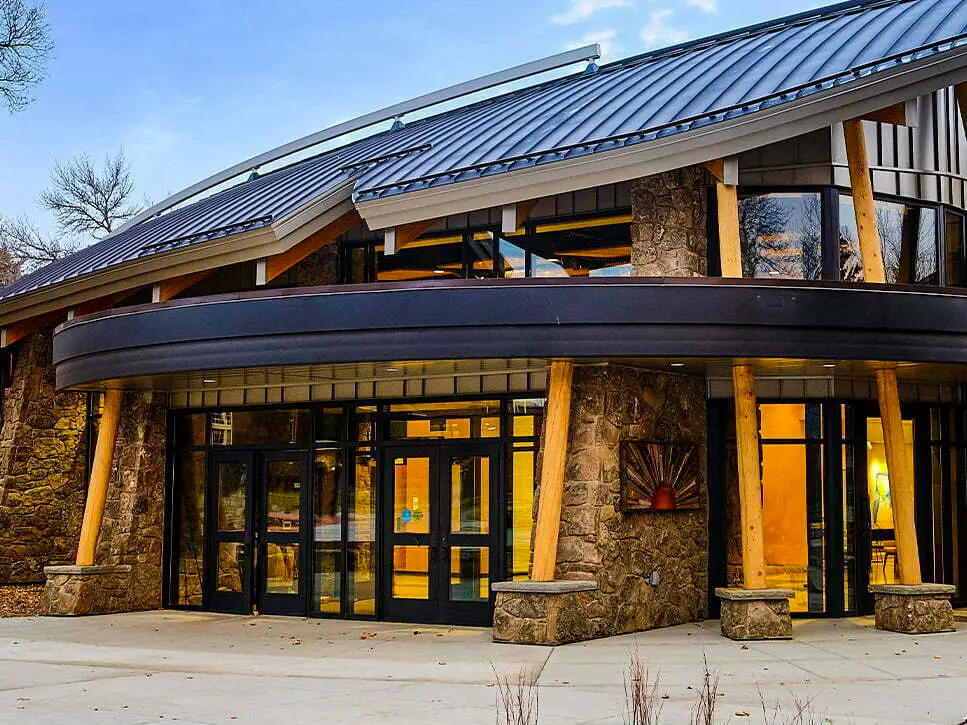
MSU’s American Indian Hall named LEED Platinum Version 4.1, highest sustainable classification
Wednesday, April 27, 2022
MSU News Service
Montana State University’s new American Indian Hall has become the first building in Montana to earn LEED Platinum certification under version 4.1, the highest ranking using the United States Green Building Council’s sustainability rating system, MSU officials said today.
“This rating substantiates our belief that the new American Indian Hall is the finest building of its type,” said MSU President Waded Cruzado. “Not only is it one of the most beautiful buildings of its kind in the world but it also has the highest sustainability rating possible, which will allow it to serve MSU students for decades to come.”
Walter Fleming, director of MSU’s Department of Native American Studies, which is housed in the building, said that the designation is important for a building that sits on ancestral lands of many tribes.
“It was always our mantra that if any building on campus needed to be LEED Platinum, it was important for the American Indian Hall to earn that,” Fleming said. “It is so consistent with the Native traditional practices not to leave anything to waste; to use all parts of the bison, for example. What is also important is the statement that a building does not have to sacrifice its cultural significance in order to exceed modern standards of construction.”
Following opening ceremonies in October, the 38,000-square-foot American Indian Hall opened to the public in January 2022. Located on the east side of the university’s Centennial Mall, it serves a record 811 Native American and Alaska Native students enrolled at MSU this year. Designed by ThinkOne Architecture and TSP Architects with consultation by MSU graduate Dennis Sun Rhodes, the interior includes Native American art, design and furnishings crafted from trees recycled on site to make room for the building.
The building is surrounded by gardens and indigenous and medicinal plants, which were planted by MSU Native American staff and students. The building is heated and cooled by 24 geothermal wells and produces up to 62 kilowatts of solar energy through photovoltaic panels. Swank Enterprises was the general contractor on the project.
John How, associate vice president for University Services, explained that the LEED rating system is the most widely used green-building rating system in the United States and is important because of the implications to costs of long-term use, operations and maintenance of the building. A LEED project earns points by addressing considerations such as carbon footprint, energy efficiency, water conservation, site selection, materials, day lighting, waste reduction and health and indoor environmental quality. Projects go through a verification and review process and are awarded points that correspond to a level of LEED certification: To earn a Platinum level, the project must have earned more than 80 points. Level 4.1 Platinum is the most recent series of LEED platinum awards.

“Without Walter, Wayne and Major Robinson leading from the outset it wouldn’t have had the cultural significance that it does,” How said.
How said the building was an example of collaboration in which every entity involved was focused on an end product that exhibited both beauty and excellence. He commended the work of Bill Hanson of ThinkOne Architecture, Robinson, a former Montana University System Regent who served as a cultural liaison with Montana tribes, and MSU’s project management team. He also recognized the work of Megan Sterl, director of MSU Engineering and Utilities, and Kath Williams, a Bozeman-based energy consultant who helped with LEED certification.
Additionally, How said that the American Indian Hall design experience has transformed the way MSU buildings will be designed and built in the future. He said prior to the project, the university would build a building and then place pieces of public art within it. The process was switched with the AIH building project, he said. A campus committee found appropriate public art pieces to suit the building and then designed the facility around them, How said.
The AIH includes art by artists Bently Spang, a member of the Northern Cheyenne Tribe who lives in Billings and installed a bank of video monitors onto a frame built in the shape of a large Plains Indian war shirt; Robert Martinez, a Northern Arapaho painter who lives in Riverton, Wyoming, and painted several murals; and Stacia Goodman of Minneapolis, who installed a mosaic of art glass and tile that sheathed a central column.
“AIH fundamentally changed our building process going forward,” How said. For example, he said the Student Wellness Center building, currently under construction, has followed the AIH procedure, with artwork selected prior to final design with specific pieces reserved for student artists.
For more information about the MSU American Indian Hall, see montana.edu/aih.
In addition to the American Indian Hall’s LEED Platinum Level 4, Norm Asbjornson Hall is rated LEED Platinum. Other MSU buildings with LEED certifications include: Rendezvous Dining Pavilion, Cooley Lab, Jabs Hall, Gallatin Hall and Yellowston Hall, all LEED Gold; and Gaines Hall and Miller Dining Hall, LEED Silver.
To learn more, go to montana.edu/sustainability/programs_and_projects/leed_certified_buildings.html#Platinum
MSU News Service shares stories about Montana State University in Bozeman,
Montana, and the accomplishments of its students, faculty, alumni and staff.
Follow on Facebook and Twitter.
[ad_2]
Source link