











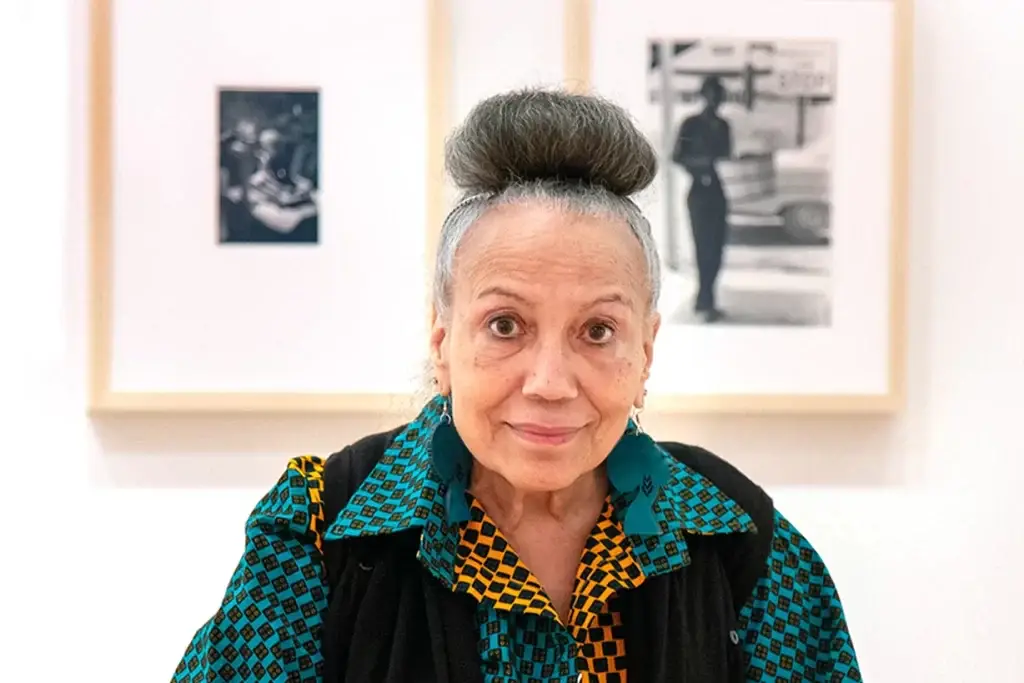
Doris Derby, who was one of the few Black women to chronicle the civil rights movement through photography, amassing an archive of thousands of images that reveal in poignant intimacy the lives of the people for whom the movement was fought, died March 28 at a hospice center in Newnan, Ga. She was 82.
[ad_1]
The cause was complications from cancer, said Charmaine Minniefield, an artist who described Dr. Derby as a mentor.
Dr. Derby was teaching elementary school in New York in 1963 when she uprooted her life to join the civil rights movement in the South. She was compelled to go there, she said, by the images she saw in the news of violent attacks on peaceful protesters.
“The police had German shepherd dogs and billy clubs, and they were blasting people with fire hoses,” she told a publication of the University of Illinois at Urbana-Champaign, her graduate alma mater. “I said, ‘Oh my goodness, if people there can subject themselves to these life-threatening actions, the least I can do is go to Mississippi and use my God-given talents.’ ”
Dr. Derby went to Mississippi as a field secretary for the Student Nonviolent Coordinating Committee, planning to give one year of her life to the movement. In the end, she stayed for nearly a decade. She registered African Americans to vote, taught adult literacy courses and organized farming cooperatives to give Black sharecroppers independence from White landowners. With several other activists, she founded a theatrical troupe that performed free of charge before largely Black audiences.
During the course of that work, she documented Black life as a photographer with a project known as Southern Media.
“Her images stood in stark contrast to other civil rights images made at the time because she looked at segregation and despair and joy and family at the same time — and used the stories that emphasized a sense of hope,” Deborah Willis, a professor of photography at New York University, where she is also director of the Center for Black Visual Culture/Institute of African American Affairs.
Dr. Derby had what she called a “broad” concept of civil rights, instilled in her by her parents and grandparents. Her grandmother had been an early member of the NAACP. Her father, trained as an engineer but unable to find work in the field because he was Black, had become a civil servant and fought discrimination in government employment.
In her own activism, Dr. Derby sought to overturn not only the official laws that disenfranchised and disempowered African Americans, but also the entrenched social patterns that limited their educational, economic and cultural opportunities.
She brought an equally broad vision to her civil rights photography. She documented the funeral of four girls killed in the 1963 bombing of the 16th Street Baptist Church in Birmingham, Ala., and the funeral of the Rev. Martin Luther King Jr. after his assassination in 1968. She also photographed sharecroppers working the land, seamstresses at a sewing cooperative, mothers tending to their young ones and children going about their childhood.
The subjects of her portraits included boxer Muhammad Ali, writer Alice Walker and activist Fannie Lou Hamer. They also included unsung activists doing the behind-the-scenes work powered large-scale change.
“I wanted to show who the people are, where they lived, and what they were doing. They were the basis of the success of the civil rights movement,” she told an interviewer with the University of Illinois. “Many activities and initiatives, including forming cooperatives, were a part of that whole movement. Anything you did to challenge the status quo was considered political.”
“Outsiders often see those who are out there protesting, meeting with officials, or scenes from a tragedy — which all are very important,” she continued. “But not everybody was involved outwardly in that part. My focus was to document Black people who were engaged in the struggle for equality and justice for all. To depict the life-giving force of the Black community keeping on. Even though they face poverty and injustice, they’re surviving, they’re living.”
After being largely overlooked for decades, Dr. Derby’s photography has been displayed in recent years at institutions including the Smithsonian’s National Museum of African American History and Culture and the High Museum of Art in Atlanta. Gregory Harris, the curator of photography at the High Museum, remarked in an interview that “as a Black woman, her perspective is very unusual.” The “element of ease and comfort” seen in her pictures, he said, is something “an outsider wouldn’t normally be able to get.”
Doris Adelaide Derby was born in the Bronx on Nov. 11, 1939. Her mother was a homemaker and later an educator at a school for deaf students. Her father, in addition to his civil service job, supported his children as a cabinetmaker.
He was also an amateur photographer, Dr. Derby recalled, and gave her a Kodak Brownie camera when she was in elementary school.
Both of Dr. Derby’s parents encouraged her interest in the arts, which led her to lessons with Katherine Dunham, an acclaimed dancer and choreographer who helped introduce Black cultural traditions to modern dance.
Dr. Derby was 16 when she joined the NAACP. She enrolled at Hunter College in New York City, where she majored in elementary education and anthropology and traveled to Nigeria before graduating in 1962. She was working in Yonkers, N.Y., when the civil rights activist Bob Moses recruited her to SNCC.
“It was very dangerous, with firebombings of houses and shootouts,” she recalled. “There were mass arrests of local Black men, women and children, as well as of White and Black civil rights volunteers.”
Once during her stay in Mississippi, Dr. Derby was driving past a church that housed a Head Start program for Black preschoolers. She noticed a flame at the end of a wire leading to the church. She and the others in the car jumped out and extinguished the flame before what appeared to be an explosive device could detonate.
After a decade in the South, Dr. Derby enrolled at the University of Illinois, receiving a master’s degree in 1975 and a PhD in 1980, both in anthropology. She specialized in African American studies.
“As a youngster growing up in New York,” she said in an interview with the website AlternateRoots, “I saw my mission in life as one who would identify, document, associate with and learn from Black artists, dancers, writers, musicians, actors, poets and historians to gather information and get it out to our people in whatever form I could because it was sorely lacking in our community and wasn’t readily available in mainstream textbooks, magazines, newspapers, movies or on TV.”
She spent much of her academic career at Georgia State University in Atlanta, where she led the office of African American student services and programs.
Dr. Derby married Robert Banks in 1995. Besides her husband, of East Point, Ga., survivors include a sister.
Last year, Dr. Derby published a book of her photography, “A Civil Rights Journey.”
In one of her images, an African American woman in saddle shoes is depicted hanging laundry on a porch, the breeze almost visible in a white sheet billowing along the line.
Reflecting years later on the woman in the picture, Dr. Derby remarked, “I would say that she was glad that we were there representing the struggle for equality, the struggle to … help her improve her lot in life.”
[ad_2]
Source link
Trending Topics

Features
- Drive Toolkit
Download and distribute powerful vaccination QI resources for your community.
- Health Champions
Sign up now to support health equity and sustainable health outcomes in your community.
- Cancer Early Detection
MCED tests use a simple blood draw to screen for many kinds of cancer at once.
- PR
FYHN is a bridge connecting health information providers to BIPOC communities in a trusted environment.
- Medicare
Discover an honest look at our Medicare system.
- Alliance for Representative Clinical Trials
ARC was launched to create a network of community clinicians to diversify and bring clinical trials to communities of color and other communities that have been underrepresented.
- Reducing Patient Risk
The single most important purpose of our healthcare system is to reduce patient risk for an acute event.
Related Posts
National Disability Employment Awareness Month and Health Access
- Jessica Wilson
RSV Season Is Starting. Here’s What Families Should Know
Victor Mejia Lacayo
World Dense Breast Day 2026 Raises Awareness of Breast Density and Cancer Risk
- Subash Kafle