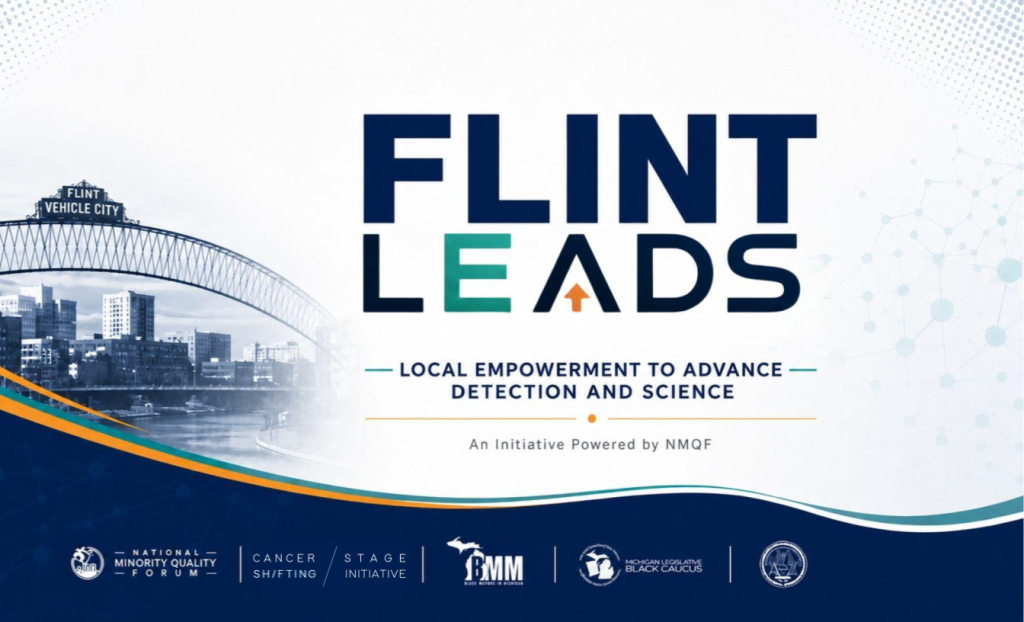
Flint, Michigan, has long been at the center of national conversations about environmental risk, public trust and health access. Now, the National Minority Quality Forum is working with community leaders, advocates and residents to help Flint become a model for something new: a city where early disease detection is not reserved for the wealthy or well-connected, but becomes part of a broader community health strategy.
During the Flint LEADS webinar, NMQF President and CEO Dr. Gary A. Puckrein introduced the initiative as part of a larger effort to connect communities facing environmental and health risks with science, data, advocacy and community leadership. LEADS stands for Local Empowerment to Advance Detection and Science, and Puckrein emphasized that the program begins with listening.
“This work is really about collaborating with community,” Puckrein said during the webinar. He explained that NMQF’s goal is to listen carefully to the health care challenges residents face and work with them to improve access, quality and long-term health outcomes.
That message carries special weight in Flint, where the legacy of the water crisis continues to shape public health concerns and trust in institutions. The CDC has supported Flint and Michigan health officials through programs focused on identifying eligible participants, monitoring health and service use, improving service delivery and coordinating community programs related to lead exposure.
Early Detection as a New Standard of Care
A major focus of the webinar was the promise of early detection. Puckrein compared the rise of early detection science to the transformation brought by germ theory, saying medicine may be entering a new period in which disease signals can be identified years before symptoms appear.
Screening is already a proven part of cancer prevention and care. The CDC notes that regular screening can find breast, cervical, colorectal and lung cancers early, when treatment is more likely to work best. But many communities still face barriers to accessing routine screenings, newer diagnostic tools and follow-up care.
For Flint LEADS, the goal is not only to raise awareness, but also to make sure residents are included in conversations about new technology, testing, data and health policy. Puckrein noted that some early detection tests are already available to people who can afford them, but access remains uneven.
“We want to make sure that as standard of care, the people in Flint get these multi-disease tests,” he said.
Multi-cancer early detection tests are an emerging area of science. The American Cancer Society explains that these tests look for signs of more than one type of cancer from a single sample, although they are not yet FDA-approved and still require careful evaluation. The National Cancer Institute has also noted that early detection can create opportunities for more effective treatment with fewer side effects.
Puckrein used pancreatic cancer as one example of why earlier detection matters. Pancreatic cancer is often diagnosed late, after it has already spread, making it difficult to treat. The National Cancer Institute notes that pancreatic cancer can be hard to treat because of its location and because it has often spread by the time it is found.
For Flint residents, the broader question is how new science can be made accessible in a way that respects privacy, builds trust and benefits families.
During the webinar’s Q&A session, one attendee asked how the program would protect participant privacy. Puckrein said NMQF goes to “great lengths” to protect data, explaining that information is de-identified and stored through secure systems. He also said the organization works with an institutional review board and external monitors to oversee research protocols.
The concern is important because medical research has often failed to earn trust in communities that have experienced neglect, discrimination or harm. Puckrein acknowledged that history directly, saying NMQF understands where mistrust comes from and wants residents to speak up if they ever believe their data or privacy is at risk.
The webinar also introduced several NMQF centers that will support Flint LEADS, including teams focused on clinical and social research, health information strategy, sustainable health care quality, public policy, communications and community engagement. NMQF’s Health Information Strategy and Services team described its work turning data into evidence and evidence into action, including community-specific cancer risk maps and environmental health education tools.
Adjoa Kyerematen, NMQF Vice President of Communications and Public Affairs, said the program is also about storytelling, education and community voice. She highlighted findings from a Flint community survey shared during the webinar, including strong interest in early detection and willingness among many residents to take a blood test to better understand cancer risk.
The webinar closed with an invitation for Flint residents to stay involved. Kyerematen said NMQF is looking for community ambassadors and patient ambassadors who want to participate in future educational events and outreach.
For Puckrein, becoming an early detection city means Flint residents are not simply participating in a program. They are helping define what the future of equitable health care should look like.
“You are helping to write the future,” he said. “You are helping to build a new healthcare system.”
Watch the webinar here: Youtube
Trending Topics

Features
- Drive Toolkit
Download and distribute powerful vaccination QI resources for your community.
- Health Champions
Sign up now to support health equity and sustainable health outcomes in your community.
- Cancer Early Detection
MCED tests use a simple blood draw to screen for many kinds of cancer at once.
- PR
FYHN is a bridge connecting health information providers to BIPOC communities in a trusted environment.
- Medicare
Discover an honest look at our Medicare system.
- Alliance for Representative Clinical Trials
ARC was launched to create a network of community clinicians to diversify and bring clinical trials to communities of color and other communities that have been underrepresented.
- Reducing Patient Risk
The single most important purpose of our healthcare system is to reduce patient risk for an acute event.
- Jessica Wilson
- Subash Kafle