










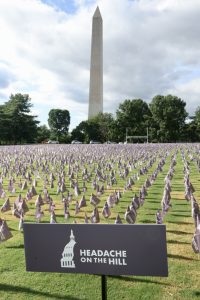
Thousands of purple flags lined a field near the National Mall this week as patients, doctors, advocates and families gathered in Washington, D.C., to bring national attention to a disease many say remains invisible despite affecting more than 40 million Americans.
Over the past two days, organizers behind the Flags for Headache campaign hosted two major public events during Migraine and Headache Awareness Month: the Walk for Headache Health on Tuesday evening and Speak Out for Headache Health on Wednesday morning. Together, the events blended grief, advocacy and policy demands while spotlighting the growing movement to push migraine and headache disorders into the center of national public health conversations. The gatherings took place beside an installation of 30,000 purple flags at Raoul Wallenberg Mixed Use Field, with each flag symbolizing people living with migraine and other headache disorders. Organizers said the display was designed to make visible conditions that are frequently misunderstood, underdiagnosed and dismissed despite their severe impact on daily life.
According to the World Health Organization, headache disorders affect about 40 percent of the global population and migraine ranks among the leading causes of neurological disability worldwide. WHO researchers say migraine can severely affect employment, mental health, family life and social participation, while anxiety and depression are significantly more common among people living with chronic migraine conditions.
Tuesday’s Walk for Headache Health centered on remembrance and mental health awareness. Participants carried candles and signs along the Tidal Basin to the Jefferson Memorial, honoring people who died after battling chronic migraine and other debilitating headache disorders. Organizers noted the symbolic importance of the memorial, citing historical accounts that Thomas Jefferson himself experienced recurring severe headaches throughout his life. “Tonight, we gathered in a different spirit,” said Julienne Verdi, executive director of The Headache Alliance and the Alliance for Headache Disorders Advocacy. “We are here to honor the people we have lost to migraine and headache disorders. We are here to honor those whose lives were cut short, those whose suffering was not fully understood, and those whose pain was too often invisible to the world around them.”

Speakers at the memorial walk included advocates from Chronic Migraine Awareness and Cluster busters, as well as family members who shared deeply personal stories about loss and survival. Billy Dwyer spoke about his sister Melissa, who died by suicide after struggling with chronic migraine and mental health challenges. “In the 13 years following her death, our family has worked to share her experience with Chronic Migraine, and the debilitating nature of this disease,” Dwyer said. “We will continue to advocate for a better future for those struggling with headache disorders.”. Advocates repeatedly emphasized the emotional burden tied to chronic pain conditions, particularly for patients who feel isolated or dismissed by employers, schools, insurers or even healthcare providers. That stigma, advocates say, disproportionately harms communities with less access to specialty neurological care, including many low-income families and communities of color where neurological disorders may go undiagnosed longer due to healthcare inequities.
The following morning, the tone shifted from memorial to mobilization as lawmakers, neurologists, patients and public health advocates gathered for Speak Out for Headache Health, a rally calling for stronger federal action on migraine and headache disorders.
A major focus of Wednesday’s event was the bipartisan HEADACHE Act, newly introduced federal legislation that would establish a coordinated national strategy to improve headache education, research, diagnosis and treatment access. Representative Lori Trahan, one of the bill’s lead sponsors, told attendees that migraine patients have been overlooked for too long. “For far too long, more than 40 million Americans living with headache and migraine disorders have been forced to suffer in silence, overlooked in our research priorities and underserved by our healthcare system,” Trahan said. “Invisible pain is real pain.”
Neurologist Dr. Jessica Lowe, widely known online as “Dr. Brain Barbie,” said migraine remains one of the most misunderstood neurological diseases despite its enormous social and economic consequences. “Advocacy isn’t just about changing policy, it’s about changing lives,” Lowe said. “Every conversation we have with lawmakers brings us one step closer to improving access to care, advancing research and ensuring patients are finally seen, heard, and taken seriously.”
The event also highlighted the experiences of children and teenagers living with migraine disease. Sixteen-year-old advocate Mohsin Starling spoke about growing up with migraine while trying to navigate school and adolescence. “I am 16 years old and I have migraine,” he said. “I am here to speak on behalf of all kids with migraine.”
WHO data shows headache disorders affect people across all ages, beginning as early as childhood, yet only a minority of patients worldwide receive proper diagnosis and treatment. Experts say shortages of headache specialists and uneven insurance coverage continue to leave many patients without consistent care.
Advocates at both events also stressed that migraine is not “just a headache,” but a complex neurological disease that can include severe pain, nausea, sensory disturbances, cognitive impairment and disability lasting hours or even days. Online patient communities have increasingly used social media platforms to discuss migraine as a disabling condition that affects work, education and quality of life.

As the purple flags continue to wave near the National Mall through the end of June, organizers say their campaign is about more than awareness. They hope the events will drive long-term investment in research, expand access to specialists and reduce the stigma that still surrounds chronic headache disorders.
“What must change is how seriously these diseases are recognized, researched, treated, and supported today,” Verdi told attendees. “The people represented by these flags deserve dignity. They deserve more good days.”
Stay Informed. Stay Empowered.