










It was the middle of July and already this summer had become a top contender for the hottest in Texas’s recorded history. In San Antonio, which by July would normally experience about three days of triple-digit heat, there had been three dozen. Houston, Waco and Austin were also seeing temperatures 5 to 8 degrees above normal. The state was roasting and Texans were using a record amount of electricity to stay cool.
New calculations suggest that, by the middle of this century, this record-breaking summer in Texas may look normal.
Across much of the United States, millions of people are expected to experience extreme temperatures more frequently and for longer periods of time — a threat that will grow as climate change worsens. The new data, released Monday by the nonprofit First Street Foundation, calculates the heat risk facing each property in the contiguous United States over the next 30 years, the length of a typical mortgage, providing some of the most detailed nationwide estimates. It uses heat index, a measure of how hot it feels outside by including temperature and humidity.
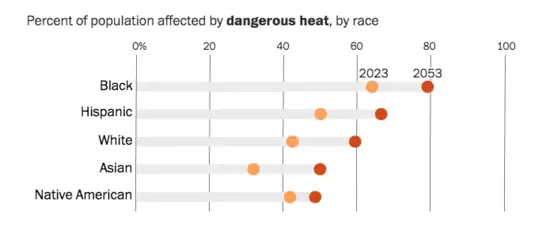
A Washington Post analysis of the group’s data found that today’s climate conditions have caused an estimated 46 percent of Americans to endure at least three consecutive days of 100-plus degree heat, on average, each year. Over the next 30 years, that will increase to 63 percent of the population.
Nowhere is the danger more widespread than in the South, where global warming is expected to deliver an average of 20 extra days of triple-digit heat per year. In some southern states, such as Texas and Florida, residents could see over 70 consecutive days with the heat index topping 100 degrees Fahrenheit.
“We’re talking about taking summer, which is already hot, and expanding it for months,” said Jaime González, director of the Houston Healthy Cities program for the Nature Conservancy in Texas. “That’s going to cause all sorts of disruptions to everyday life.”
This data comes as more Americans are moving to some of the hottest parts of the United States. For more than a decade, census data has shown Sun Belt states like Arizona, Texas and Florida drawing in new residents, while Northeastern and Midwestern states are not.
Trending Topics

Features
- Drive Toolkit
Download and distribute powerful vaccination QI resources for your community.
- Health Champions
Sign up now to support health equity and sustainable health outcomes in your community.
- Cancer Early Detection
MCED tests use a simple blood draw to screen for many kinds of cancer at once.
- PR
FYHN is a bridge connecting health information providers to BIPOC communities in a trusted environment.
- Medicare
Discover an honest look at our Medicare system.
- Alliance for Representative Clinical Trials
ARC was launched to create a network of community clinicians to diversify and bring clinical trials to communities of color and other communities that have been underrepresented.
- Reducing Patient Risk
The single most important purpose of our healthcare system is to reduce patient risk for an acute event.
- Jessica Wilson
- Jessica Wilson
- Jessica Wilson