[ad_1]
By Anne Blythe and Elizabeth Thompson
Though many North Carolinians are ready to say so long to the COVID pandemic, Kody Kinsley, secretary of the state Department of Health and Human Services told lawmakers Tuesday that the state is getting closer to that point but it’s not quite there.
Lawmakers on the Joint Legislative Oversight Committee on Health and Human Services encouraged Kinsley and his team to develop an exit strategy.


“There are a number of states now that are doing that,” said Rep. Donnie Lambeth (R-Winston-Salem) and committee co-chair. “I think we need to begin to look to that future. It could be very quickly, as things are changing, but I think people need to have some hope at the end of this tunnel.”
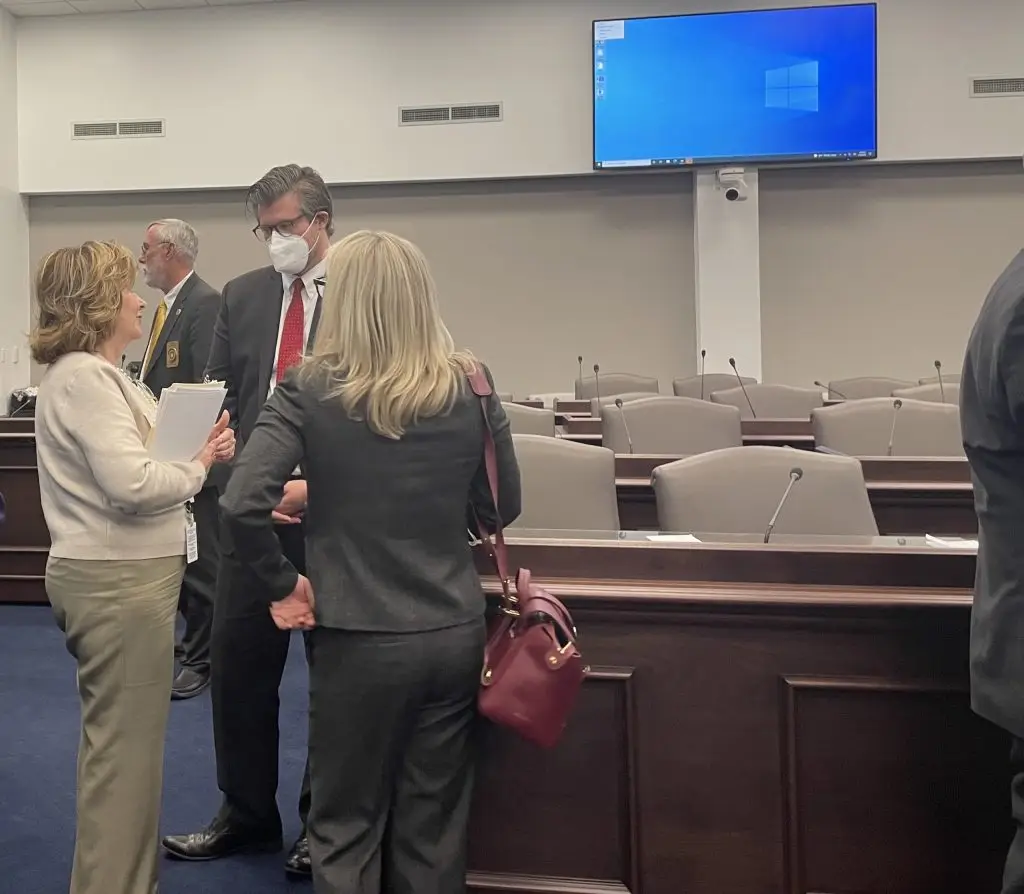
During a three-hour meeting on Tuesday, Kinsley went before lawmakers on the powerful health care commission for the first time since becoming head of the 18,000-employee agency in charge of improving the health and well-being of the state. The discussion was wide-ranging, highlighting the diversity of tasks under the DHHS umbrella.
They couldn’t escape talking about the pandemic, though. COVID-19 has thrown curveball after curveball for the past couple of years.
In the summer of 2021, it seemed as if the other side of the pandemic was near. Vaccines were accessible, offering protection and case counts were dropping. The number of people in hospitals with illness related to COVID had dropped to 336, but then the Delta variant caused a surge in late summer. Then late last year, Omicron hit hard.
The highly transmissible variant moved quickly across the state, sending case numbers and hospitalizations to record highs.
Kinsley has had to seek help from the federal government for two health care systems battling depleted workforces as Omicron surged.
Case rates peaked on Jan. 19, Kinsley said, and the number of people in hospitals with COVID-related illness hit a high mark on Jan. 26 at 5,206.
“So I am excited to see that we’ve had a bit over two weeks of a very good decline in our hospitals,” Kinsley said. “Of course, our numbers remain relatively high.”
On Tuesday, there were 3,142 people hospitalized with COVID-related illness, according to the DHHS dashboard, and 562 were in intensive care units. Meanwhile, North Carolina has received limited supplies of monoclonal antibodies, Kinsley said, but nowhere near as much as he would like to see.
Lambeth encouraged Kinsley and his staff to begin to think about COVID similarly to the flu, a seasonal virus in which a vaccine is needed each year.
“It has been a tough two years and I think as we start thinking about life after the pandemic … it’s not going to go away,” Lambeth said. “I think you ought to start developing that strategy and start talking about that in your news conferences.”
Kinsley and his team outlined many issues that they’ll wrestle with as they look beyond the pandemic. The future promises nursing and other health care worker shortages if changes aren’t made, he said.
They also expect behavioral health challenges and more people in need of substance use disorder treatment.
Making mental and behavioral health priorities
As many states across the country look forward to exiting the pandemic, the toll the past two years have had on everyone’s mental health is something the state wants to be ready to deal with, DHHS officials said Tuesday.
Since the pandemic hit North Carolina, the state has seen a 40 percent increase in adults who have reported symptoms of a mental health issue, said Deepa Avula, director of the division of mental health at DHHS.
“We are in a crisis situation,” Avula said. “So we have to act now to respond to that crisis.”
DHHS plans to address the critical need for behavioral health resources by creating an “array of services” outside of law enforcement and emergency departments, Avula said — providing support for every step of the way for an individual in mental health crisis, whether it be early intervention or recovery support.
Starting in July, the Suicide Prevention Hotline will be more accessible to all Americans, who will simply have to dial the three-digit number 988 for help. North Carolina also has a regional call center, mobile crisis team, crisis stabilization facilities and a real-time bed registry to identify open beds in hospitals.
The mental health crisis has had a disproportionate impact on the justice-involved population. Sixty percent of incarcerated people reported that they have had symptoms of a mental health disorder in the past 12 months, according to DHHS. However, staff said 83 percent of incarcerated people with mental illness didn’t receive treatment.
DHHS is working on early diversion models to prevent people from entering the justice system, such as Drug Education School for people arrested on first-time drug offenses, Avula said. For those who are incarcerated, DHHS is working on increasing access to treatment and expanding reentry efforts.
Evidence-based reentry resources have proven key for formerly incarcerated people reentering society, research shows, but there usually isn’t enough support to meet the need in North Carolina, NC Health News previously reported.
Responding to the opioid epidemic
The opioid epidemic has festered as the state has rushed to respond to the COVID-19 pandemic.
“Even after years of working on battling the opioid epidemic we have lost considerable traction in that fight,” Kinsley said.
Sen. Kevin Corbin (R-Franklin), who represents a swath of land in the westernmost corner of the state, said that substance use disorder is a problem that plagues his district’s sheriffs. When asked how crime would be impacted by effectively eliminating substance use disorder, Corbin said sheriffs consistently said 80 to 90 percent of crime would disappear.
“We’re terribly underserved in the state with mental health as far as behavioral, as far as substance abuse disorder,” Corbin said.


DHHS has been working on increasing access to Medication-assisted Treatment programs for opioid use disorder, with a focus on rural and underserved areas, such as jails and prisons and on tribal lands. Since 2020, opioid treatment programs have seen a 22 percent increase in unique patients served, according to DHHS.
After speaking with law enforcement across the state, Kinsley said he’s heard one thing repeatedly — “we’re not going to arrest ourselves out of this problem.”
Federal money allocated for opioid use disorder can help connect people to medication-assisted treatment, Kinsley said, but recovery requires more — access to dental care, housing and employment are all vital to helping people recover.
Medicaid expansion?
“For me, there is a no-brainer opportunity here which is expanding Medicaid, providing coverage support for these individuals,” Kinsley said.
North Carolina is one of 12 states that hasn’t expanded Medicaid, which has been an option on the table since 2013. If the state were to expand the program, more than 500,000 low-income North Carolinians would have access to health insurance.
Though Republicans leading the General Assembly had been staunchly against expansion of the state’s Medicaid program for much of the past decade, Senate leader Phil Berger (R-Eden) announced late last year that he had warmed to the idea.
Since then, House Speaker Tim Moore (R-Kings Mountain) announced the creation of a Joint Legislative Oversight Committee on Access to Healthcare and Medicaid Expansion. The first meeting is Friday.
“Our committee will explore and seek solutions to critical health care issues with the goals of broadening access to quality health care for working people, lowering health insurance premiums for everyone, addressing the cost of uncompensated care especially for rural hospitals, and providing more affordable health care options to help small businesses retain employees,” Lambeth, the Winston-Salem Republican tapped as co-chairman of the committee, said in January.


X
Republish this article
You are free to use NC Health News content under the following conditions:
- You can copy and paste this html tracking code into articles of ours that you use, this little snippet of code allows us to track how many people read our story.
- Please do not reprint our stories without our bylines, and please include a live link to NC Health News under the byline, like this:
By Jane Doe
- Finally, at the bottom of the story (whether web or print), please include the text:
North Carolina Health News is an independent, non-partisan, not-for-profit, statewide news organization dedicated to covering all things health care in North Carolina. Visit NCHN at northcarolinahealthnews.org. (on the web, this can be hyperlinked)
1
[ad_2]
Source link