











[ad_1]
A group of Latinx health researchers join the faculty at San Diego State University this year, adding to a strong and growing network of expertise on health disparities.
Nine professors have been hired at the College of Science, College of Health and Human Services and SDSU Imperial Valley as part of SDSU FUERTE (Unified Faculty Towards Excellence in Research and Transformational Engagement), a National Institutes of Health-funded effort to strengthen research on Latinx health disparities and provide researchers with thoughtful career development and mentorship .
The new faculty will look at Latinx health from all angles, including aging, cancer, and environmental health.
Aging minds and migrant community health
Ariana Stickel studies neuropsychology, particularly Alzheimer’s disease and dementia, in Latin American populations. She identifies risk factors for cognitive aging, considering how other health conditions like cardiovascular disease and cultural pressures to acculturate might be correlated with dementia. Stickel said her Latina grandmother fueled her focus on the elderly and informed clinical decisions for the understudied Latino population.
“I feel like I’m coming home,” Stickel said. “I wouldn’t be where I am without SDSU and the opportunities I’ve had here.”
As a first-generation psychology major, Stickel dipped her toes into research working with bilingual preschoolers, then joined the precursor to the National Institutes of Science-funded Advancing Diversity in Aging Research program. Health and led by a professor of psychology. Terry Cronan. Ms. Stickel looks forward to mentoring students in the program who, like her, are interested in using research to improve the way clinicians diagnose and treat dementia.
When several Mexican and Central American immigrants arrived to work in carpet factories in his small hometown of Dalton, Georgia, Jessica McCurley observed a sharp increase in anti-immigrant sentiment in his community.
This experience, combined with several family members – including a grandmother – suffering from chronic physical and mental health problems, motivated McCurley to become a clinical psychologist who examines the effectiveness of behavioral health interventions for low-income minorities. and migrant populations with chronic health conditions.

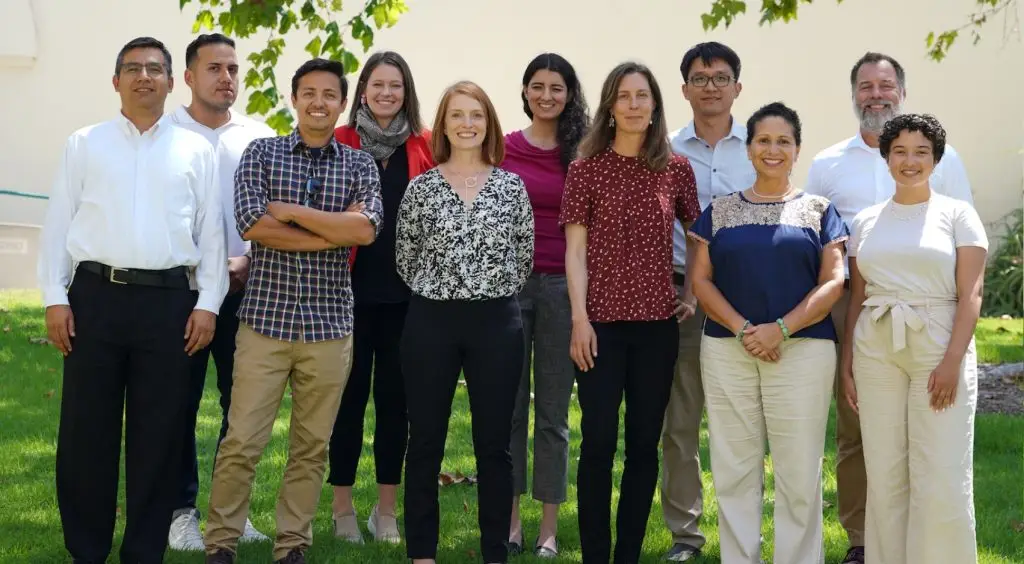
In the photo above from left to right – First row: Miguel Zavala, Nicolás López-Gálvez, Corinne McDaniels-Davidson, Teresa Monkkonen, Mari Zúñiga (co-principal investigator), Syona Hurst (program coordinator). Last row: Benjamin Aceves, Jessica McCurley, Ariana Stickel, Kai-Chung Cheng, Mark Reed (co-principal investigator)
“There’s no better place to do that than somewhere right on the border,” McCurley said. “SDSU is so strong with community health and community participatory research, so it was a perfect fit.”
“There’s no better place to do that than somewhere right on the border,” McCurley said. “SDSU is so strong with community health and community participatory research, so it was a perfect fit.”
Cancer disparities
Teresa Monkkonen will join the biology department as an assistant professor specializing in intercellular communications implicated in the most aggressive types of breast cancer.
Although she won’t officially start as a faculty member until the spring semester of 2023, Monkkonen has already been involved in several FUERTE activities, such as a grant-writing retreat to collaboratively build research projects with the other new faculty. She said the retreat was a good indicator of the support and welcome from her fellow cancer researchers in San Diego.
Corinne McDaniels Davidson is director of the SDSU Institute for Public Health, associate director of public health practice, and assistant professor of public health. Her recent research focuses on HPV-related cancer-related health disparities. This ranges from identifying disparities in outcomes and upstream causes of cancer disparities to designing interventions to reduce them.
“I’m a first-generation student from a place where I didn’t have many college graduates to turn to. This has made it difficult to navigate the higher education and research enterprise. FUERTE provides a support and sponsorship infrastructure that recognizes the need to fill these gaps.
Children and the influence of the community
Benjamin Acèves is an Assistant Professor in the Division of Health Promotion and Behavioral Sciences in the School of Public Health. His FUERTE research focuses on social factors that influence access to care among Latino populations, especially those living with chronic illnesses.
Nicolas Lopez Galvez is an Assistant Professor of Environmental Health in the School of Public Health. He credits his experience as a first-generation Latino immigrant to the United States with influencing his commitment to addressing environmental justice issues and health disparities in minority populations.
His study examines the health impact of exposure to carcinogens in children living near the US-Mexico border in Imperial County. Imperial County children are seen in emergency rooms for asthma-related conditions at a rate three times higher than the average rate for other California children. Her pilot project aims to determine pesticide exposure levels of children living in the border region and to investigate any potential neurodevelopmental issues associated with the exposure.
Environmental Health in the Imperial Valley
Three SDSU FUERTE researchers affiliated with the School of Public Health join the faculty of SDSU Imperial Valley. The group focuses on environmental health in underserved communities, including communities along the border region.
Environmental Health Researcher Miguel Zavala joins SDSU IV as an associate professor. It uses tools to track air pollution – including mathematical and computational models and field studies that assess the impact of pollution on human health – and investigates the association between air pollution and public policies. During COVID-19, Zavala examined how COVID-19 and subsequent changes in daily human activity affect air quality.
“I am inspired by how SDSU FUERTE is strongly committed to research on health disparities and environmental justice in underserved communities. It’s really unique and not something you can find everywhere. We tackle real issues that matter to people and communities,” Zavala said.
“I want to learn more about the impact of factors such as dust in the air, biomass burning, emissions from border traffic and insecticides from agriculture on the local community,” Zavala continued. . “How prevalent is exposure, what are the impacts of these pollutants, and how can we change policies to improve health?”
Environmental toxicologist Linda Lara Jacobo joined SDSU IV as an assistant professor. His research focuses on monitoring contaminants in wastewater, including pharmaceuticals, personal care products, nanoparticles, flame retardants and pesticides. Tracking contaminants is an essential first step in understanding how environmental threats are affecting a population and mitigating those threats in the future.
Wastewater monitoring can also help researchers track disease.
“You can track so many things through water: cancer biomarkers, tuberculosis proteins or using RNA and DNA to identify viruses like COVID-19, monkeypox and the flu,” Lara-Jacobo said. “It allows you to predict and track outbreaks – because often you can see problems in the sewage before the community shows symptoms.”
Environmental Health Researcher Kai Chung Cheng will join SDSU IV as an assistant professor in the spring. Chen measures and models indoor air quality, examining issues such as second-hand smoke intrusion and major traffic emissions.
“SDSU FUERTE researchers working at SDSU IV focus on improving the health of underserved communities and how environmental health issues, inequities, and environmental justice have an outsized negative impact on these communities,” said social work and SDSU co-leader FUERTE. Maria Luisa Zuniga.
[ad_2]