














- By FYH News Team
[ad_1]
Citation: Andriano TM, Arnsten J, Patel VV (2022) Social determinants of health and HIV Pre-Exposure Prophylaxis (PrEP) interest and use among young Black and Latinx sexual minority men. PLoS ONE 17(4):
e0267031.
https://doi.org/10.1371/journal.pone.0267031
Editor: Jesse L. Clark, David Geffen School of Medicine at UCLA, UNITED STATES
Received: April 1, 2021; Accepted: April 1, 2022; Published: April 15, 2022
Copyright: © 2022 Andriano et al. This is an open access article distributed under the terms of the Creative Commons Attribution License, which permits unrestricted use, distribution, and reproduction in any medium, provided the original author and source are credited.
Data Availability: There are ethical restrictions that prevent us from sharing de-identified data publicly. Specifically, the data contains potentially sensitive information since it involves a marginalized population. These restrictions are imposed by the Albert Einstein College of Medicine Institutional Review Board. Interested, qualified researchers may request access to the data set from the Office of Human Research Affairs at Albert Einstein College of Medicine at ‘irb@einsteinmed.org‘. They may also contact the author, Dr. Viraj Patel (vpatel@montefiore.org).
Funding: This study was supported in part by NIH K23MH102118, the Einstein-Rockefeller-CUNY Center for AIDS Research (NIH P30AI051519), and the Einstein Office of Medical Student Research. The funders had no role in study design, data collection and analysis, decision to publish, or preparation of the manuscript.
Competing interests: The authors have declared that no competing interests exist.
Introduction
From 2014 to 2018, new annual HIV diagnoses in the United States decreased from 40,836 to approximately 37,000, with almost all at-risk populations experiencing declines. However, young Black and Latinx sexual minority men (YBLSMM) continue to experience a disproportionate burden of new HIV infections. In 13–24 year old sexual minority men (SMM), Black/African American and Hispanic/Latinx accounted for the highest percentage of new HIV diagnoses (52% and 27%, respectively) [1]. Pre-exposure prophylaxis (PrEP) with oral tenofovir disoproxil fumarate and emtricitabine (TDF/FTC) is highly effective at preventing new HIV infections [2]. However, data of SMM in the United States supports unequal PrEP access, uptake, and persistence across different ages, races, and ethnicities [3–9]. Of 78,360 PrEP users in 2016, only 11.2% were Black/African American and 13.1% were Hispanic [10]. Reasons identified for low PrEP uptake among YBLSMM include concerns about side effects, perceived high cost, limited access, and stigma [11–14].
Social determinants may also contribute to low PrEP uptake among YBLSMM. The uptake of biomedical prevention tools and health services in general has been shown to be impacted by unmet social determinants of health (SDOH) needs [15]. These include basic needs (e.g., food, shelter, water), health/social service needs (e.g., healthcare), and economic needs (e.g., money for savings). Socioeconomic factors identified to affect PrEP uptake in the general population included lack of insurance, difficult access to transportation, and inflexible work situations [16, 17]. Individuals with more unmet SDOH needs may have other priorities that divert their focus from obtaining preventative health services [18].
Young SMM have substantial financial hardship and SDOH needs, which may impact their health service utilization [15]. However there is a paucity of information about SDOH needs among HIV-negative YBLSMM. Additionally, there is little known about associations of SDOH needs with PrEP uptake in YBLSMM. Our research investigated associations of SDOH needs with both intention to use and current use of PrEP in a sample of YBLSMM. We hypothesized that more unmet SDOH needs would be associated with lower proportions of both intention to use and current use of PrEP.
Methods
Study design and setting
We performed a secondary analysis of data from the Empowering with PrEP (E-PrEP) study, a cluster-randomized controlled trial of a peer-based social network intervention to increase PrEP adoption among YBLSMM in New York City [19]. The intervention took place in 2017 completely online, with follow-up surveys completed at baseline, six weeks, and twelve weeks. The six-week assessment included questions about SDOH needs. The Albert Einstein College of Medicine Institutional Review Board approved the E-PrEP study and this analysis.
Measures
We collected participant age, gender identity, borough of residence, race/ethnicity, sexual orientation, education level, income, employment, living situation, health insurance status, and type of health insurance.
The primary independent variable was SDOH needs measured by a 17-item scale (Cronbach’s Alpha = 0.96) previously validated among a sample of YBLSMM in New York City [15]. The SDOH needs scale asked participants whether they and their family currently had adequate resources to meet specific needs right now, such as food for two meals per day, a house or apartment, medical care, or money to save. Items in the scale were grouped into three subscales: 11-items on basic needs (e.g., food, shelter, water), 2-items on health/social service needs (e.g., access to medical care), and 4-items on economic needs (e.g., money to save). Each item had 6 answer options: “never,” “rarely,” “less than half of the time,” “about half of the time,” “more than half of the time,” or “always” (S1 Table). The mean of responses to all 17 items was computed to determine the full score. The mean responses to items for each subscale (basic needs, health/social service needs, and economic needs) were also computed. Mean scores ranged from 1 (never had enough resources for indicated items) to 6 (always had enough resources for indicated items), with lower scores indicating more unmet SDOH needs.
The primary outcome was intention to use PrEP, measured by the following question: “PrEP is currently available with a prescription from your doctor and research has shown that a majority of insurance companies cover most or all of the costs of PrEP. Do you plan to begin PrEP in the next 30 days?” (yes/no). The secondary outcome was current use of PrEP, measured by the following question: “Are you currently taking PrEP for HIV prevention?” (yes/no).
Results
Participant characteristics
The mean age of the 143 participants was 24 years and the majority identified their current gender as male (87%). Over half (51%) of participants lived in the Bronx. All participants identified as either Latinx/Hispanic (37%) or Non-Hispanic Black (63%), and most identified as gay/homosexual (76%). Many participants (37%) had a high school education or less, 27% were unemployed, and a minority (15%) reported no income. Participants reported a range of living situations, including living with their parents or family (41%) and no place to live (6%). Among participants with health insurance (79%), 53% had Medicaid (Table 1).
Association of SDOH needs with PrEP interest and use
Of the 114 participants not using PrEP, 69 (61%) reported intending to use PrEP in the next 30 days. Only 29 participants (20%) were currently using PrEP.
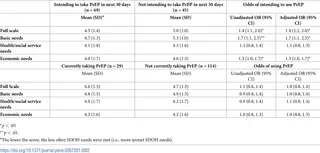
Results from bivariable analyses showed that among participants not using PrEP (n = 114), those intending, compared to those not intending, to take PrEP in the next 30 days (n = 69) had a lower mean score on the full SDOH need scale (4.5 vs. 5.0, p = .03), and lower mean scores on all three subscales: basic needs (4.7 vs. 5.3, p = .01), health/social service needs (4.1 vs. 4.3, p = .55), and economic needs (4.0 vs. 4.6, p = .04). In multivariable analyses, these associations remained significant for the full SDOH scale (aOR [95% CI] = 1.4 [1.1–2.0]), the basic needs subscale (aOR [95% CI] = 1.7 [1.1–2.5]), and the economic needs subscale (aOR [95% CI] = 1.3 [1.0–1.7]). There were no significant differences in mean SDOH needs scores between current PrEP use and not currently taking PrEP (Table 2) or between current PrEP use and intending to take PrEP. In sensitivity analysis controlling for intervention arm, findings did not significantly differ for SDOH needs and intention to use PrEP or PrEP use.
Discussion
In one of the first studies exploring the relation of PrEP adoption with SDOH needs among mostly YBLSMM, we found that almost all participants had some unmet needs. We further found that among those not currently using PrEP, intention to use PrEP was associated with greater unmet basic and economic SDOH needs. Surprisingly, we did not observe any associations between PrEP use and SDOH needs.
Individuals with greater unmet SDOH needs are vulnerable to adverse health related outcomes due in part to chronic stressors in daily living [20]. Associations have been seen between chronically stress-inducing life experiences (e.g., socioeconomic disadvantages) and sexually transmitted infection acquisition [21, 22]. Our results suggest that YBLSMM with unmet SDOH needs believe that they would benefit from using PrEP, likely due to concomitant unmet sexual healthcare needs. However, the higher rates of unmet SDOH needs may leave this population without resources to move from intention to action. Research has shown that individuals often forego PrEP due to pressing requirements of daily life, such as employment demands, housing insecurity, or other social hardships [23–25]. The findings from this study underscore the importance of previous recommendations to assess SDOH needs in at risk populations for optimized health intervention benefit. For example, prior research demonstrates that improving housing and neighborhood quality can reduce HIV risk [26]. Additionally, more holistic support may improve PrEP use, as implementation of client centered care addressing social and material needs was associated with high PrEP uptake (79%) in Black men who have sex with men [27, 28]. Such targeted interventions however have not been evaluated in YBLSMM. Examining the impact of SDOH interventions paired with PrEP outreach in YBLSMM may provide valuable insight to addressing discrepancies between intent and use. Nevertheless, our findings help fill a critical void in the literature regarding the impact of SDOH on PrEP adoption in YBLSMM.
Unexpectedly, there were no significant differences in mean SDOH needs scores between current PrEP use and not currently taking PrEP. This may have likely been due to the low PrEP use (n = 29) and relative homogeneity of unmet SDOH needs in this sample, suggesting that people with unmet SDOH needs may need to prioritize other concerns over PrEP. New York City contains a large and robust network of social and medical services, including outreach programs for young SMM and numerous LGBTQ-competent/affirming, Medicaid-accepting or low cost/free medical providers [29]. Among participants in this study, health and social service needs were more likely than other needs to be met all of the time, suggesting that YBLSMM in New York City may be able to access healthcare despite other unmet needs [30]. However, despite access to healthcare, PrEP uptake remained low in our sample, signifying that additional strategies are needed to overcome barriers to PrEP use.
Our findings should be interpreted in the context of this study’s limitations. Given the cross-sectional design, causality cannot be inferred; longitudinal studies would be helpful to understand potential downstream impacts of unmet SDOH needs on PrEP uptake. Participants in this study were all in a similar age range, recruited online, and based in New York City, potentially limiting generalizability to other settings. Given the low PrEP use in this sample, studies with larger YBLSMM samples may help to further elucidate associations between PrEP use and SDOH needs. We conducted this survey in English, and thus findings may not be generalizable to YBLSMM who are not fluent in English, and who may have more unmet SDOH needs.
Acknowledgments
We thank all the participants and Nataly Rios for their contributions to this study.
References
- 1.
Center for Disease Control and Prevention. Diagnosis of HIV Infection in the United States and Dependent Areas, 2018. HIV Surveillance Report, vol. 31. 2019 [Available from: https://www.cdc.gov/hiv/library/reports/hiv-surveillance.html. - 2.
Hare C, Coll J, Ruane P, Molina J, Mayer K, Jessen H, et al., editors. The phase 3 DISCOVER study: daily F/TAF or F/TDF for HIV preexposure prophylaxis. Conference on retroviruses and opportunistic infections; 2019. - 3.
Furukawa NW, Schneider JA, Coleman ME, Wiener JB, Shrestha RK, Smith DK. Out-of-pocket costs and HIV pre-exposure prophylaxis persistence in a US multicity demonstration project. Health Serv Res. 2020. - 4.
Huang YA, Tao G, Smith DK, Hoover KW. Persistence with HIV Preexposure Prophylaxis in the United States, 2012–2017. Clin Infect Dis. 2020. - 5.
Rolle CP, Onwubiko U, Jo J, Sheth AN, Kelley CF, Holland DP. PrEP Implementation and Persistence in a County Health Department Setting in Atlanta, GA. AIDS Behav. 2019;23(Suppl 3):296–303. pmid:31468296 - 6.
Serota DP, Rosenberg ES, Lockard AM, Rolle CM, Luisi N, Cutro S, et al. Beyond the Biomedical: PrEP Failures in a Cohort of Young Black Men who have Sex with Men in Atlanta, GA. Clin Infect Dis. 2018. - 7.
Chan PA, Goedel WC, Nunn AS, Sowemimo-Coker G, Galarraga O, Prosperi M, et al. Potential Impact of Interventions to Enhance Retention in Care During Real-World HIV Pre-Exposure Prophylaxis Implementation. AIDS Patient Care STDS. 2019;33(10):434–9. pmid:31584857 - 8.
Lankowski AJ, Bien-Gund CH, Patel VV, Felsen UR, Silvera R, Blackstock OJ. PrEP in the Real World: Predictors of 6-Month Retention in a Diverse Urban Cohort. AIDS Behav. 2019;23(7):1797–802. pmid:30341556 - 9.
Chan PA, Mena L, Patel R, Oldenburg CE, Beauchamps L, Perez-Brumer AG, et al. Retention in care outcomes for HIV pre-exposure prophylaxis implementation programmes among men who have sex with men in three US cities. Journal of the International AIDS Society. 2016;19(1):20903. pmid:27302837 - 10.
Huang YA, Zhu W, Smith DK, Harris N, Hoover KW. HIV Preexposure Prophylaxis, by Race and Ethnicity—United States, 2014–2016. MMWR Morb Mortal Wkly Rep. 2018;67(41):1147–50. pmid:30335734 - 11.
Bauermeister JA, Meanley S, Pingel E, Soler JH, Harper GW. PrEP awareness and perceived barriers among single young men who have sex with men. Curr HIV Res. 2013;11(7):520–7. pmid:24476355 - 12.
Brooks RA, Landovitz RJ, Regan R, Lee SJ, Allen VC Jr. Perceptions of and intentions to adopt HIV pre-exposure prophylaxis among black men who have sex with men in Los Angeles. Int J STD AIDS. 2015;26(14):1040–8. pmid:25638214 - 13.
Kubicek K, Arauz-Cuadra C, Kipke MD. Attitudes and perceptions of biomedical HIV prevention methods: voices from young men who have sex with men. Arch Sex Behav. 2015;44(2):487–97. pmid:25633499 - 14.
Hannaford A, Lipshie-Williams M, Starrels JL, Arnsten JH, Rizzuto J, Cohen P, et al. The Use of Online Posts to Identify Barriers to and Facilitators of HIV Pre-exposure Prophylaxis (PrEP) Among Men Who Have Sex with Men: A Comparison to a Systematic Review of the Peer-Reviewed Literature. AIDS Behav. 2018;22(4):1080–95. pmid:29285638 - 15.
Ompad DC, Palamar JJ, Krause KD, Kapadia F, Halkitis PN. Reliability and Validity of a Material Resources Scale and Its Association With Depression Among Young Men Who Have Sex With Men: The P18 Cohort Study. Am J Mens Health. 2018;12(5):1384–97. pmid:27226330 - 16.
Arnold T, Brinkley-Rubinstein L, Chan PA, Perez-Brumer A, Bologna ES, Beauchamps L, et al. Social, structural, behavioral and clinical factors influencing retention in Pre-Exposure Prophylaxis (PrEP) care in Mississippi. PLOS ONE. 2017;12(2):e0172354. pmid:28222118 - 17.
Pinto RM, Berringer KR, Melendez R, Mmeje O. Improving PrEP Implementation Through Multilevel Interventions: A Synthesis of the Literature. AIDS and Behavior. 2018;22(11):3681–91. pmid:29872999 - 18.
Kreuter MW, McQueen A, Boyum S, Fu Q. Unmet basic needs and health intervention effectiveness in low-income populations. Prev Med. 2016;91:70–5. pmid:27496395 - 19.
Patel VV, Ginsburg Z, Golub SA, Horvath KJ, Rios N, Mayer KH, et al. Empowering With PrEP (E-PrEP), a Peer-Led Social Media-Based Intervention to Facilitate HIV Preexposure Prophylaxis Adoption Among Young Black and Latinx Gay and Bisexual Men: Protocol for a Cluster Randomized Controlled Trial. JMIR Res Protoc. 2018;7(8):e11375. pmid:30154071 - 20.
Pampel FC, Krueger PM, Denney JT. Socioeconomic Disparities in Health Behaviors. Annu Rev Sociol. 2010;36:349–70. pmid:21909182 - 21.
Sales JM, Smearman EL, Swartzendruber A, Brown JL, Brody G, DiClemente RJ. Socioeconomic-related risk and sexually transmitted infection among African-American adolescent females. J Adolesc Health. 2014;55(5):698–704. pmid:24974317 - 22.
Harling G, Subramanian S, Barnighausen T, Kawachi I. Socioeconomic disparities in sexually transmitted infections among young adults in the United States: examining the interaction between income and race/ethnicity. Sex Transm Dis. 2013;40(7):575–81. pmid:23965773 - 23.
Spinelli MA, Laborde N, Kinley P, Whitacre R, Scott HM, Walker N, et al. Missed opportunities to prevent HIV infections among pre-exposure prophylaxis users: a population-based mixed methods study, San Francisco, United States. Journal of the International AIDS Society. 2020;23(4):e25472. pmid:32294338 - 24.
Linnemayr S. HIV prevention through the lens of behavioral economics. J Acquir Immune Defic Syndr. 2015;68(4):e61–3. pmid:25559597 - 25.
Brinkley-Rubinstein L, Peterson M, Arnold T, Nunn AS, Beckwith CG, Castonguay B, et al. Knowledge, interest, and anticipated barriers of pre-exposure prophylaxis uptake and adherence among gay, bisexual, and men who have sex with men who are incarcerated. PLoS One. 2018;13(12):e0205593. pmid:30532275 - 26.
De Jesus M, Williams DR. The Care and Prevention in the United States Demonstration Project: A Call for More Focus on the Social Determinants of HIV/AIDS. Public Health Rep. 2018;133(2_suppl):28S–33S. pmid:30457952 - 27.
Wheeler DP, Fields SD, Beauchamp G, Chen YQ, Emel LM, Hightow-Weidman L, et al. Pre-exposure prophylaxis initiation and adherence among Black men who have sex with men (MSM) in three US cities: results from the HPTN 073 study. Journal of the International AIDS Society. 2019;22(2):e25223. pmid:30768776 - 28.
Wheeler DP, Lucas J, Wilton L, Nelson LE, Hucks-Ortiz C, Watson CC, et al. Building effective multilevel HIV prevention partnerships with Black men who have sex with men: experience from HPTN 073, a pre-exposure prophylaxis study in three US cities. Journal of the International AIDS Society. 2018;21 Suppl 7:e25180. pmid:30334600 - 29.
Cahill S, Trieweiler S, Guidry J, Rash N, Stamper L, Conron K, et al. High Rates of Access to Health Care, Disclosure of Sexuality and Gender Identity to Providers Among House and Ball Community Members in New York City. J Homosex. 2018;65(5):600–14. pmid:28537845 - 30.
Remien RH, Bauman LJ, Mantell JE, Tsoi B, Lopez-Rios J, Chhabra R, et al. Barriers and facilitators to engagement of vulnerable populations in HIV primary care in New York City. J Acquir Immune Defic Syndr. 2015;69 Suppl 1:S16–24. pmid:25867774
[ad_2]
Source link
Trending Topics
Features
- Drive Toolkit
Download and distribute powerful vaccination QI resources for your community.
- Health Champions
Sign up now to support health equity and sustainable health outcomes in your community.
- Cancer Early Detection
MCED tests use a simple blood draw to screen for many kinds of cancer at once.
- PR
FYHN is a bridge connecting health information providers to BIPOC communities in a trusted environment.
- Medicare
Discover an honest look at our Medicare system.
- Alliance for Representative Clinical Trials
ARC was launched to create a network of community clinicians to diversify and bring clinical trials to communities of color and other communities that have been underrepresented.
- Reducing Patient Risk
The single most important purpose of our healthcare system is to reduce patient risk for an acute event.
- Jessica Wilson
- Subash Kafle


