












Study Finds Alarmingly High Suicide Rates Among AI/AN VHA Patients

[ad_1]

Nathaniel V. Mohatt, PhD, a research psychologist with the VA’s Rocky Mountain Mental Illness Research, Education, and Clinical Center.

AURORA, CO — American Indian and Alaska Natives (AI/ANs) in the general population have the highest rates of suicide of all race groups in the United States, as well as the most rapidly growing suicide rates, according to a new study.

The suicide rate in U.S. veterans as a whole is approximately 50% higher than that of nonveterans. Yet, little has been known specifically about suicide in American Indians and Alaska Native veterans.

“To support effective VHA suicide prevention services for AI/AN veterans, we need to first understand the basic context of suicide risk among VHA veterans,” said Nathaniel V. Mohatt, PhD, a research psychologist with the VA’s Rocky Mountain Mental Illness Research, Education, and Clinical Center.

Mohatt is the lead author of the new study that provides the first published data on suicide data among AI/AN veterans who received healthcare services provided or paid for by the VHA. The study reveals a large and growing problem and discovers patterns of suicide that differ from those of the VA population as a whole.

The study, published in Medical Care, used VHA clinical and administrative records to identify American Indian and Alaska Native veterans who received care at the VA between fiscal years 2003 and 2014 and who were alive at the end of fiscal year 2004. AI/AN veterans were defined as those with any VHA record indicating AI/AN race, including veterans with single race AI/AN identification as well as those who identified with other races (multirace AI/AN).1
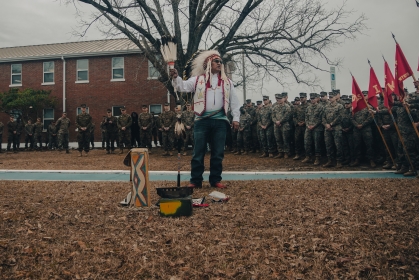
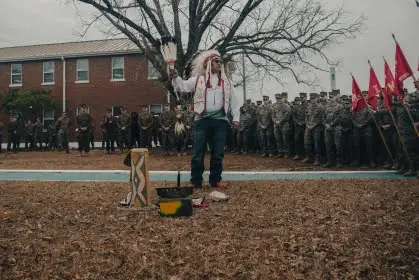
Sandor Iron Rope, a Native American spiritual leader in the Lakota Tribe, gives a speech to U.S. marines and sailors of 3rd Battalion, 6th Marine Regiment 2d Marine Division, during the opening ceremony for the Teufelhunden Games at Camp Lejeune, NC, earlier this year. The games pay tribute to Native American service in the military. U.S. Marine Corps photo by Lance Cpl. Deja Thomas

The researchers used age-specific and age-adjusted (using the 2000 US Standard Population) suicide rates, per 100,000 person-years at risk and computed 95% confidence intervals in this cohort of just under 87,000 people for the years 2004-2018, in five-year observation periods: 2004-2008, 2009-2013 and 2014-2018. The five-year study periods were created to calculate reliable suicide rates over time, given the relatively small size of this population. They calculated rates for three age groups: younger (18-39) middle-aged (40-59), and older (60+.) veterans.

Young Had Higher Suicide Rates

Date and cause of death were determined using the Centers for Disease Control and Prevention’s National Death Index records housed within the VA/DoD Mortality Data Repository. Suicides were classified based on International Classification of Diseases, 10th Edition (ICD-10) underlying cause-of-death codes as firearms, poisonings, suffocation and other.

The study had two key findings, said Mohatt. “First, suicide rates grew substantially from 2004 to 2018 among the VA-enrolled American Indian and Alaska Native veterans. More specifically, they more than doubled, from an overall suicide rate of 19.1/100,000 person year to 47.0/100,000 person years—an increase of 146%. In contrast, over a similar period, suicide rates among all veterans enrolled in VA health care rose by just over 30%.”.
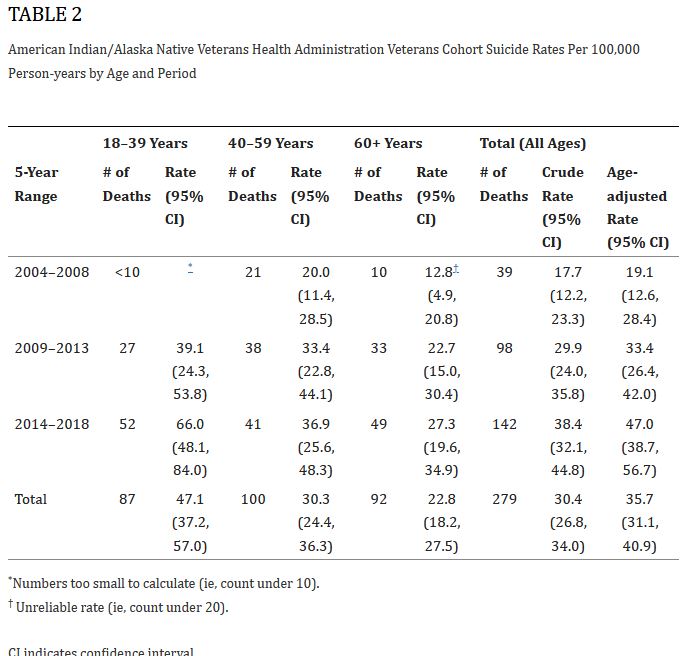
Click to Enlarge Source: Med Care. 2022 Apr; 60(4): 275–278.

“Second, the youngest age group in our study, veterans under 40, had much higher suicide rates than the older American Indian and Alaska Native veterans,” he said. “In the most recent years that we looked at—2014-2018—American Indian and Alaska Native veterans under 40 had a suicide rate of 66/100,000 person years.”

Although Mohatt said he expected to find high rates of suicide in American Indian and Alaska Native veterans, he said he found the rate of growth in suicides alarming. “A few years back when we heard suicide rates had grown 30% in the United States over the last 10 years, we were shocked as a country. So, identifying a 146% increase is that much more upsetting,” he explained.

Also surprising were both the higher rates and greater numbers of suicide among the youngest age group, Mohatt noted. “We typically see the highest veteran suicide rates among the younger veterans, but higher numbers of suicide among older veterans.”

While there is still much to be learned to draw clear conclusions for clinicians and clinical practice, these findings are a first step toward identifying and confirming a higher risk of suicide among American Indian and Alaska Native veterans, and a prominent risk among younger American Indian and Alaska Native veterans, Mohatt said.
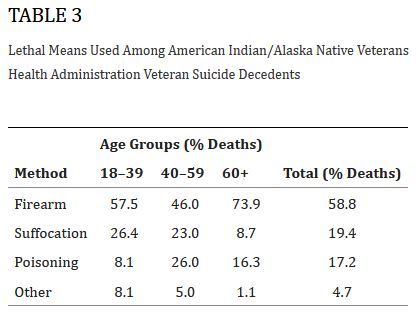
Click to Enlarge Source: Med Care. 2022 Apr; 60(4): 275–278.

“We need to evaluate whether our risk identification and treatment approaches for suicide are equally effective for American Indian and Alaska Native veterans,” he advised. “We need to consider how well we train and prepare VA providers to interact with and support people who are from a cultural identify other than their own, so healthcare is delivered in a culturally responsive and safe way for American Indian and Alaska Native veterans, including their families and communities.”


  1. Mohatt NV, Hoffmire CA, Schneider AL, Goss CW, Shore JH, Spark TL, Kaufman CE. Suicide Among American Indian and Alaska Native Veterans Who Use Veterans Health Administration Care: 2004-2018. Med Care. 2022 Apr 1;60(4):275-278. doi: 10.1097/MLR.0000000000001656. PMID: 35271514; PMCID: PMC8923357.

[ad_2]

Source link
Trending Topics

Features

Download and distribute powerful vaccination QI resources for your community.

Sign up now to support health equity and sustainable health outcomes in your community.

MCED tests use a simple blood draw to screen for many kinds of cancer at once.

FYHN is a bridge connecting health information providers to BIPOC communities in a trusted environment.

Discover an honest look at our Medicare system.

ARC was launched to create a network of community clinicians to diversify and bring clinical trials to communities of color and other communities that have been underrepresented.

The single most important purpose of our healthcare system is to reduce patient risk for an acute event.

Related Posts
Early Cancer Detection Is Entering a New Era. Flint Is Helping Lead the Way.
Why Your “Ozempic” May Not Be Ozempic: FDA Warnings Highlight Growing Risks of Unregulated GLP-1 Drugs
The Communities Most Burdened by Disease Should Be the First to Benefit from Artificial Intelligence
Scroll to Top
Featured Articles
Early Cancer Detection Is Entering a New Era. Flint Is Helping Lead the Way.
Why Your “Ozempic” May Not Be Ozempic: FDA Warnings Highlight Growing Risks of Unregulated GLP-1 Drugs
Why Your “Ozempic” May Not Be Ozempic: FDA Warnings Highlight Growing Risks o...
The Communities Most Burdened by Disease Should Be the First to Benefit from Artificial Intelligence
The Communities Most Burdened by Disease Should Be the First to Benefit from ...
Cancer Pain Care Access Gap Hits Black, Asian Patients
Black and Asian Cancer Patients Wait Longer for Pain Relief in New Study
What Is Cyclosporiasis Symptoms, Food Safety, and Reasons
What Is Cyclosporiasis? The Foodborne Illness Showing Up in the News
Why Minority Mental Health Awareness Month Matters More Than Ever
Categories
AI
ATTR-CM
BIPOC News
Cancer
Clinical Trials
Covid19
Diseases of the Body
Environment
Health Data
Health Equity Events
Health Policy
Health Tips
Subscribe to our newsletter to receive our latest news​
All Stories
Early Cancer Detection Is Entering a New Era. Flint Is Helping Lead the Way.
Why Your “Ozempic” May Not Be Ozempic: FDA Warnings Highlight Growing Risks of Unregulated GLP-1 Drugs
Why Your “Ozempic” May Not Be Ozempic: FDA Warnings Highlight Growing Risks o...
The Communities Most Burdened by Disease Should Be the First to Benefit from Artificial Intelligence
The Communities Most Burdened by Disease Should Be the First to Benefit from ...
BIPOC News
Early Cancer Detection Is Entering a New Era. Flint Is Helping Lead the Way.
The Communities Most Burdened by Disease Should Be the First to Benefit from Artificial Intelligence
The Communities Most Burdened by Disease Should Be the First to Benefit from ...
Why Minority Mental Health Awareness Month Matters More Than Ever
Environment
UV Safety Awareness Month Raises Urgency on Skin Cancer Prevention and Sun Protection Equity
UV Safety Awareness Month Raises Urgency on Skin Cancer Prevention and Sun Pr...
Extreme Heat Safety Tips 5 Ways to Protect Your Health This Summer fyh.news
5 Heat Safety Tips That Could Protect Your Health This Summer
Lupus Awareness Event in Baltimore Aims to Support Research and Shine a Light on Health Disparities
Lupus Awareness Event in Baltimore Aims to Support Research and Shine a Light...
Work Force
A multigenerational Black and Hispanic family sitting together in a park, showing how Social Security helps support older adults, people with disabilities, and families across generations.
Millions of Older Americans Could Face Smaller Social Security Checks by 2032...
dreamstime_s_243253251
The Caregiver Journey: The Hidden Backbone of American Healthcare
Families gather at a Bronx community festival with live music, kids’ activities, and health booths sharing SOMOS social care resources and free screenings.
Celebrating Hispanic heritage while learning about health care

[xyz-ips snippet=”Output-Source-Name”]

Clinical Trials
Early Cancer Detection Is Entering a New Era. Flint Is Helping Lead the Way.
Why Your “Ozempic” May Not Be Ozempic: FDA Warnings Highlight Growing Risks of Unregulated GLP-1 Drugs
Why Your “Ozempic” May Not Be Ozempic: FDA Warnings Highlight Growing Risks o...
Clinical Trial Diversity Remains a Critical Challenge in Alzheimer’s Research
Vaccines and Outbreaks
A parent checking a child's temperature during summer, illustrating the changing RSV patterns and year-round respiratory virus risks.
Can You Get RSV During the Summer?
Michelle Lam, MBA, of NYC Health + Hospitals/Elmhurst & Amy Harris of NYC Health + Hospitals/Elmhurst
Healthcare Leaders Spotlight Vaccine Equity and Adult Immunization Strategies...
Measles Outbreaks Surge: Essential Facts and Prevention Strategies
Other Categories
AI
Read the latest AI News stories trending around the world
ATTR-CM
Cancer
Read the latest Cancer stories trending around the world
Covid19
Diseases of the Body
Read about the latest Diseases of the Body trending around the world
Friday Webinars
Every Friday, we bring you insightful webinars covering critical topics in healthcare, data equity, and policy reform.
Health Data
Read the latest Health Data stories trending around the world
Health Equity Events
Read the best Health Equity Events around the country.
Health Policy
Read the latest Health Policy stories trending around the world
Health Tips
Heart Health
Read the latest on Heart Health News, Stories and Tips.
kidney Health
Read more trending News about Kidney Health, Stories and Tips.



