












The ‘invisible’ targets of hatred and hardship: Lower-income Asian Americans the focus of new COVID-19 study

[ad_1]

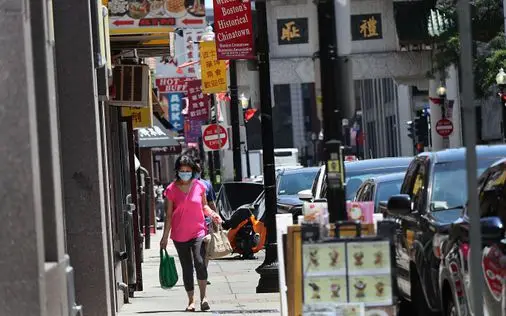
“Those in Chinatown or the working communities in Malden and Quincy are often invisible,” said Carolyn Wong, a political scientist at the Institute for Asian American Studies at UMass.

Wong said she embarked on research to help widen the public’s perception of Asian Americans, who are often stalked by a “model minority myth.”

“The impression that policy makers and a lot of the public have is just looking at the better off [Asian Americans],” Wong said.

“The movies, TV, a lot of media images, or ideas people have about how well off Asians are, come from the successful scientists and medical folks, and those are the ones who are more prominent in the public’s mind,” she said.

Wong and her UMass coauthor, Ziting Kuang, surveyed 192 mostly low- and middle-income Asian Americans in 2020 and early 2021 in Greater Boston and found that roughly 75 percent reported working jobs that placed them at higher risk for COVID, and about 40 percent reported feeling very or extremely worried about being able to pay their rent or mortgage.

A third said they were very or extremely afraid they would run out of food because of a lack of money.

About one in five reported being threatened or harassed, and more than half said they were treated with less courtesy and respect because of their race.

An earlier study by other colleagues at UMass and Northeastern University randomly surveyed about 1,600 people in Boston, including about 145 Asian Americans, on their pandemic experiences. But the survey was in English and Spanish only — no Asian dialects — and included many who were college graduates or with advanced schooling, and did not include many Asian American respondents who are low-income.

In that larger survey, slightly more than two-thirds of respondents reported they were in excellent or very good health, as opposed to just 51 percent of lower-income respondents in the more recent survey. And fewer than half in the survey of more wealthy, educated Asian Americans said they worked in professions that required interaction with the public, placing them at less risk during the first year of the pandemic.

Wong and Kuang felt that missed the experiences of a large swath of lower-income, more poorly educated Asian Americans in the region. That prompted their more recent survey of Asian Americans in Greater Boston, using community groups to contact hard-to-reach enclaves and offering the survey in English, Chinese, and Vietnamese. It was not a random sampling.

“We should not look at just ethnicity but at the class makeup of any group,” said Suzanne Lee, president emeritus of the Chinese Progressive Association and a longtime Boston community leader.

Lee, who emigrated from China in the 1960s and lives in Chinatown, said many of the people who work in small businesses and restaurants in her community are older, or offspring of lower-income Asian Americans, and not the younger, newer wave of immigrants from India or China, many of whom live in the suburbs and work in high-tech, medical, or research professions.

The large gap in experiences the UMass researchers found between wealthy and low-income Asian Americans mirrors the findings of a 2018 Pew Research Center report that found income inequality rising most rapidly among that group. It found that income distribution among Asian Americans transformed from being one of the most equal to being the most unequal among the United States’ major racial and ethnic groups.

Income inequality, the report found, is the greatest among Asian Americans, displacing Black people as the most economically divided racial or ethnic group in the country.

But the new UMass report did find some common ground among rich and poor Asian Americans: More than two-thirds of those surveyed reported donning masks very early in the pandemic — earlier than Black, Latino, or white people did. And about 5 percent of both groups of Asian Americans reported COVID infections in the first year of the pandemic, roughly half the percentage reported by Black, Latino, and white respondents.

Lee said those findings ring true to what she still sees every day around her in Chinatown.

“Asian people, in general, are more used to wearing masks,” she said.

Lee said many Asian immigrants come from polluted areas where wearing masks is considered normal.

“People wear masks to protect themselves, so in that way it kind of helped they were the first to mask up and protect themselves,” she said.

Another vestige of the pandemic that has not disappeared, Lee said, is hateful acts directed at Asian people. During the first year of the pandemic, former president Donald Trump often and very publicly referred to COVID as the “Chinese virus,” which some researchers have linked to a rise in anti-Asian behavior in the United States.

Lee said that while dramatic instances of Asian American people being randomly attacked on the street may have subsided, everyday bullying and harassment away from the public’s eye have not.

“Once that idea [of the Chinese virus] gets into people’s head, it’s hard to get it out. It takes a lot longer, a lot more intentional work,” she said.

“This idea that just because you don’t have a president anymore that says that, that some other people won’t say that anymore, we are fooling ourselves,” she said. “Those things are ingrained.”


Kay Lazar can be reached at kay.lazar@globe.com Follow her on Twitter @GlobeKayLazar.


[ad_2]

Source link

Trending Topics

Features

Download and distribute powerful vaccination QI resources for your community.

Sign up now to support health equity and sustainable health outcomes in your community.

MCED tests use a simple blood draw to screen for many kinds of cancer at once.

FYHN is a bridge connecting health information providers to BIPOC communities in a trusted environment.

Discover an honest look at our Medicare system.

ARC was launched to create a network of community clinicians to diversify and bring clinical trials to communities of color and other communities that have been underrepresented.

The single most important purpose of our healthcare system is to reduce patient risk for an acute event.

Related Posts
Early Cancer Detection Is Entering a New Era. Flint Is Helping Lead the Way.
Why Your “Ozempic” May Not Be Ozempic: FDA Warnings Highlight Growing Risks of Unregulated GLP-1 Drugs
The Communities Most Burdened by Disease Should Be the First to Benefit from Artificial Intelligence
Scroll to Top
Featured Articles
Early Cancer Detection Is Entering a New Era. Flint Is Helping Lead the Way.
Why Your “Ozempic” May Not Be Ozempic: FDA Warnings Highlight Growing Risks of Unregulated GLP-1 Drugs
Why Your “Ozempic” May Not Be Ozempic: FDA Warnings Highlight Growing Risks o...
The Communities Most Burdened by Disease Should Be the First to Benefit from Artificial Intelligence
The Communities Most Burdened by Disease Should Be the First to Benefit from ...
Cancer Pain Care Access Gap Hits Black, Asian Patients
Black and Asian Cancer Patients Wait Longer for Pain Relief in New Study
What Is Cyclosporiasis Symptoms, Food Safety, and Reasons
What Is Cyclosporiasis? The Foodborne Illness Showing Up in the News
Why Minority Mental Health Awareness Month Matters More Than Ever
Categories
AI
ATTR-CM
BIPOC News
Cancer
Clinical Trials
Covid19
Diseases of the Body
Environment
Health Data
Health Equity Events
Health Policy
Health Tips
Subscribe to our newsletter to receive our latest news​
All Stories
Early Cancer Detection Is Entering a New Era. Flint Is Helping Lead the Way.
Why Your “Ozempic” May Not Be Ozempic: FDA Warnings Highlight Growing Risks of Unregulated GLP-1 Drugs
Why Your “Ozempic” May Not Be Ozempic: FDA Warnings Highlight Growing Risks o...
The Communities Most Burdened by Disease Should Be the First to Benefit from Artificial Intelligence
The Communities Most Burdened by Disease Should Be the First to Benefit from ...
BIPOC News
Early Cancer Detection Is Entering a New Era. Flint Is Helping Lead the Way.
The Communities Most Burdened by Disease Should Be the First to Benefit from Artificial Intelligence
The Communities Most Burdened by Disease Should Be the First to Benefit from ...
Why Minority Mental Health Awareness Month Matters More Than Ever
Environment
UV Safety Awareness Month Raises Urgency on Skin Cancer Prevention and Sun Protection Equity
UV Safety Awareness Month Raises Urgency on Skin Cancer Prevention and Sun Pr...
Extreme Heat Safety Tips 5 Ways to Protect Your Health This Summer fyh.news
5 Heat Safety Tips That Could Protect Your Health This Summer
Lupus Awareness Event in Baltimore Aims to Support Research and Shine a Light on Health Disparities
Lupus Awareness Event in Baltimore Aims to Support Research and Shine a Light...
Work Force
A multigenerational Black and Hispanic family sitting together in a park, showing how Social Security helps support older adults, people with disabilities, and families across generations.
Millions of Older Americans Could Face Smaller Social Security Checks by 2032...
dreamstime_s_243253251
The Caregiver Journey: The Hidden Backbone of American Healthcare
Families gather at a Bronx community festival with live music, kids’ activities, and health booths sharing SOMOS social care resources and free screenings.
Celebrating Hispanic heritage while learning about health care

[xyz-ips snippet=”Output-Source-Name”]

Clinical Trials
Early Cancer Detection Is Entering a New Era. Flint Is Helping Lead the Way.
Why Your “Ozempic” May Not Be Ozempic: FDA Warnings Highlight Growing Risks of Unregulated GLP-1 Drugs
Why Your “Ozempic” May Not Be Ozempic: FDA Warnings Highlight Growing Risks o...
Clinical Trial Diversity Remains a Critical Challenge in Alzheimer’s Research
Vaccines and Outbreaks
A parent checking a child's temperature during summer, illustrating the changing RSV patterns and year-round respiratory virus risks.
Can You Get RSV During the Summer?
Michelle Lam, MBA, of NYC Health + Hospitals/Elmhurst & Amy Harris of NYC Health + Hospitals/Elmhurst
Healthcare Leaders Spotlight Vaccine Equity and Adult Immunization Strategies...
Measles Outbreaks Surge: Essential Facts and Prevention Strategies
Other Categories
AI
Read the latest AI News stories trending around the world
ATTR-CM
Cancer
Read the latest Cancer stories trending around the world
Covid19
Diseases of the Body
Read about the latest Diseases of the Body trending around the world
Friday Webinars
Every Friday, we bring you insightful webinars covering critical topics in healthcare, data equity, and policy reform.
Health Data
Read the latest Health Data stories trending around the world
Health Equity Events
Read the best Health Equity Events around the country.
Health Policy
Read the latest Health Policy stories trending around the world
Health Tips
Heart Health
Read the latest on Heart Health News, Stories and Tips.
kidney Health
Read more trending News about Kidney Health, Stories and Tips.


