














[ad_1]
CLICK HERE FOR THE INTERACTIVE VERSION
Engine Company 4 is a woefully unknown player in the history of both the Washington, DC, fire department and racial equality in America. Created in 1919 at the request of every African American fireman in Washington, DC – all three of them – the company has stood for over 100 years. It served as an example of racial inclusion, a source of artistic inspiration, and as a launch point for Washington, DC’s first African American fire chief. It’s a story of success and growth. However, it’s a history almost completely unknown.

Beginning with the first laws governing fire control in 1803, Washington’s fire department consisted of various rival volunteer groups utilizing buckets and hand-powered apparatus. It was not until July 1, 1864, that plans were approved to establish the Washington City Fire Department. The department was integrated in August of 1868 with the hiring of the first African American, John S. Brent, to Union Engine Company No. By September 23, 1871, the department officially adopted an all-career structure, with seven firefighters on the payroll, three horse-drawn engine companies, and one horse-drawn ladder company for a city of approximately 76,000.
“Engine Company 4, was actually the South Washington Fire Company, back in 1870,” Battalion Chief Anthony Kelleher said. “Over a year later, they would become a part of the DC Fire Department.”
The South Washington Fire Company, the predecessor for Engine Company 4, was the first expansion of the Part Paid Fire Department. Even today, the engine company is sometimes referred to as “Bowen Engine Company.” The name Bowen came from the moniker of the company’s fire engine. A new steam fire engine was purchased for the newly formed company and was named in honor of then-Mayor Sayles J. Bowen.
“In 1871 after the Civil War, all companies, including Bowen, became permanent fire companies. By that I mean they were fully career, no more volunteers, ”Curator of the DC Fire and EMS Museum Mark Tennyson said. “There were some real shortages during the civil war. There did not seem to be too much concern about color, initially. It was more about, ‘Let’s get the firefighting job done because it’s so important and so difficult.’ ”
Shortly after the end of World War One, private Charles E. Gibson, a driver in the now District of Columbia Fire Department, took it upon himself to establish an all-African American fire unit in the city. The catalyst for his decision was the impossibility of career advancement for all African American men in the fire department. In one reported incident, Gibson was refused command of his fire company when all the white officers were absent. Private Gibson, alongside two other privates, Frank Hall and Richard J. Holmes, petitioned the Chief Fire Engineer and Fire Commissioner to organize an all-African American unit.


For three varied reasons, the petition was favorably received. The first reason was because Gibson had personally sought endorsements from local businesses for support. Second, the newly established company would allow African Americans the opportunity for promotions within the department. Third, all African Americans would be funneled solely into that unit and out of all others. Congress had recently passed a bill permitting a two-platoon system in the local fire department. The bill caused a surge of prospective personnel from various racial backgrounds.
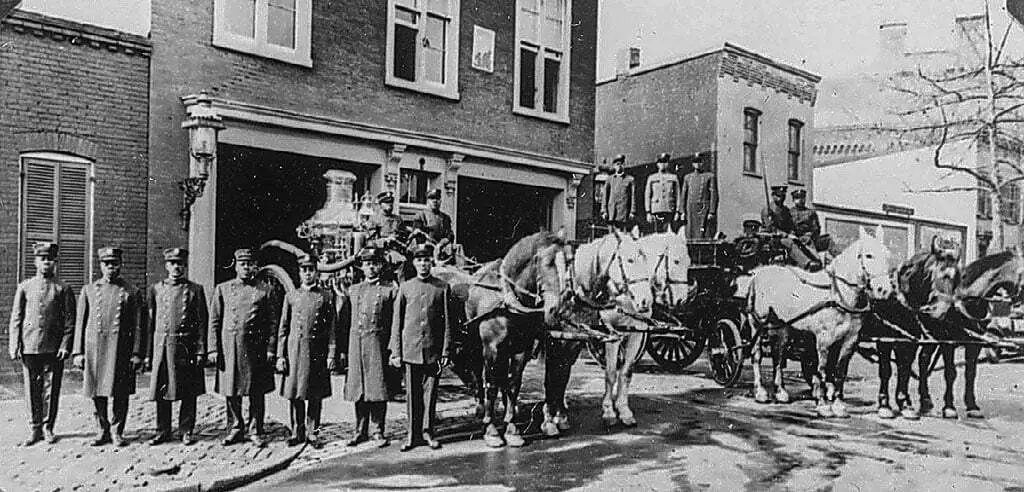
On April 13, 1919, Engine Company No. 4 was officially organized into the first “all-Negro” fire unit with three officers and eleven privates. The company was given two apparatus: a horse-drawn, steam-piston fire engine built in 1888 (rebuilt in 1909) and a 70 gallon twin-tank wagon also pulled by horses. It was not until 1921 that the company would receive its first motorized apparatus.


Engine Company 4 would go on to distinguish itself in numerous instances. Only three years after its creation, the company would respond to the Knickerbocker theater disaster of 1922. Two days of heavy snowfall caused the theater’s roof to collapse, killing 98 and wounding 133. Several members of the company were decorated for acts of bravery and valor during the rescue operations.
In 1940, Engine Company 4 relocated to 931 R. Street NW. While there, the company was responsible for overseeing the protection of U Street. Before the city was desegregated, that street of DC was referred to as “the Black Broadway.” The area served as an oasis in a city riddled with Jim Crow era policies and regularly attracted notable figures such as Louis Armstrong and Billie Holliday.
“During this time period, Mr. Gordon Parks, who was a professional photographer and would later become a professional director of motion pictures such as Shaft, ends up doing a photo essay on the group of individuals assigned to Engine Company 4, ”Battalion Chief Anthony Kelleher said. “Because their story was really not known publicly at the time, he does a very thorough photographic essay.” Mr. Parks’ photographs of Engine Company 4 remain accessible from the Library of Congress.
At the same time Gordon Parks began photographing the city, a young man by the name of Burton Westbrooke Johnson began his career in the DC Fire Department. Born on September 5, 1917, in Philadelphia, Pennsylvania, Johnson moved to DC at an early age. He graduated from Dunbar High School in 1934 and continued his education by attending courses American University, Ohio State University, University of Maryland, and Purdue University. Johnson was appointed to Engine Company 4 on January 16, 1943. However, his fire career was almost immediately put on hold as he began the first of two tours of duty with the U.S. Army in September of that year. By the end of his second tour, he was honorably discharged with the rank of Master Sergeant and several commendations including the Meritorious Unit Award, Good Conduct Medal, and Asiatic Pacific Theater Ribbon.
During Johnson’s distinguished 35-year career with the Fire Department, there were many firsts. He became the first black Sergeant, black Lieutenant, and black Captain-Commander in the Fire Prevention Division. He was the first black Battalion Fire Chief for the District of Columbia. He was the first black fire marshal for the District of Columbia. And finally, in 1973, he attained the highest rank in the entire department to become the first black Fire Chief in the history of the nation’s capital. It was also Chief Johnson who, in 1978, appointed Beatrice Rudder to become the first female firefighter in Washington DC


“At this point in history, a lot of firehouses in the city started to have nicknames or mascots,” Kelleher said. “What occurs at Engine 4 is they become known as The Hornet’s Nest.”
While there is some disagreement on how exactly The Hornet’s Nest earned its moniker – and whether or not the apostrophe is part of the name – those familiar with the history of the company all credit prior members’ drive and competitive nature as the likely cause.
“It’s a huge thing in the fire service to be able to put someone else’s fire out,” Kevin Brown, Technician for Engine Company 4 said. “Four Engine did some creative things to swoop in and put other companies’ fires out. Whether it’s going through a window on the floor above and coming back down, or going through the back door and coming through the front to put the fire out. Essentially when that happened, the guys from Four Engine would go, ‘You guys got stung.’ Additionally, a Battalion Chief who was in the Fourth Battalion way back in the day, he dubbed this firehouse as ‘The Hornet’s Nest,’ because of all the shenanigans that were going on inside. ”
After the passing of Chief Johnson in 2007, the fire station was dedicated to him in 2009. Since then, DC has undergone a mass hiring event to address the growth of the population and aging of structures throughout the city. The members of Engine Company 4 have settled into a comfortable rhythm of training and response as they continue to serve the city, and instill their values in the next generation.
“I’m surrounded by a high amount of knowledgable people,” Probationer Bill Johnson said. “The Chiefs here have nothing less than fifteen, twenty years, on the job. It’s a high pedigree of knowledge. There are no shortcomings, as far as Engine Four. ”


Project by Roland Hesmondhalgh (CLICK HERE FOR THE INTERACTIVE VERSION)
[ad_2]
Source link



