












[ad_1]
Maine’s transportation system is largely focused on moving cars quickly from point A to point B. But this focus risks missing the point entirely—and serves to create congestion, cost, and carbon pollution.
If we are to meet the challenge of the climate crisis, Maine needs to deliver healthier, more affordable and accessible transportation options that connect Maine people from Portland to Presque Isle to jobs, services, and their community. This paradigm shift requires changes to the way we plan and fund transportation projects through the Maine Department of Transportation (MDOT), a point emphasized in a Portland Press Herald editorial entitled, “We can choose to build roads that work for everyone.”
The good news is that MDOT is signaling that change could be coming, and new Federal funding through the Bipartisan Infrastructure Law (BIL) can help make it happen.
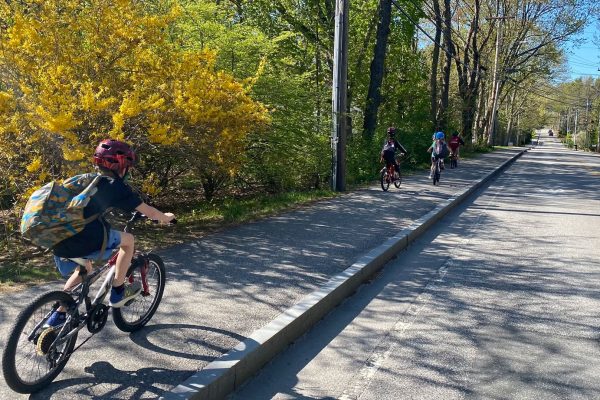
Photo by Colin Durrant
There are many ways in which we must adapt and change to act on climate, and the transportation sector is a great place to start. Emissions from cars and trucks account for more than half of the state’s carbon pollution. Of that, light-duty cars and trucks are responsible for 59% of carbon emissions from the transportation sector, with medium- and heavy-duty vehicles contributing another 27%. More than 80% of Maine households use two or more cars, and 78% of commuter trips in 2019 were taken by people driving alone. Beyond pollution, our prioritization of vehicles has a serious ongoing human cost: 2021 was the deadliest year for Maine pedestrians and bicyclists in history despite a drop in driving rates due to the pandemic.
Solving these problems requires changing our funding priorities. MDOT holds the transportation purse strings and has great flexibility in how it determines the projects that will be funded and pursued throughout the state each year. Historically, these have been heavily weighted toward highway expansion and bridge projects, with little allocation to or incorporation of transit, biking, walking, and rail that are healthier for our climate, our small business community, and our residents. This year, with extra funding coming to Maine through the recently passed Bipartisan Infrastructure Law, MDOT has indicated a commitment to more multimodal transportation projects. It has never been more important to see that commitment followed through with action.
Each January, MDOT releases a new three-year workplan, and the most recent version was released a few weeks ago. Maine has faced persistent transportation infrastructure funding shortages, estimated at $232 million annually. The Bipartisan Infrastructure Law brings a record $2.4 billion to Maine through a number of traditional funding avenues and competitive grant programs.
Climate change, and our response to it, will increasingly define Maine’s future, with escalating impacts piling up from our tidal pools to mountain ponds. Without a marked shift in priorities, no amount of funding will do enough to reduce our emissions and turn us decisively toward more people-centered transportation solutions. MDOT’s work plan reflects a notable shift toward lower-emission transportation systems. Let’s dive in.
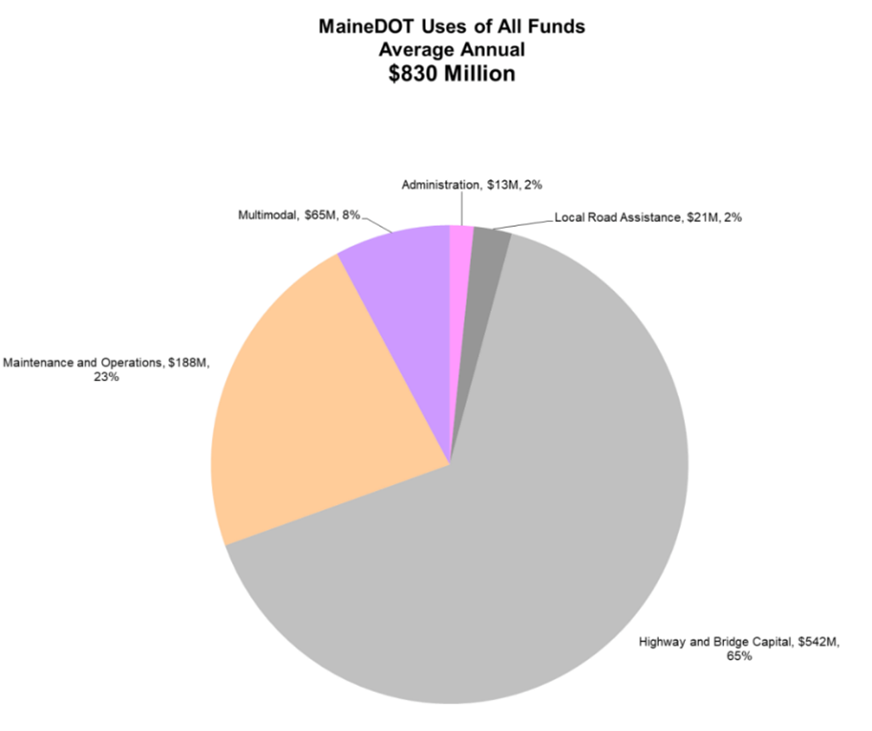
MDOT average use of annual funds
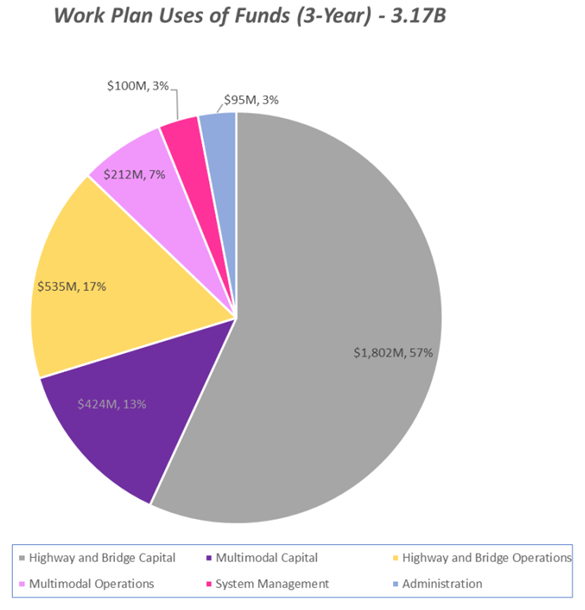
MDOT 2022 three-year plan projected use of funds
Previously, a mere 8% of annual MDOT funds went to multimodal projects, which includes ferries, rail, aviation, transit, and active transportation (like bicycle and pedestrian infrastructure). This time around, while the majority of funding is still largely projected to be spent on highways and bridges, we are seeing a significant increase in the allocation to multimodal funding. The 2022 three-year workplan not only shows an overall funding increase, but also a bump to the proportion of funding going to multimodal projects as can be seen in the graphics above.
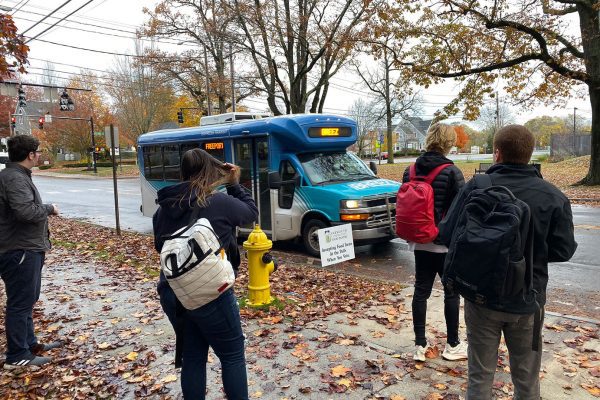
Photo by Colin Durrant
Don’t get me wrong, Maine’s roads do need repair. Our state received a C- grade on an infrastructure report card given by the American Society for Civil Engineers, and a typical Maine driver spends about $543 a year on costs associated with poor road conditions. What we don’t need are new highway or road expansions, which are both costly for ongoing maintenance and are shown to increase congestion and vehicle miles driven. Rather than spending tens or even hundreds of millions of dollars on highway expansions we don’t need, Maine would be far better off aligning investment with a “fix-it-first” mentality and further committing to expanding the options Mainers have for getting around cleanly and safely without a car.
MDOT’s singular influence on the largest sector of Maine’s emissions makes them a key player in our climate progress in Maine. The shift toward multimodal funding opportunities represents real progress, as do several planning processes and projects contained within the new three-year work plan. MDOT is embarking on a “Family of Plans” intended to assemble a longer-term vision of our state’s transportation future, including an Active Transportation Plan to build out our states walking and biking corridors, and a Strategic Transit Plan to bolster Maine’s notoriously underfunded transit system. At the same time, MDOT will be pursuing a Village Partnership Initiative to revitalize downtown areas and improve walking, biking, and transit access to those social and economic hubs.
Realizing the vision of these new programs and plans will require MDOT to both make better decisions about how it spends the money it is provided by the federal government while also aggressively pursuing competitive federal grant opportunities to invest in safe and reliable transit, biking, and walking infrastructure.
We are encouraged by these new planning and funding priorities. We look forward to supporting initiatives and funding that plan for a future for our state that is more centered around people than cars. As MDOT moves forward into the implementation stage, it critical that the multimodal projects highlighted in the three-year plan are pursued with as much diligence as projects that support our highway system. Climate change is a scary prospect, but it also provides the impetus for Maine to reimagine our current systems and redesign them to work better for everyone.
—by Josh Caldwell, NRCM Climate & Clean Energy Outreach Coordinator
[ad_2]
Source link