











[ad_1]

If you or a loved one are in crisis, please call the National Suicide Prevention Lifeline at 1-800-273-TALK (8255), or contact the Crisis Text Line by texting TALK to 741741.
Marisa McPeck-Stringham, a mental health therapist in Layton, Utah, watched an unsettling pattern unfold last week: Six of her clients, all transgender teenagers, said they were experiencing suicidal ideation caused by the state moving forward with a bill to ban gender-affirming care for minors.
The legislation made her young trans clients feel under attack, regardless of whether they planned to medically transition, she said. Some of her cisgender queer clients have also said they are stressed and anxious about the bill. McPeck-Stringham’s clinical director at the Wiconi Counseling Center — a rare trans-affirming mental health space in Utah’s Davis County — told her that three of her own trans teen clients last week expressed increased levels of suicidal ideation due to Utah’s new bill.
Then, over the weekend, it became law.
“Who knows what I’ll see this week?” McPeck-Stringham said. She worries about her young trans clients acting on these suicidal thoughts — and about whether the local resources she can direct them to will be trans-affirming and safe, especially in situations involving hospitalization.
Utah’s law went into effect on Saturday, making it the first new anti-trans law in the country this year. The ACLU of Utah and the National Center for Lesbian Rights are planning a lawsuit. The ban does not impact trans youth previously diagnosed with gender dysphoria — effectively those already receiving gender-affirming care before this weekend — but it does place an indefinite moratorium on access to hormone therapy and puberty blockers for future patients. While the ban is in place, lawmakers have ordered a “systemic medical evidence review” of such care for minors. The purpose of that review is to provide the legislature with recommendations to consider when deciding whether to lift the ban, the bill reads.
The bill, introduced the first day the Utah legislature opened and signed in just under two weeks, seemed to local advocates to move incredibly swiftly. It marks the beginning of a session occupied by several other bills that advocates say will harm trans and LGBTQ+ youth, deepening advocates’ frustrations with the state’s Republican Gov. Spencer Cox. Last year, the governor vetoed a ban on trans students joining school sports that match their gender identity; now, he has moved forward to implement restrictions on care for trans youth.
“If one trans child takes their life because of this bill, the blood is on your hands Governor,” McPeck-Stringham tweeted.
“I don’t think it’s just the governor,” she added later in an interview with The 19th. “I think it’s the [lawmakers] who voted. They’re putting their political careers above the lives of children. That’s not the kind of values I want our state to have.”
McPeck-Stringham and her colleagues develop safety plans with their clients after they express suicidal ideation — figuring out safe people for their client to call, locking up implements that can be used for self-harm, and creating a plan to alert their parents when the ideation becomes more serious. One of her six trans clients who’d expressed ideation related to the bill already had a safety plan in place due to consistently experiencing such feelings.
The sentiment from those trans youth was, “If our governor hates us, why do we want to live here, or anywhere?” she said. On Monday, two of her teenage clients who are queer and gender fluid but who don’t identify as trans brought up the bill organically in their sessions, saying they want to move out of Utah when they become adults.
The governor’s office declined to make Cox available for an interview or provide comment on either the lawsuit or the law’s potential harm to trans teenagers.
“It was kind of surprising to see a governor who said he cared about trans children to just automatically sign this bill into law without much of a fight. That was disappointing. I think it felt to people that they lost an ally. These are just things that have come up in session,” said McPeck-Stringham, whose clients include both adults and minors.
In his veto statement against the state’s sports bill last year, Cox criticized the legislative process that proposed restricting trans students in school sports, as well as the likelihood of the bill to invite lawsuits — and he cited data indicating that many trans youth experience suicidality.
“Rarely has so much fear and anger been directed at so few,” Cox wrote at the time, after pointing out that the bill would target a small number of transgender students. “I don’t understand what they are going through or why they feel the way they do. But I want them to live. And all the research shows that even a little acceptance and connection can reduce suicidality significantly.”
His veto was overridden by state lawmakers and the ban went into effect last summer, before it was blocked last August by the Third Judicial District Court of Utah. In his signing statement for the state’s gender-affirming care ban, Cox wrote: “We sincerely hope that we can treat our transgender families with more love and respect as we work to better understand the science and consequences behind these procedures.”
To McPeck-Stringham, those words ring hollow.
“If he actually treated trans people with love and respect, he would give them the dignity of believing that they’re the experts in their own lives,” she said.
Medical groups including the American Medical Association (AMA) and the American Academy of Pediatrics oppose state bills that prohibit hormone therapy and puberty blocker treatments prescribed to trans youth to treat gender dysphoria. The AMA has specifically urged governors to oppose such bills.
The ACLU of Utah and the National Center for Lesbian Rights (NCLR) are preparing a lawsuit against the bill. Shannon Minter, legal director of the NCLR, last year found Cox’s veto of Utah’s sports bill an encouraging sign. He doesn’t understand the governor’s shift.
“It’s really distressing,” Minter said. “I don’t understand why there’s such a stark difference between his understanding and compassion for the harm caused to transgender kids by the sports ban and his apparent inability to see that with this much more damaging law.”
To Minter, a legal challenge against bills like Utah’s going into effect is inevitable — the same pattern has played out in Arkansas and Alabama, and is expected to play out in Florida as the state’s board of medicine finalizes a gender-affirming care ban.
With five more weeks of the state’s legislative session left, Marina Lowe, policy director of Equality Utah, has her sights on the next round of anti-LGBTQ+ legislation coming from the statehouse.
One bill currently being considered by the House Business and Labor Committee would loosen the state’s prohibition on conversion therapy by allowing methods given through verbal or written communication, while continuing to prohibit physical abuse. Another bill in the House Rules Committee would ban minors from being able to update their name or sex on their birth certificate. A third bill aims to restrict schools from changing a student’s gender identity in their education record without written parental consent.
Utah’s ban on gender-affirming care went through much faster than other bills that she’s seen, Lowe said — and these three bills are already moving quickly. “It seems like things like this are getting fast-tracked,” she said.
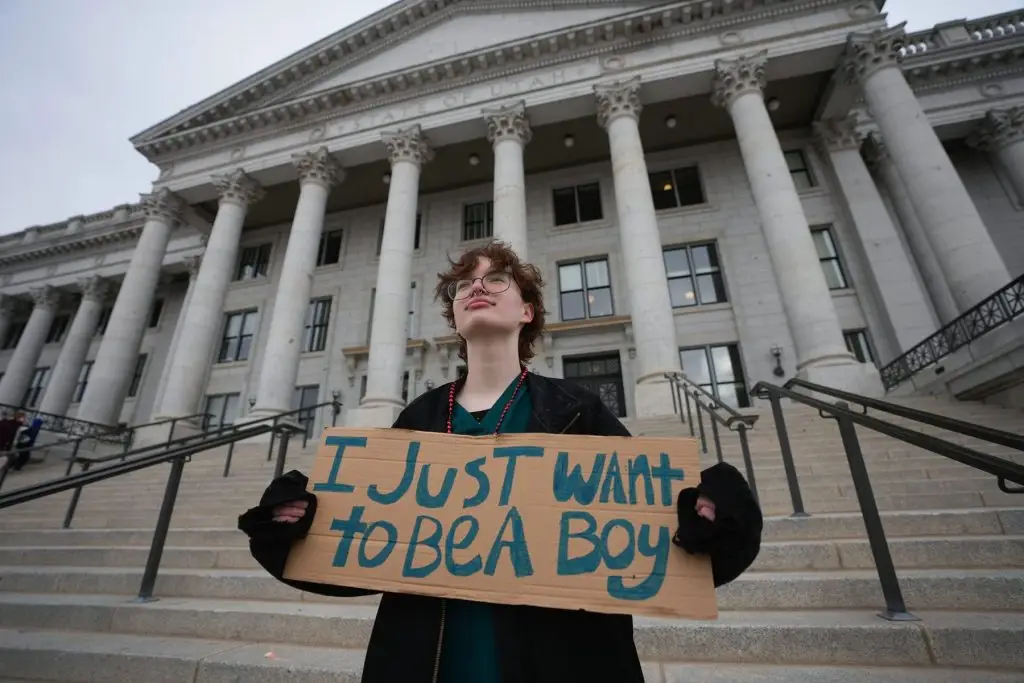
Alongside those fast-paced legislative efforts, Utah advocacy groups and local LGBTQ+ people have moved just as quickly to respond. Aaron Welcher, communications director for the ACLU of Utah, reflected that the organization helped host a rally on the capitol’s south steps last week. Young people and local activists held a protest outside the governor’s office last Friday.
As the state’s legislation targeting trans youth picks up speed, McPeck-Stringham and her colleagues are tasked with putting together survival and safety plans for their trans clients experiencing suicidal ideation.
“Every day we’re in between sessions, talking about, ‘Oh, got to write another safety plan because of this bill.’ Every time I have to write one it’s heartbreaking to me,” she said.
McPeck-Stringham knows her trans youth clients already face stigma in their daily lives — and then on top of that, she worries about the effects of the state government removing access to care that might help them. One client, for instance, can’t use the bathroom of their choosing at school. “It’s gotten so bad that they were self-harming,” she said.
And though she sees her patients go through a lot, she reflects that the parents sending their kids to her are the ones that care enough to find a trans-affirming therapist. She’s worried about what happens to kids who don’t have affirming parents that won’t accept their name or pronouns.
For trans and LGBTQ+ youth who are coping with the current political situation in the state, McPeck-Stringham recommends the Utah Pride Center in Salt Lake City and the organization’s trans teen support group — as well as the SafeUT app, and to remember 988, the national suicide prevention number.
[ad_2]
Source link