












[ad_1]

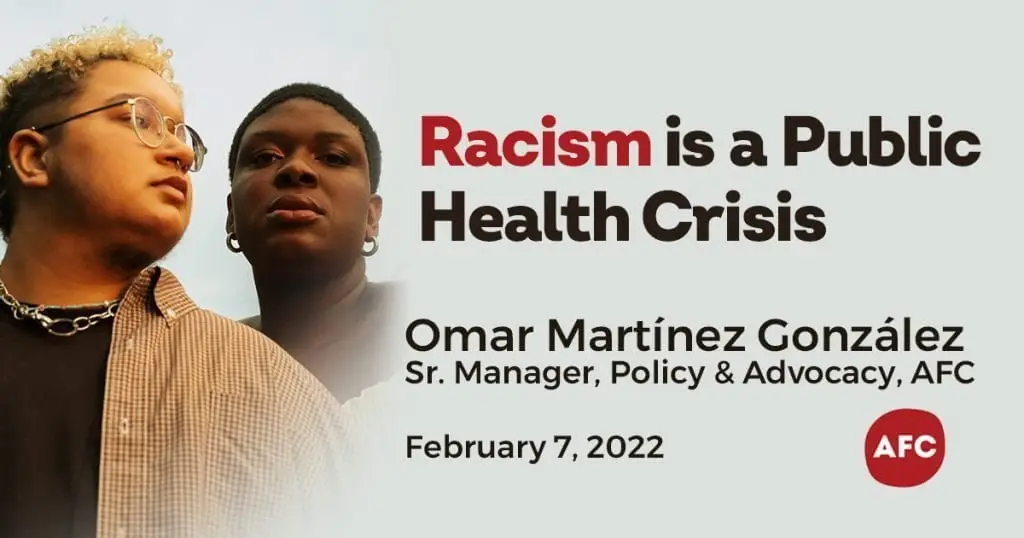
Racism is a public health crisis. This is evident in the decades of public health data that show disproportionate levels of morbidity and mortality among people of color, and in particular Black and Latino/a/e/x people. These trends are rooted in the legacy of racism and the extent to which it has permeated into public health, health care, and other systems. Beyond health care, we have understood for over two decades the profound impact that non-medical factors—so-called social determinants—have on health and life expectancy outcomes. Housing inequality, environmental pollution, and lack of community investment diminish quality of life and lead to chronic disease. Until we address racism in public health and other support systems, Black and Latino/a/e/x people will continue to be left behind. Therefore, AIDS Foundation Chicago calls on Illinois and the city of Chicago to take a bold stance on behalf of Black and Latino/a/e/x people by declaring racism a public health crisis, as other jurisdictions in the United States have done, and to mobilize vital resources to eliminate racist structures and policies that continue to threaten our communities.
On the shortcomings of the public health system. The failure of the public health system to work for Black and Latino/a/e/x people is readily apparent in the HIV epidemic in the United States. According to the Centers for Disease Control and Prevention (CDC), there were an estimated 1.2 million adults and adolescents living with HIV in the United States at the end of 2020, of which 30,692 people were newly diagnosed that year. Of these new diagnoses, Black people accounted for 42% despite Black people making up only 13% of the entire U.S. population, and Latino/a/e/x people accounted for 27% despite Latino/a/e/x people making up only 18% of the population. Of the 1,286 new HIV diagnoses in the state of Illinois in 2019, 50% of these were among Black people and 23% among Latino/a/e/x people. Meanwhile, Black people made up just 14% and Latino/a/e/x people just 18.2% of the entire population in Illinois in the 2020 census.
When we look at access to Pre-Exposure Prophylaxis (PrEP), first approved by the Food and Drug Administration (FDA) to prevent HIV in 2012, we see the same disparities. Of the 18,131 PrEP users in Illinois in 2021, only 12.5% were Black and only 16.8% were Latino/a/e/x. Not only do these two groups bear the brunt of the HIV epidemic, but they also have less access to powerful and proven prevention options that have been available for over a decade. Notwithstanding, Illinois’s rate of PrEP uptake is twice that of neighboring states thanks to Illinois’ bold commitment to end HIV by 2030 through the implementation of the Getting to Zero plan. By laying out a clear and actionable roadmap, the state has been able to dedicate resources to achieve this bold goal and has a means of holding itself accountable.
On health care disparities. A report by the Chicago Department of Public Health found that, in 2017, there was an 8.8-year gap in life expectancy between Black people and white people, driven primarily by disparities in chronic disease incidence, gun-related homicide, infant mortality, HIV and other infectious disease, and opioid overdose. As a direct result of the COVID-19 pandemic, we also saw the life-expectancy gap widen to 10 years between Black and white people, and Latino/a/e/x people saw a drop in life expectancy of three years, the largest of any group. Despite the launch of the Initiative to Eliminate Racial and Ethnic Disparities in Health by the Year 2010 in the late 90s, generally seen as the U.S. government’s first major attempt to address health disparities, these persist. While clinicians, public health, and elected officials have recognized the implications of systemic, interpersonal and internal racism on racial disparities in health and quality of life outcomes for decades, we have largely failed to explicitly call out the legacy of racism in our public institutions and to mobilize resources to dismantle it.
Localities that have declared racism as a public health crisis have proposed as remedies: the creation of an office or taskforce to gather data on racial inequities in their respective communities, the allocation of new or repurposed funding for racial justice work, increased funding to public health entities, the promotion of an “equity in all policies” principle to ensure old and new programs are analyzed through the lens of racial equity, and more. These are just some of the ways that such a declaration can foster intentionality and accountability.
The role of racism in medical mistrust. Distrust in the medical establishment is deeply ingrained in Black and Latino/a/e/x communities and has impeded even the best-intentioned initiatives from success. Historical examples of medical abuse on Black and Latino/a/e/x people are abundant, such as the experimentation on enslaved Black women by John Marion Sims, lauded as the “Father of American Gynecology” (and who gave rise to the racist myth that Black women experience pain less severely than white women), the exploitation of Henrietta Lack’s cancer cells for scientific research which has generated billions of dollars in profits for private companies, and the targeted, forced, and government-sanctioned sterilization of Black, Mexican, Puerto Rican, and Indigenous women from the 1910s to the 1960s.
Yet people of color experience these injuries daily in the present day. In September of 2020, there were reports of a whistleblower complaint that immigrant detainees at the Irwin County Detention Center (ICDC) in Ocilla, Georgia, a subcontractor of the Department of Homeland Security (DHS), were being denied COVID-19 testing, medical records were being fabricated, and COVID-19 cases were being underreported. Most shockingly, the complaint alleged that female detainees were being given unnecessary hysterectomies and without a full knowledge and understanding of the procedure they were undergoing. Members of Congress immediately called on DHS to investigate these allegations, specifically citing the United States’ history of forced sterilization and medical racism, and on May 20, 2021, DHS under the Biden administration announced the closure of that facility along with another detention facility in Massachusetts with a history of civil rights abuse.
In December 2020, Dr. Susan Moore’s story resonated with Black people—particularly with Black women—when her white attending physician refused to manage her pain while she was hospitalized with COVID-19. In a series of social media posts, she documented the failure of her clinician, not only to take her complaints of pain seriously, but of his refusal to treat her with Remdesivir, one of the first treatments approved by the FDA to manage COVID-19 infection. A physician herself, Dr. Moore was able to advocate for herself to get the care she needed before being discharged. Tragically, she was readmitted to a different hospital and died of COVID-19 complications just over two weeks after her initial hospital admission. The disproportionate impact of the COVID-19 pandemic on Black, Latino/a/e/x and Indigenous people was so evident and the quality of treatment so disparate, that the Centers for Disease Control and Prevention (CDC) issued guidance to clinicians alerting them of the detrimental effects of implicit bias on communities of color.
Racism as a housing barrier. Housing is health care, a notion that is evident among people living with HIV, for whom housing continues to be the biggest unmet need. When people are experiencing unstable housing, it is nearly impossible to prioritize taking daily medication to stay healthy or attending regular medical appointments. This of course extends beyond HIV. Housing inequities between people of color and white people have their roots in the racist, post-Civil War Jim Crow laws, and the redlining policies of the federal government. Simply taking a ride in Chicago’s public transit from the generally more white and affluent north side of the city to the primarily Black south side or Latino/a/e/x west side is enough to witness the legacy of these harmful and decades-old policies. While the Fair Housing Act of the 1960s criminalized inequitable treatment based on race and ethnicity, we know that these practices continue to occur today, albeit indirectly through such measures as crime-free housing ordinances which prevent people with criminal records from accessing certain housing opportunities. Black and Latino/a/e/x people are disproportionately impacted by the criminal justice system and thus many are locked out of affordable housing, which presents yet another barrier to accessing quality and stable care, and which contributes to the health disparities we see.
On perpetuating racist structures through the criminal justice system. According to the National Institute of Justice, Black people account for 28% of all arrests in the U.S., and almost 40% of the incarcerated population. However, incarceration statistics only paint part of the picture. In 2013, Black people accounted for 30% of probationers and 38% of parolees despite making up a minority of the entire U.S. population. A criminal record can make it harder for people of color, and especially Black people, to find and maintain gainful employment, with some studies showing that it can lower the likelihood of a job call-back or offer by as much as 50%. This undoubtedly impacts housing stability, and locks individuals out of employer-based health insurance among other benefits that adversely impact health and wellness. One study on reentry in New Haven, Connecticut, found that a history of incarceration impacted people’s ability to finish their formal education, and confirmed the adverse impact on finding a job and maintaining housing The same study found that white individuals were more likely than Black individuals to report being caught doing something illegal by police and being let go. Until we address the racial inequities of the criminal justice system, we will continue to see these racial disparities persist.
On environmental racism. Air pollution not only leads to greater incidence of chronic obstructive pulmonary disease and asthma, but it also impacts cardiovascular, neural and digestive health. It is unsurprising then that, since 2019, primarily Black and Latino/a/e/x communities in Chicago’s southeast side have banded together in opposition to the relocation of a metal scrap business to their community from the primarily white Lincoln Park neighborhood on the city’s north side. The metal scrap business has been cited 11 separate times for pollution and noise violations, and this was part of the reason the City Council voted to deny their relocation permit. What is striking is the city’s involvement in fast-tracking the permit process until residents voiced their concerns. This prompted the federal Housing and Urban Development (HUD) agency to open a multi-year investigation into the practices of the city in approving the relocation of polluting entities into Black and Latino/a/e/x neighborhoods, which culminated in 2022 in a reprimand from HUD, accusing the city of outright discrimination. HUD has given the city an ultimatum—voluntarily agree to address disparities in environmental impacts on Black and Latino/a/e/x communities or lose hundreds of millions in federal housing dollars.
If Illinois is serious about improving health outcomes for Black and Latino/a/e/x communities, it must declare racism a public health crisis, and outline specific actions for change across multiple systems—including public health, health care, housing, criminal justice, and environmental protection—modeled after those proposed in other localities that have declared racism a public health crisis. The COVID-19 Public Health Emergency taught us that where there is a will to get ahead of a crisis, there is a way to make it happen through robust investment of resources and policy changes. It is long overdue for the state of Illinois and localities throughout it, including the city of Chicago, to declare racism a public health crisis and to take specific, measurable actions to address this 400+ year old crisis.
Categorized under
Advocacy, AFC news, Inside Story and Public Statements.
[ad_2]
Source link