











You can explore healthcare career options through resources like the U.S. Bureau of Labor Statistics Occupational Outlook Handbook, local community colleges, workforce development programs, and organizations like the National Institutes of Health and Health Resources and Services Administration, which provide guidance on training, certifications, and job outlooks in healthcare fields.Quick Answer: Where can I find information about healthcare career paths and training programs?
Healthcare is quietly becoming the backbone of the U.S. economy, driving job growth at a time when other industries are slowing down or being reshaped by technology.
Recent labor data shows a striking trend. Over the past year, the U.S. added about 156,000 jobs overall, yet healthcare alone accounted for roughly 375,000 new positions. This means that without the medical sector, the broader economy would have lost jobs during that period. The numbers reflect a major shift in where economic growth is happening.
Federal data supports this pattern. The U.S. Bureau of Labor Statistics projects that healthcare and social assistance will remain the fastest-growing sector over the next decade, fueled largely by rising demand for care.
For communities of color, this shift carries significant implications. Many traditional high-paying industries remain geographically distant or require advanced degrees that are not always accessible. Healthcare jobs, however, are expanding within neighborhoods, offering more immediate and local pathways to employment.
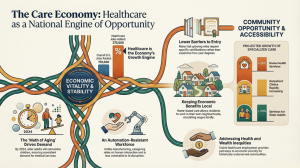
Experts say this trend is tied to a major demographic change. By 2034, older adults are expected to outnumber children in the United States, according to Census Bureau projections. As the population ages, the need for healthcare services continues to grow regardless of economic conditions.
This shift has been described by economists as a “care economy,” driven by what some call the “math of aging.” Older populations require more consistent care, from routine medical visits to long-term support. Unlike other industries, this demand does not depend on global markets, trade policy, or technological disruption.
That stability makes healthcare a critical economic safeguard. While sectors like retail and manufacturing are affected by automation and artificial intelligence, caregiving jobs rely on human interaction. The Bureau of Labor Statistics notes that demand for healthcare workers will remain strong because aging populations require more hands-on care and support.
Stay Informed. Stay Empowered.
This reliability is especially important for communities that have historically faced economic instability. Workers of color are often among the first to be affected during downturns. In contrast, healthcare offers a more consistent source of employment that is less vulnerable to sudden job losses.
At the same time, the nature of healthcare jobs is changing. Much of the growth is no longer centered in hospitals. Instead, it is shifting toward lower-cost settings like home health services and outpatient clinics. Federal labor projections show that services for older adults and people with disabilities are among the fastest-growing segments, with increases exceeding 20 percent in some areas.

This shift matters because these roles are often more accessible. Many positions, such as home health aides and medical assistants, require certifications rather than four-year degrees. This creates faster entry points into the workforce, especially for young people who may not have the resources for extended education.
The impact extends beyond employment. Public health research consistently shows that economic stability is closely linked to health outcomes. The Centers for Disease Control and Prevention identifies stable income and employment as key factors that influence physical and mental health.
In communities of color, where disparities in income and access to care persist, the expansion of healthcare jobs can help address both economic and health inequities at the same time.
There is also a growing need for culturally competent care. As the population ages, many older adults prefer providers who understand their language, culture, and lived experiences. Yet workforce shortages remain, particularly in communities of color.
Federal workforce projections warn of gaps across multiple healthcare roles in the coming years, including behavioral health and long-term care positions. Expanding the workforce within these communities could help close those gaps while improving care quality.
Another key factor is where the economic benefits are felt. Many healthcare jobs, especially in home-based care, are performed locally. Workers are employed within their own neighborhoods, reducing long commutes and keeping wages circulating in the community.
This local impact is significant. When residents earn income close to home, they are more likely to spend money at nearby businesses, supporting broader economic activity.
However, challenges remain. Many healthcare services in underserved communities depend heavily on Medicaid funding. Policy changes or funding cuts could reduce reimbursement rates and affect job stability. In addition, a large share of home healthcare workers are immigrants, and changes in immigration policy could lead to workforce shortages.
Despite these risks, the overall trend is clear. Healthcare is doing much of the heavy lifting in the U.S. economy, creating jobs at a scale that few other sectors can match.
For communities of color, this moment represents a shift in how opportunity is defined. Healthcare is no longer just a system people rely on in times of need. It is becoming a pathway to stable careers, stronger local economies, and improved health outcomes.
As the demand for care continues to grow, the sector is positioned to play an even larger role in shaping the economic future of underserved communities.
Stay Informed. Stay Empowered.