









- By Subash Kafle
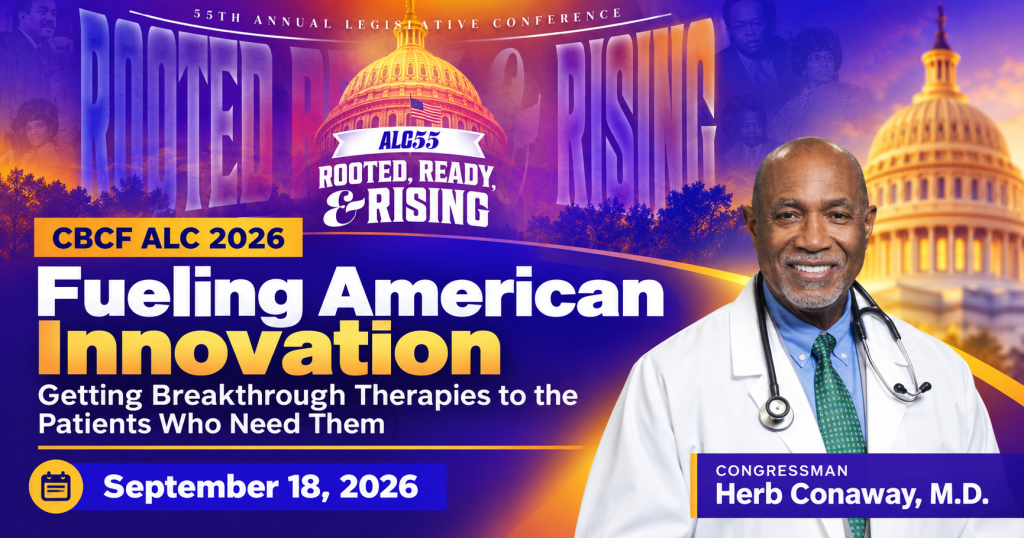
WASHINGTON — At CBCF ALC 2026, healthcare, advocacy and policy leaders will gather this week for a discussion focused on a central challenge in American medicine: how to ensure that scientific breakthroughs reach the patients and communities who need them.
The third-party session, “Fueling American Innovation: Getting Breakthrough Therapies to the Patients Who Need Them,” is scheduled for Sept. 18 at 9 a.m. at the Walter E. Washington Convention Center in Washington, D.C. The discussion will take place during the Congressional Black Caucus Foundation’s 55th Annual Legislative Conference, which runs Sept. 16 through Sept. 20.
The Annual Legislative Conference, or ALC, is the Congressional Black Caucus Foundation’s flagship public-policy gathering. CBCF describes it as the leading policy conference focused on issues affecting African Americans and the global Black community, bringing together lawmakers, policy experts, advocates, industry leaders and community members for discussions on public health, education, economic development, civil rights and other national issues.
This year’s theme, “Rooted, Ready & Rising,” coincides with CBCF’s 50th anniversary. According to the foundation, the five-day conference will feature more than 100 public-policy forums in addition to signature events and other programming.
“The Annual Legislative Conference has stood the test of time as a homecoming for Black political power and thought,” Nicole Austin-Hillery, president and CEO of the Congressional Black Caucus Foundation, said in announcing this year’s conference theme.
The Sept. 18 health session will feature special remarks from Congressman Herb Conaway, M.D. Wendy Short Bartie of Bristol Myers Squibb will moderate the discussion. Bartie currently serves as the company’s executive vice president and chief corporate affairs officer.
Panelists include Dr. Gary Puckrein, president and CEO of the National Minority Quality Forum; Angela Sailor of the American Cancer Society Cancer Action Network; and Dr. Jennifer Ellis of the Association of Black Cardiologists. The session is sponsored by Bristol Myers Squibb.
According to event materials, the discussion will bring together leaders from healthcare, advocacy and policy to examine ways to accelerate medical innovation while expanding access to breakthrough therapies.
Why access to medical innovation matters
The conversation comes as advances in treatment continue to reshape medicine while substantial differences in health outcomes persist across communities.
The American Cancer Society reports that Black people continue to face disproportionately high mortality from several cancers. Black women, for example, are 38% more likely to die from breast cancer than White women despite being less likely to be diagnosed with the disease. Differences in stage at diagnosis and access to timely, high-quality treatment contribute to the disparity, according to the organization.
Other diseases show similarly significant differences. The American Cancer Society reports that multiple myeloma is more than twice as common among Black people as White people.
Cardiovascular disease also continues to place a disproportionate burden on Black communities. In a May 2026 update, the American Heart Association reported that high blood pressure affects 62.3% of non-Hispanic Black men and 59.2% of non-Hispanic Black women. High blood pressure is a major risk factor for heart disease and stroke.
Ensuring that medical advances serve diverse patient populations also begins during clinical research. In final guidance issued in December 2025, the U.S. Food and Drug Administration recommended approaches for increasing enrollment of representative populations in clinical trials supporting applications for new drugs and biologic products. The agency said broader participation can help study populations more accurately reflect the patients who may ultimately use a treatment and allow researchers to better evaluate safety and effectiveness across patient groups.
For communities experiencing differences in disease burden, diagnosis, treatment and survival, the question is therefore not only whether new therapies can be developed. It is also whether patients can participate in the research behind those therapies and obtain timely access once new treatments become available.
That intersection of scientific innovation and health access will be at the center of the Sept. 18 discussion as policymakers, clinicians, advocates and industry leaders gather in Washington for the 55th Annual Legislative Conference. The conversation will examine how advances in medicine can translate into meaningful improvements for patients, including communities that have historically faced barriers to timely, high-quality care.
Also Read: NMQF Expands Early Detection Work in Michigan as Flint Research Effort Nears Enrollment Goal
Trending Topics
Features
- Drive Toolkit
Download and distribute powerful vaccination QI resources for your community.
- Health Champions
Sign up now to support health equity and sustainable health outcomes in your community.
- Cancer Early Detection
MCED tests use a simple blood draw to screen for many kinds of cancer at once.
- PR
FYHN is a bridge connecting health information providers to BIPOC communities in a trusted environment.
- Medicare
Discover an honest look at our Medicare system.
- Alliance for Representative Clinical Trials
ARC was launched to create a network of community clinicians to diversify and bring clinical trials to communities of color and other communities that have been underrepresented.
- Reducing Patient Risk
The single most important purpose of our healthcare system is to reduce patient risk for an acute event.
- Subash Kafle
- Jessica Wilson
- Subash Kafle