











[ad_1]

It’s a practice that’s inherent in Kate Fox’s work and research. As professor and director of the Research on Violent Victimization Lab, which was established in January 2020 through a generous ASU Women and Philanthropy grant, Fox and her student-led team must tread lightly while being diligent in the pursuit of justice.
“There are many barriers in why numbers of missing Native American peoples go unreported,” said Fox, who was a guest speaker on the “Bridging Research, Advocacy and Policy to Address Missing and Murdered Indigenous Peoples” panel. “Trust in law enforcement, trust in victim advocacy, trust that something will be done about the case and that it will be taken seriously … it’s all connected to historical trauma and colonization.”
Fox said her team members, almost half of whom are Native American, do a lot of listening instead of talking to earn trust in the tribal communities where they conduct their research.
“We listen to the experts, which are Indigenous people because they are used to research in many, many different capacities,” said Fox, whose research unit is housed in ASU’s School of Criminology and Criminal Justice. “It has to be Indigenous-led so that researchers can come in, help, connect and collaborate to help solve a collective problem. Data needs to be collected with Indigenous peoples, not on Indigenous peoples. We are very much dedicated to this in perpetuity.”
Reaching out to tribal nations also means pulling up the next generation of Indigenous scholars not only to continue their work but maintain respectful research methodology.
Angela Gonzales, a member of the Hopi tribe and an associate professor in ASU’s School of Social Transformation, is the co-principal investigator of a $750,000, three-year grant to train rising Indigenous researchers. Supported by Genetech, a member of the Roche Group, the Indigenous Health Equity Initiative is one of 30 groundbreaking projects selected for the 2022 Genetech Innovation Fund.
“Our goal with this grant is to develop gold-standard policies and practices that support tribal sovereignty and promote institutional transformation grounded in respectful, reciprocal and equitable research partnerships between universities and Native communities … to use so that they too can engage in respectful and reciprocal practices,” said Gonzales, who co-leads the grant with Nate Wade, executive director for strategic initiatives and innovation, and an assistant research professor in the College of Health Solutions, with support from Gary F. Moore, a researcher in the Biodesign Institute’s Center for Applied Structural Discovery and an associate professor at ASU’s School of Molecular Sciences.
Moore heads up the ASU-Berkeley Lab STEM Pathways Program, which provides travel, a stipend and housing costs for Indigenous undergraduates interested in obtaining a PhD in STEM.
“The idea is to find matching pairs of researchers and students with an interest in STEM and provide a pipeline for them,” said Moore, a chemist from the Powhatan Pamunkey tribe in Virginia. “We want to get them excited about a career in STEM, which is vast and could include science, technology, engineering, mathematics and even architecture.”
Colin Ben’s research has also contributed to helping Indigenous students become more successful in academia. As an assistant research professor in the School of Social Transformation, Ben (Navajo) and Jessica Solyom, also an assistant research professor in the school, recently submitted a chapter titled “How Unique Ways of Knowing, Being and Learning Contribute to Persistence Factors Among Underrepresented Students” to editors David J. Nyguyen and Christina W. Yao for their 2022 publication “A Handbook for Supporting Today’s Graduate Students.”
“The chapter draws on my previous research on the decision-making factors that led Navajo students to want to pursue doctoral education,” said Ben, who is also the associate director of the Center for Indian Education. “ASU is truly leading the way in graduating and investing in and meeting the needs of our Indigenous students who are living and working within their tribal communities.
“And that’s what makes working at ASU so exciting.”
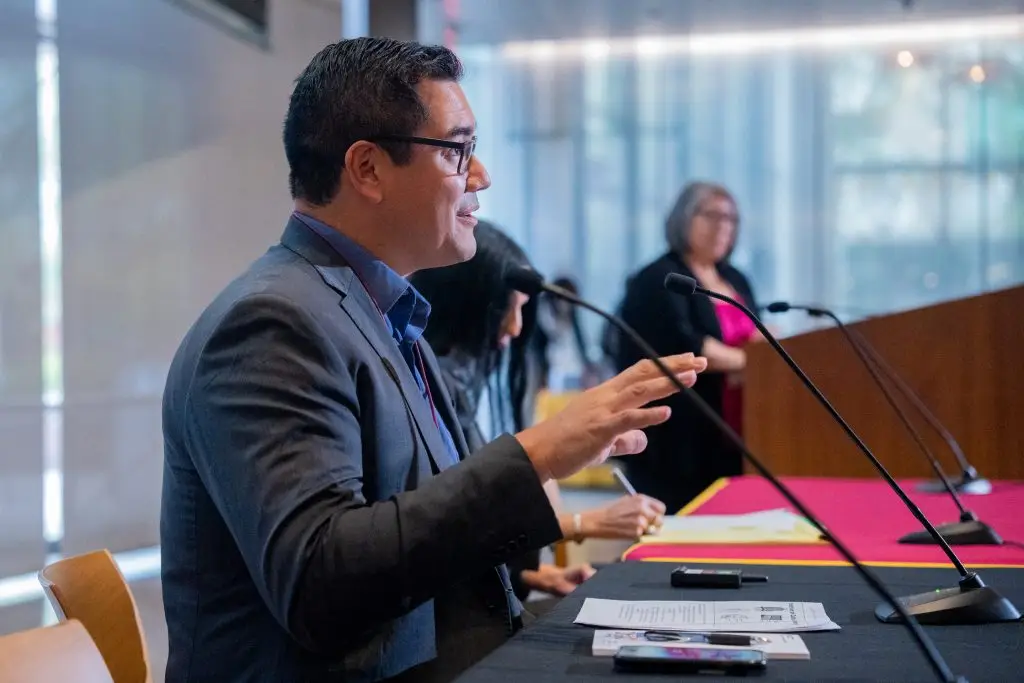
Top photo: Associate Professor of law Trevor Reed speaks during a panel discussion on “Threats to Tribal Sovereignty” at the Armstrong Great Hall inside the Beus Center for Law and Society on ASU’s Downtown Phoenix campus on Dec. 16. Photo by Samantha Chow/Arizona State University
[ad_2]
Source link