







- By FYH News Team
[ad_1]
In a petition, students at the Bloomberg School of Public Health (SPH) have called on its leadership to implement anti-racism and anti-colonialism into the school’s curriculum and reckon with the institution’s own history of racism.
Loraine Arikat, a student at the School of Public Health and member of the SPH Student Organizing Group, explained the group’s goals in an interview with The News-Letter.
“It was pretty clear from Orientation itself that Hopkins was going to kind of erase all of this history that’s been happening in East Baltimore and the ongoing advocacy of community members,” Arikat said. “There was not a real discussion on what our role is as students coming into a new area and how we can be a part of aggravating issues like gentrification.”
Arikat’s background is in social work in Baltimore. From working at the University of Maryland School of Social Work, she learned how that institution is reckoning with its own history and wants to see SPH do the same.
One way Arikat wants to see change is within the overall structure of SPH’s leadership and its commitment to transparency.
“We’re also pushing for greater transparency and accountability on department chairs who are responsible for implementing diversity, equity and inclusion into their department,” she said. “We’re pushing for understanding public health from both an anti-racist lens but also an anti-colonial, as a lot of the work that Hopkins does is focused on global health.”
Arikat discussed how one measure the students are calling for is a box on all course evaluations that would ask students to evaluate the professor and the course on how well it includes anti-racist content and if the structure of the class fosters critical engagement in these issues.
“Our long-term goal for this petition is to create the foundation of the infrastructure for greater student involvement and community member involvement in the decision-making of policies that impact community members,” she said. “We want to be involved with curriculum decisions that impact all of our education [as] future public health professionals that will go out and do community health work.”
Located near Hopkins Hospital, the Middle East neighborhood has been part of a major redevelopment initiative to expand the University’s medical campus into a biotech hub for Hopkins-affiliated students and entrepreneurs.
This initiative has displaced around 800 predominantly Black and brown families. Long-time residents of the community say this project is gentrifying neighborhoods and creating a hostile relationship between the people Hopkins Hospital serves and the institution it represents.
SPH student Johanna Marie Jornadal discussed the University’s role in Middle East and the impacts it has there.
“There’s a clear segregation between academia and our community. There are a lot of factors that Hopkins perhaps can’t control in terms of gentrification, even though they are big stakeholders in it, or with policing,” she said. “There are things that Hopkins can do, for instance, like putting out a public statement against on-campus policing — or actually taking our recommendations and implementing them.”
Paula Kahn, another SPH student organizer, also spoke to the importance of a public health curriculum that addresses the root issues of health inequity. She highlighted that the prestige SPH carries contrasts with the gaps in its educational curriculum.
“I came to the School of Public Health to study potential frameworks for violence prevention, particularly thinking about U.S. militarism and how that disproportionately affects communities of color around the entire planet,” Kahn said. “I was really disappointed to be in classes with professors that did not represent me or identified with promoting ideologies that are going to produce a very particular kind of public health practitioner that may be complicit in imperialism.”
Kahn also spoke to the emotional and mental burden of constantly being the spokesperson in talking about these issues.
“It’s exhausting to consistently challenge people in the classroom to reframe their thinking, and it’s not trauma-informed or survivor-centered,” she said. “It seems like professors are uncomfortable with really addressing the historical wounds that perpetuate the violence on the historical community in the Middle East neighborhood in Baltimore.”
All the students who spoke with The News-Letter emphasized the importance of looking at the historical roots of oppression within the local Baltimore community and how the University has played at part in this, such as contributing to redlining that has produced neighborhoods with poor access to health care.
Arikat spoke specifically to how the location of the University has impacted the communities surrounding it.
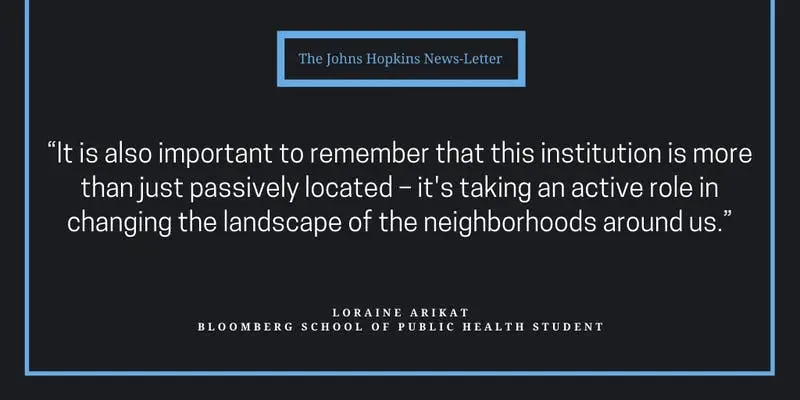
“It is also important to remember that this institution is more than just passively located — it’s taking an active role in changing the landscape of the neighborhoods around us. We should be aware of that history and really pushing the University to take ownership,” she said. “We will perpetually have the responsibility to think about reparations and to think about redistributing power to community members who have lived experience and expertise in their lives and in their issues.”
In an email to The News-Letter, Barbara Benham, SPH associate director of media and public relations, responded to the student petition.
“Bloomberg School of Public Health leadership is in dialogue with the organizers of the petition and leaders of the Student Assembly, working to foster continued engagement and action on school-wide efforts to advance inclusion, diversity, anti-racism, and equity,” she wrote.
In conversations with community members, Arikat and other students voiced that they felt the University did not listen to the recommendations of grassroots activists and other people in the community who were most impacted by the University’s actions.
Arikat stated that she wants there to be active discussions rather than modules or other forms of education that are not engaging.
“We’re really asking for a culture shift, and we know that it’ll take time, but we’re pushing for it. We want students to be actively holding our admin accountable for it,” she said.
[ad_2]
Source link
Trending Topics

Features
- Drive Toolkit
Download and distribute powerful vaccination QI resources for your community.
- Health Champions
Sign up now to support health equity and sustainable health outcomes in your community.
- Cancer Early Detection
MCED tests use a simple blood draw to screen for many kinds of cancer at once.
- PR
FYHN is a bridge connecting health information providers to BIPOC communities in a trusted environment.
- Medicare
Discover an honest look at our Medicare system.
- Alliance for Representative Clinical Trials
ARC was launched to create a network of community clinicians to diversify and bring clinical trials to communities of color and other communities that have been underrepresented.
- Reducing Patient Risk
The single most important purpose of our healthcare system is to reduce patient risk for an acute event.
- Jessica Wilson
- Jessica Wilson
- Subash Kafle