












[ad_1]

Editor’s Note: This story by John Lippman first appeared in the Valley News on April 15.
A Wilder man who was arrested this week after police searched his home for explosive devices was making pipe bombs in the basement and voicing threats of violence against neighbors, people of color and Democrats, according to federal prosecutors.
William “Will” Hillard, of 110 Perkins Place in Wilder, was taken into custody Wednesday by Vermont State Police. He was found in possession of an AR-15 assault-style rifle with “white power” stickers on the side of it, according to the criminal complaint filed in federal court in Burlington. Authorities said Hillard has a fascination with explosives that extends back 28 years to when he blew off several fingers while making a bomb in his student dorm room at New England College in Henniker, New Hampshire, in 1996.
Following a hearing held via video teleconference on Friday in U.S. District Court in Burlington, Judge Kevin Doyle granted the prosecutor’s motion to hold Hillard, 51, in preventive custody at Southern State Correctional Facility in Springfield, pending further hearings.
Doyle, after weighing arguments presented by federal prosecutor Nate Burris and by Hillard’s public defender, Sarah Puls, said there is “clear and convincing evidence Mr. Hillard presents a danger to the community for which no conditions can be set at this time.”
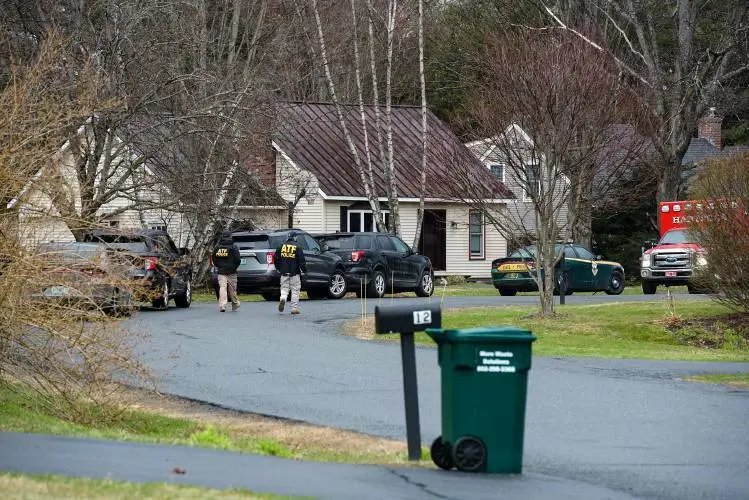
On Wednesday morning, Vermont State Police troopers, the state bomb squad, Hartford police as well as agents from the FBI and Bureau of Alcohol, Tobacco, Firearms and Explosives descended upon Hillard’s residence in a cul-de-sac in Wilder and spent much of the day searching his home for explosive devices and other hazardous material, police said. State police announced that evening that they had found an explosive device at Hillard’s home and arrested him on a charge of being a felon in possession of a firearm.
Hillard resides in the home owned by his mother, Stephanie “Stevie” Hillard, a middle school librarian. His father, Dan Hillard, a financial adviser and onetime head of the Vermont Republican Party before he stepped down following news that he’d embezzled a client’s money, died at age 76 in 2019.
Hartford police first got wind that Hillard might be engaged in alleged bomb making from a confidential informant who reported he had received an “M-class” explosive and had set off several “bombs” with Hillard in recent weeks, according to the criminal complaint. “M-class” refers to a broad category of illegal explosive capacities ranging from firecracker-level “M-80” with 3 grams of explosive material up to “quarter stick” containing as much as 30 grams of explosive, according to the ATF.
The informant, who described Hillard as “crazy,” told police that he had witnessed Hillard make his bombs more potentially lethal by packing them with items such as “ball bearings, BBs or screws.” The informant, whose gender was not disclosed, further said that Hillard is currently using both methamphetamine and heroin “and is extremely paranoid,” the complaint said.
Hillard “has made comments about killing Black people and Democrats (and) wants to start a revolution in our country as he is unhappy with the current government and, within the past two weeks, told the informant that he wants to ‘kill all of his neighbors,’ ” the complaint said.
Until recently, Hillard worked as a carpenter, but since suffering an injury, he now works in the restaurant industry, Puls said during her client’s detention hearing on Friday.
“He has resided in Vermont or nearby in New Hampshire his entire life,” Puls told the judge in arguing that Hillard should be released on bail and did not pose a flight risk: “He doesn’t have significant resources which he could utilize to flee, and he tries to support his mother on whatever money he has left over.”
Burris, the U.S. attorney, argued against Hillard’s release, noting that 80 pounds of ammunition were found at the home along with the AR-15-style rifle and “loaded ammunition magazines, some of which can be characterized as high-capacity magazines” and “explosive powders” from which to make bombs.
“The defendant admitted that he had detonated as many as 50 explosive devices in recent years,” said Burris, referring to what Hillard allegedly told police when they were searching his residence.
Hillard’s mother told police that she did not usually go into her son’s bedroom or to his carpentry workshop in the basement and was unaware of his alleged bomb-making activity or of his possession of a firearm, according to the criminal complaint.
Burris noted that Hillard has two prior felony convictions in New Hampshire, both from 1997, the first relating to a bomb that exploded while he was making it in his college dorm room and for which he received a one-year fully suspended sentence and was barred him from possessing a firearm. The second felony was connected to controlled substances, Burris said.
Despite the prior conviction when he was a student, “it appears not to have deterred him from continued involvement with explosives,” Burris argued.
Hillard’s bomb-exploding incident during college 28 years ago was known to some neighbors.
“Does it surprise me a lot? No, not a lot. He’s done stuff like this before,” Arthur Trottier, who lives next door to the Hillards, said when the state bomb squad vehicle spent much of Wednesday parked on his street.
Hillard was 24 years old and a senior at New England College when he blew off three fingers on his left hand while trying to make an explosive device in his dorm room in 1996, according to newspaper reports at the time. He was found outside his dorm, his hand bloodied and crying for help and first taken to Concord Hospital where he underwent surgery. He underwent another procedure at Dartmouth-Hitchcock Medical Center.
Police when they inspected his room also found nitrous oxide cartridges, a 9 mm handgun and a 7.62-caliber SKS rifle, a firearm that at the time was banned from sale and manufacture under then-president Bill Clinton’s crime bill, the New Hampshire Union Leader reported.
Hillard waived his Miranda rights and agreed to speak with investigators at the scene on Wednesday, according to the criminal complaint, and told them “he had made the explosive devices to protect himself and his residence from Antifa and what (he) described as other Democrat-affiliated extremist groups because Hillard believed there would be societal unrest.”
Hillard also told investigators that he had never fired the AR-15-type rifle and “denied he had plans to attack anyone,” the criminal complaint said.
Given his own knowledge about Hillard’s prior experience with explosives, Trottier wasn’t shocked by the police presence outside his home on Perkins Place this week.
“I don’t think he has an explosives license,” Trottier said. “They tend to frown upon things like that.”
Stay on top of all of Vermont’s criminal justice news. Sign up here to get a weekly email with all of VTDigger’s reporting on courts and crime.
[ad_2]
Source link



