











[ad_1]
By Vivian Nguyen
Northwest Asian Weekly

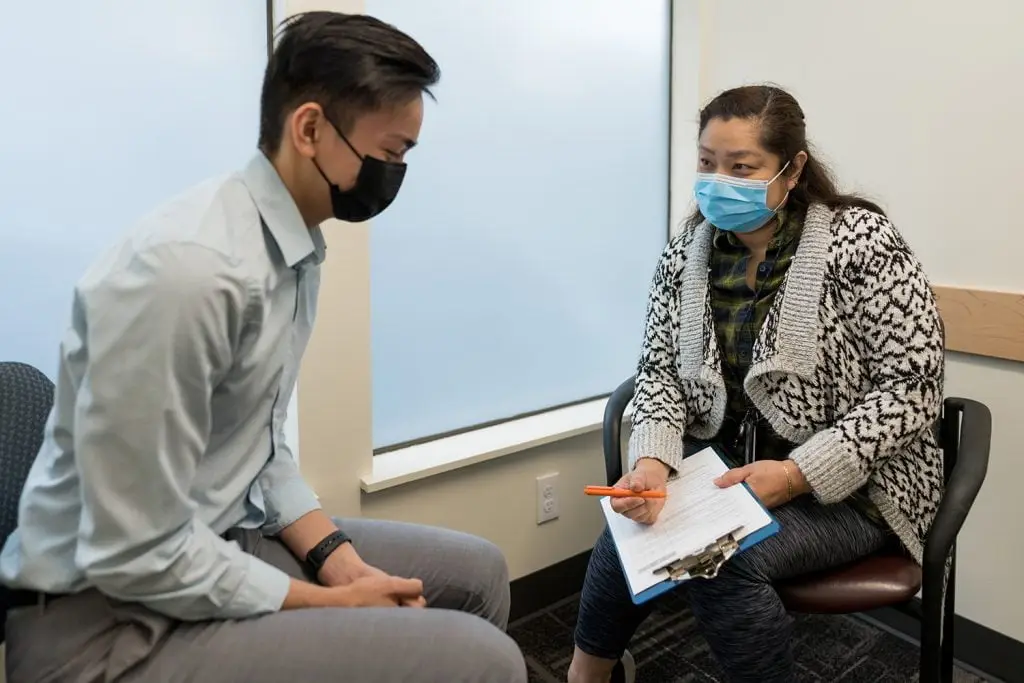
ICHS behavioral healthy specialists assist patients of all ages, genders, and sexual orientations. (Photo from ICHS)
The month of May recognizes and celebrates two important observances—Mental Health Awareness Month and Asian Pacific American Heritage Month.
For International Community Health Services (ICHS), a nonprofit health clinic primarily based in Seattle, this month is a confluence of their original mission. Founded in the early 1970s, ICHS initially focused on providing medical treatment to low-income Asian immigrants in Seattle’s Chinatown neighborhood. Now, the organization serves a diverse set of patients all over the region, and provides several services including primary care, dental care, behavioral care, and more.
Jia Yin Lee is a behavioral health specialist at ICHS. She provides mental health support to patients as part of the integrated care team model, as well as behavioral interventions to patients who have issues with anxiety, depression, and substance abuse.
“Mental health and wellness should not be a privilege but a right to anyone regardless of race, age, or any other circumstance,” said Lee.
Stigma against mental health treatment
Asian Americans face a unique challenge when it comes to addressing their mental health.
Long plagued by the “model minority myth”—a stereotype that assumes all Asians achieve a higher level of success than the general population—Asian Americans frequently wrestle with an invisible pressure to live up to that image. But this pressure to excel and outperform leaves limited room for individuals to recognize any mental health issues that come up in the pursuit of excellence.
Cultural attitudes can also prohibit access to mental health.
“Asian values emphasize a community mindset where people collectively share their successes and challenges,” said Lee. And when mental health issues come up, people shy away from sharing these vulnerabilities because it can be perceived as a weakness, or a crack in the community.
Generational trauma—a concept where one generation experiences trauma and passes it down to the subsequent one—may also drive a stigma against receiving mental health treatment. Learned habits from an older generation, such as an aversion to addressing or seeking out help with mental issues, can also lead to this stigma.
Lee offered an example of emotional expression as a learned habit. If one’s parents weren’t able to teach their child healthy emotional expression, said Lee, it’s likely because they never acquired the skill set themselves. Therefore, the child inherits the same learned habits and passes it down to their own children, reinforcing the generational trauma and stigma.
Rise in mental health struggles
In recent years, there’s been a trend of an increased need for mental health services across all age groups, said Lee.
Each age group encounters specific struggles unique to their age range and environment. But no matter the situation, anxiety, frustration, and loneliness are common symptoms across all sub-groups.
While a mental health crisis has spiked for all, Asian American women faced a notable increase. According to a January 2022 study by the American Psychological Association, Asian American women have the highest rate of suicide among all women over 65.
“This age group is a unique one,” said Lee. “Many were immigrants who carried collective trauma from the process of immigration—this reinforces their isolation and loneliness, and neither their native country nor their adopted one truly feels like home.”
“The quality of care for immigrants at that age is also not ideal. Some may struggle to access social benefits due to a lack of status or income during the early years of immigration.”
Separation from family, particularly children, can also be devastating for mothers due to the value of a collective family unit in Asian culture.
“It’s hard for parents to find meaning in life when they’re separated from their children,” said Lee.
Additionally, with life expectancy higher among Asian women than men, many women are often left to shoulder the emotional burden of their family’s estrangement without their spouse. Without any family connection, mothers in this situation often cannot find meaning in their life.
While familial relationships may dictate how Asian women process their mental health, men face a different set of challenges. Gender roles and expectations cause men to suppress their feelings, especially if they’re the family’s breadwinner. The burden of providing for the family, said Lee, leaves no room for vulnerability.
“It’s a common trend to have men brought into the clinic by their wives and families,” said Lee. “It’s not impossible, but it’ll take more time [for men] to overcome [generational stigma] compared to Asian American women.”
How to address and manage stigma
When a patient arrives for an appointment, ICHS primary care providers will inform a patient that they have a behavioral health provider as part of their care team and how their behavioral health has an impact on their physical health. (Photo by ICHS)
Although it’s challenging to overcome learned habits, environmental influence can help combat existing stigma.
Lee suggests that people look into integrated care—a service model that ICHS specializes in. With integrated care, a patient could go to a clinic and address one issue while also receiving care for other aspects of one’s well-being such as physical, mental, dietary care, and more.
Because an integrated care team offers comprehensive care, said Lee, it can be especially helpful for older Asian Americans because it’s much easier for them to recognize physical issues and symptoms instead of emotional ones. Then, when they come in to have a physical issue examined, mental issues can also be addressed—even in their native tongue.
“As a member of an integrated care team, it’s just as helpful to have behavioral knowledge as it is to have medical knowledge, and to then communicate with a medical care provider to help them understand the physical and mental well-being relationship,” said Lee.
Community can also play a fundamental role in providing mental health care.
“Support groups would be a great choice if seeking professional help is disapproved of in the family or culture” said Lee.
“Nowadays, with technology and social media, it’s much more convenient to find people that share your common values and issues. The benefit of being part of a support group and community is that it eliminates feelings of loneliness, but it also provides an opportunity to learn more about mental health in general. It could even be an entry point to seeking professional mental help on an issue.”
In addition to ICHS’s services, Lee suggested other local nonprofits, such as Chinese Information and Service Center, ICHS Legacy House, or Asian Counseling and Referral Service, that provide community or social activities that cater to Asian adults.
“You don’t have to utilize their individual therapy sessions,” said Lee. “You can still join their group activities to find and connect with other people.”
For more information, visit ichs.org.
Vivian Nguyen can be reached at info@nwasianweekly.com.
Related
[ad_2]
Source link