












[ad_1]
A new behavioral health clinic has opened in Milwaukee’s Amani neighborhood, aiming to fill longstanding gaps in mental health and addiction services in one of the city’s most underserved communities.
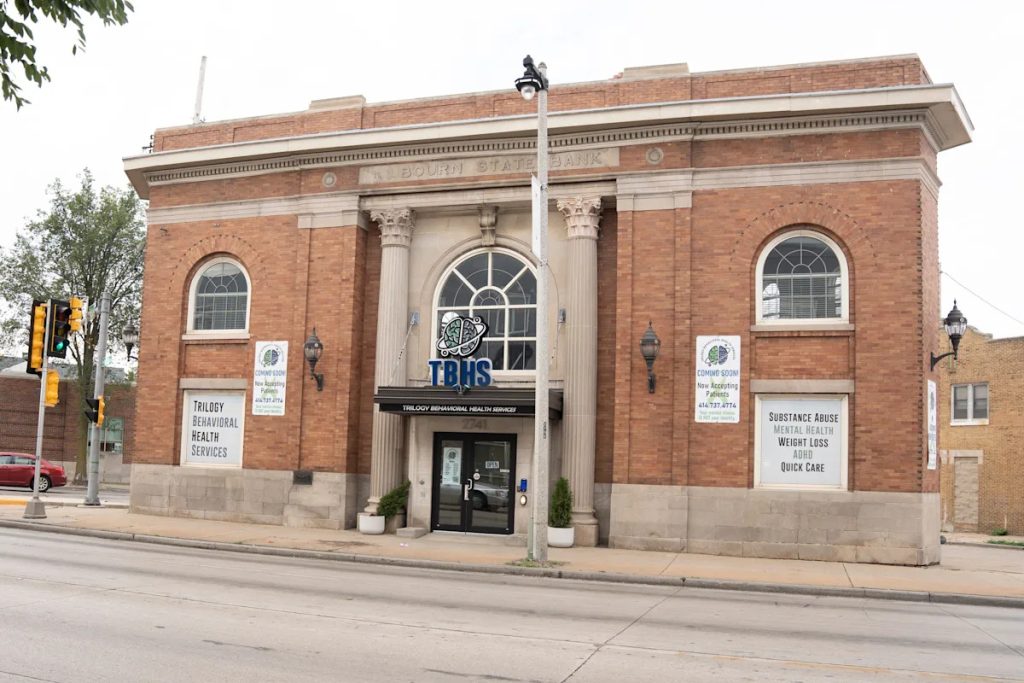
Trilogy Behavioral Health Services, founded by Shalonda “Nikki” Myles, held its grand opening on Aug. 9. The clinic, located in the former Kilbourn State Bank building on the corner of Fond du Lac Avenue and Center Street, offers outpatient treatment for depression, anxiety, bipolar disorder, schizophrenia, PTSD and substance recovery alongside primary care support. The Amani location is Myles’ second clinic – the first was located on 60th Street.
Myles’ said her passion for health care traces back to childhood, when she helped care for her chronically ill mother.
“I told her when I was eight years old, I wanted to give her her insulin injection,” she recalled. “She called me her nurse. Here I am, 25 years later, working in health care with three master’s degrees and triple board certification.”
About the new Trilogy facility
Since opening, the clinic has treated as many as 31 patients a day, according to Myles.
The two-story facility includes patient rooms, a conference room and a former vault now converted into a secure medication storage area.
Patients can receive psychiatric evaluations, prescriptions, injections and referrals to community resources.
Trilogy hosts support groups and partners with pharmacies that deliver medications directly to patients’ homes.
The intention behind the clinic’s location
The opening of Trilogy comes less than a year after Children’s Wisconsin announced it would stop offering pediatric primary care at its Next Door clinic in Metcalfe Park, citing space limitations.
The closure drew concern from families who relied on the site for accessible care. Trilogy’s arrival helps fill part of that gap by bringing health services back to the community, Myles said.
“People always say, ‘Oh, it’s in the inner city, why would you put a clinic right in the inner city?’ Tell me why I wouldn’t,” Myles said.
“It’s still a vibrant and resilient area where people need health care. They can walk to the clinic, right? They have better accessibility. They have culturally competent, evidence-based care.”
The decision to open on the Metcalfe Park-Amani neighborhood border followed months of research and guidance from the Northwest Side Community Development Corporation (NWSCDC), which helped Myles identify the neighborhood’s high levels of unmet medical needs.
“We looked at the numbers,” she said. “So many people are uninsured, underinsured or waiting months just to see a provider. Here, you don’t have to wait – we’ll see you the same day or the next day.”
Willie Smith, executive director of NWSCDC, said the area’s lack of mental health support made the clinic’s current location ideal.
“Being able to support this kind of an entity … we’re just really happy to support (Myles), given her background and skill set to effectively carry this out and support that population,” Smith said.
How Trilogy is connecting with new patients
Beyond clinical work, Myles emphasized the importance of outreach.
Since its grand opening in August, Trilogy has hosted a community cookout, met with housing providers and the Salvation Army, and is working with organizations such as Wisconsin Community Services and Unite WI to connect residents with resources.
The clinic has drawn in patients traveling from as far as Wisconsin Rapids and Manitowoc, according to Myles.
“Even those in rural areas cannot access care … So, I’m here (on) the urban side, but people are coming from all over.”
Myles added the importance of culturally competent care when meeting the needs of patients.
“One thing I like about our clinic is that we’re diverse. We have Latinos with us, African Americans, Asians, and even a provider from Ghana … Culturally competent care is a big deal for us.”
A 2023 report published by MKE Elevate found that people of color living in Milwaukee County have the highest percentage of diagnoses of mental health conditions. According to the report, 45% of patients diagnosed with mental health conditions identify as Hispanic or Latino, and 33% identify as Black.
But stigmas around mental illness, costs, long waiting lists, system navigation and a lack of awareness and providers often create barriers to accessing mental health services, according to MKE Elevate.
Myles said her long-term vision for Trilogy is to reduce those stigmas and foster stability for people in need.

Myles said she also hopes to expand the clinic’s reach to help other hard-to-serve populations, including inmates at the county and state levels.
“It just makes me feel so good that I’m able to be present and be part of someone’s healing and their recovery,” she said. “To be a helper, to help (patients) get over life’s hurdles – that’s the reward.”
April Quevedo covers Metcalfe Park for the Journal Sentinel’s Neighborhood Dispatch. Reach her at aquevedo@gannett.com. As part of the newsroom, all April’s work and coverage decisions are overseen solely by Journal Sentinel editors.
Support for this effort comes from the Zilber Family Foundation, Journal Foundation, Bader Philanthropies, Northwestern Mutual Foundation, Greater Milwaukee Foundation and individual contributions to the Journal Sentinel Community-Funded Journalism Project. The project is administered by Local Media Foundation, tax ID #36‐4427750, a Section 501(c)(3) charitable trust affiliated with Local Media Association.
Learn more about our community-funded journalism and how to make a tax-deductible gift at jsonline.com/support. Checks can be addressed to Local Media Foundation with “JS Community Journalism” in the memo, then mailed to: Local Media Foundation, P.O. Box 85015, Chicago, IL 60689.
This article originally appeared on Milwaukee Journal Sentinel: Trilogy Behavioral Health Services opens on Milwaukee’s northwest side
[ad_2]


